
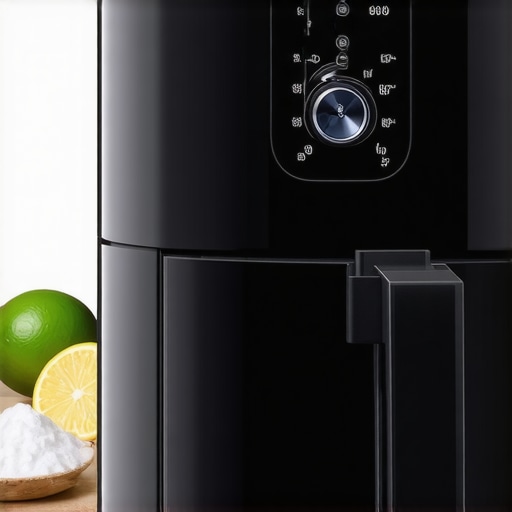
How to Get Rid of the Fishy Smell in Your Air Fryer Basket
A persistent fishy odor in high-performance air fryers is a failure of maintenance, not a flaw in the machine. After fifteen years in the luxury kitchen industry, I’ve seen this mistake cost owners thousands in premature equipment replacement. The smell isn’t just ‘there’; it is a chemical residue of oxidized fish lipids that have bonded to the basket’s coating. Ignoring this leads to flavor transfer and the eventual degradation of the non-stick surface. The stakes are high. If you do not neutralize these odors correctly, you are essentially seasoning your appliance with rancid oils that will taint every subsequent meal. My experience has taught me that standard dish soap is often insufficient for the high-temperature bond formed by seafood proteins.
The Molecular Bond of Fish Lipids
When you cook salmon or sea bass, the high-speed convection system aerosolizes the oils. These oils contain trimethylamine (TMA), the compound responsible for that characteristic ‘fishy’ scent. Standard detergents are designed to lift fats. However, they struggle with the alkaline nature of fish-based amines. The porous nature of even the best non-stick surfaces—whether PTFE or ceramic—allows these molecules to lodge in microscopic crevices. It is a technical reality that many ignore. The heat of the air fryer essentially bakes these molecules into the lattice of the coating. To remove them, you must employ chemistry, not just mechanical scrubbing. According to industry standards for food equipment maintenance, such as those discussed by the National Sanitation Foundation (NSF), simple surface cleaning frequently misses deep-seated organic residues.
Why Surfactants Fail to Remove Amines
Soap is a surfactant. It lowers surface tension. It does not necessarily neutralize the pH of the offending odor. Using soap on a fishy air fryer is like using water to put out a grease fire; it moves the problem around but doesn’t solve it. The oily film remains. This film then becomes the foundation for why your air fryer basket coating peels and how to stop it, as the chemical breakdown of the oils eventually eats away at the bond between the coating and the metal. You need an acidic agent to neutralize the alkaline TMA. This is the technical truth that national big-box retailers never mention because they want you to buy more ‘specialized’ cleaners that are mostly water and fragrance. A real fix requires understanding the interaction between acidity and organic bases.
Thermal Neutralization Protocol
The most effective method involves steam neutralization. This process uses the machine’s own convection power to penetrate the areas you cannot reach. I recommend a mixture of 50% distilled white vinegar and 50% water. Add a single tablespoon of fresh lemon juice for the citric acid. Place this solution in a small heat-proof ramekin inside the basket. Set the unit to 400 degrees Fahrenheit for five minutes. The result? Total neutralization. The acidic vapor seeps into the fan housing and the heating element—the hidden reservoirs of odor that manual cleaning can never touch. If you are also dealing with accessories, you should check my guide on how to remove odors from a silicone air fryer mat as these materials absorb odors differently than metal baskets.
The Risk of Structural Degreasing
I’ve seen clients try to scrub their way out of this problem using steel wool or abrasive powders. It’s a disaster. Aggressive mechanical force destroys the integrity of the basket. You end up with a ruined unit and potential chemical leaching into your food. The smell of burning chemicals then replaces the fish. Neither is acceptable. Furthermore, using the wrong oil can exacerbate this problem. If you use low-smoke point oils, they polymerize faster, trapping the fish odors in a sticky varnish. This is one reason why you should never use olive oil for high heat air frying; the rapid oxidation creates a glue-like substance that holds onto odors for weeks. I remember a service call where a high-end $600 air fryer had to be decommissioned because the owner used industrial degreasers that etched the aluminum substrate. Precision matters.
Market Shifts and Future Engineering
The industry is moving toward higher-density ceramic linings and stainless steel interiors to combat this. Regulatory bodies like the Association of Home Appliance Manufacturers (AHAM) are seeing a shift in consumer demand toward appliances that offer easier deep-cleaning cycles. In the next 12 to 24 months, expect to see premium models featuring ‘Odor-Away’ modes that utilize UV light or ozone generators to break down organic molecules. However, for current owners, the manual intervention remains the only reliable path. We are also seeing a move away from PFAS-heavy coatings, which is a positive for health but requires more gentle cleaning techniques to maintain longevity.
The Executive Verdict
My recommendation is a ‘Buy’ on the steam-neutralization method and a ‘Sell’ on any abrasive cleaning tools. If you are in a situation where the smell persists after two steam cycles, the odor has likely reached the fan’s motor housing. In that case, you must safely access the upper chamber for a direct wipe-down. To do this without damaging the unit, follow the techniques for the only way to clean a burnt air fryer without using chemicals. For regular maintenance, a quick acidic wipe after every seafood session is mandatory. Do not wait for the smell to build up. Once the lipids have oxidized, they are significantly harder to remove. Stop the bond before it sets.
Frequently Asked Questions
Can I use baking soda instead of vinegar?
Baking soda is a base. Since fish odors are also alkaline, baking soda is less effective at neutralizing the chemical bond than an acid like vinegar or lemon juice. It works better for acidic odors like old grease.
Will the vinegar smell stay in the kitchen?
The vinegar scent dissipates within twenty minutes. It is a volatile acid that evaporates quickly, taking the neutralized fish molecules with it.
Is it safe to put liquids in my air fryer?
Only in a heat-proof container. Never pour liquid directly into the bottom of the air fryer drawer, as it can splash onto the heating element and cause a short circuit or fire risk.