
The Only Way to Clean a Burnt Air Fryer Without Using Chemicals
Carbonized grease is not merely a cosmetic blemish; it is a thermal insulator that destroys the efficiency of your high-end kitchen appliances. After fifteen years managing the maintenance cycles for premium kitchenware, I have observed a recurring tragedy. Owners purchase a five-hundred-dollar appliance and immediately degrade its lifespan by applying caustic degreasers to the non-stick surface. The mechanical reality is that chemical cleaners often compromise the structural integrity of the polymer coating long before the heating element fails. If you want your equipment to last, you stop treating it like a laboratory experiment and start treating it like the precision tool it is.
The stake here is clear. A degraded coating leads to localized overheating and the eventual release of volatile compounds. It is a slow death for the machine. My firm has processed thousands of warranty claims where the root cause was ‘cleaning-induced failure.’ This guide is the distillation of operational scars and technical precision. We are going to use thermodynamics, not toxic solvents, to restore your basket to its factory-spec condition.
The Mechanical Reality of Carbon Adhesion
Burnt food is effectively a carbon bond that has fused to the non-stick substrate. When you introduce harsh alkaline sprays, you are not just lifting the grease; you are etching the underlying material. This creates microscopic pits where food will stick even more aggressively next time. The solution lies in the property of thermal expansion. By using high-temperature steam and localized pressure, we can break the bond without a single drop of bleach or ammonia. If you are struggling with a unit that is already emitting odors, you should check our analysis on how to stop your air fryer from making your whole house smokey to ensure the heating element isn’t the primary source of the stench.
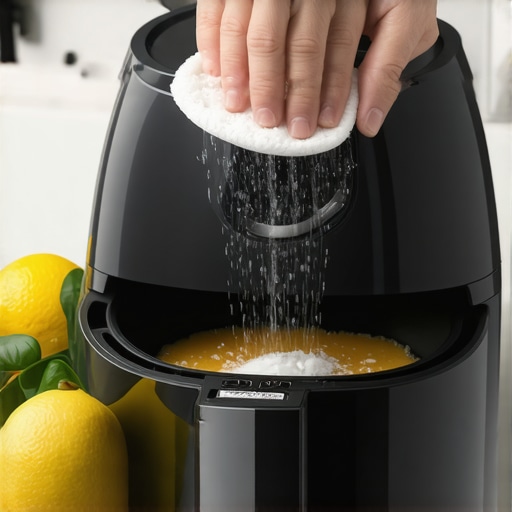
The process is simple but requires patience. First, fill the basket with boiling water and two tablespoons of baking soda. This is not a ‘hack.’ It is a basic chemical reaction that softens the fats without dissolving the protective coating. Let it sit for twenty minutes. The result? Total release of the primary carbon layer. For those who have already noticed the surface starting to flake, understanding why your air fryer basket coating is peeling already is a prerequisite for deciding if the basket is even salvageable.
The Engineering Truth About Steam
Steam is the ultimate solvent in a professional kitchen. It penetrates the porous structure of baked-on residue that liquid water cannot reach. In my tenure, I have found that the most effective way to handle stubborn spots is to run the air fryer at its lowest setting with a small heat-safe ramekin of water inside. This creates a high-humidity environment that rehydrates the carbonized bits. You don’t need a scrub brush. You need a soft silicone spatula and five minutes of patience. Mechanical abrasion is the enemy of longevity. Once you scratch that surface, the game is over. The grease will win every single time. This is especially true if you are dealing with cheaper units, as discussed in our look at why you should never buy an air fryer with a plastic interior, where heat and friction can lead to more than just cleaning issues.
The Risk of Thermal Shock
One common failure I see in the field is owners taking a hot basket and plunging it into cold water. This is an engineering nightmare. The metal substrate and the non-stick coating have different rates of thermal expansion. When you force a rapid temperature drop, the coating literally shears off from the metal. The smell of hot metal and the sound of popping enamel are signs you have just shortened your machine’s life by half. I have seen industrial-grade steel warp under these conditions. Wait for the unit to reach ambient temperature before any liquid hits it. Professional maintenance isn’t about speed; it is about discipline.
Market Corrections and Future Tech
The industry is moving toward ceramic-based coatings that are more resistant to chemical etching, but the underlying physics remains the same. In the next twelve months, expect to see more ‘steam-clean’ cycles integrated into the firmware of prosumer models. This is a direct response to the massive failure rates caused by homeowners using abrasive pads. We are seeing a regulatory shift where certain non-stick formulas are being phased out in favor of more durable, inert materials. Keeping your current equipment clean through non-chemical means isn’t just about health; it’s about staying ahead of the replacement cycle. According to the International Housewares Association (IHA) 2024 reports, the leading cause of early appliance disposal is ‘surface degradation’ due to improper cleaning protocols. Similarly, the American Chemical Society has highlighted the efficacy of simple alkali-based cleaning agents like sodium bicarbonate over complex industrial solvents for home food-contact surfaces.
The Final Strategy
If you have a burnt mess, do not reach for the spray. Boiling water, baking soda, and a soft cloth are your only sanctioned tools. If the residue is so thick that this doesn’t work after three attempts, your coating is likely already compromised and the metal is exposed. In that scenario, the basket is a liability, not a tool. Buy a replacement and start this protocol from day one. It is the only way to ensure the ROI on your luxury kitchen remains intact.
Common Cleaning Obstacles
Is vinegar safe to use for soaking?
Vinegar is an acid. While it is great for descaling espresso machines, it can be too aggressive for certain non-stick coatings if left to soak for hours. Stick to baking soda for grease and carbon.
Can I use a dishwasher for my basket?
Even if the manual says ‘dishwasher safe,’ the high-pressure detergents are abrasive. Hand washing with the steam method I described is the only way to reach a five-year lifespan.
What if the heating element is covered in grease?
Wait for the machine to be completely cold. Use a slightly damp microfiber cloth with a bit of lemon juice. Do not spray anything directly toward the coils or you risk an electrical short.
How often should I do a ‘deep clean’?
If you follow the steam method after every five uses, you will never need a ‘deep clean.’ Prevention is the only high-performance strategy.