
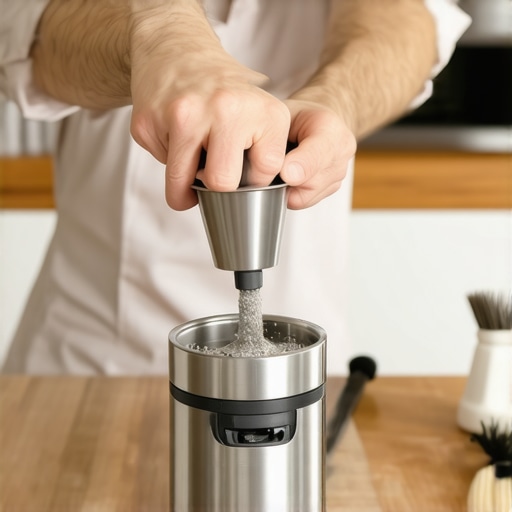
How to Deep Clean the Internal Chute of Your Burr Grinder
Neglecting the internal chute of your burr grinder is an act of mechanical sabotage. Most owners believe that running a few cleaning tablets through the hopper constitutes maintenance. This is a fallacy. After fifteen years diagnosing hardware failures in high-end luxury kitchen setups, I can confirm that the ‘dead space’ between the burrs and the exit chute acts as a graveyard for coffee oils. These oils do not just sit there. They oxidize, turn rancid, and create a sticky, resin-like bond that traps fresh grounds. The result? A flavor profile that tastes like wet cardboard, regardless of how expensive your espresso machines are. You are not just cleaning a tube; you are preserving the integrity of a precision instrument.
The Engineering Reality of Particle Retention
The physics of coffee retention revolve around static electricity and hygroscopy. As the burrs spin at high RPMs, friction generates a significant static charge. This charge causes fine particles to cling to the walls of the internal chute. When you introduce oily, dark roast beans, the problem scales exponentially. The oils act as a physical adhesive. Over time, this buildup narrows the chute diameter, forcing the motor to work harder against back-pressure. Why your coffee grinder makes so much static is a question of environmental control and material science. You need to understand the ‘clump crusher’—a small, often plastic or wire component at the end of the chute designed to break up blocks of coffee. If this is fouled with old resin, your dosing consistency dies. A 0.5-gram retention might seem trivial. In a 18-gram precision basket, that small fraction of stale, oxidized coffee ruins the shot. The Specialty Coffee Association (SCA) notes that even minor deviations in particle fresh-ness can skew extraction yields by significant percentages.
Why Dark Roasts Are Gear Killers
The messy reality often manifests as a ‘phantom clog.’ You hear the motor spinning, but nothing exits the chute. I recall a client in a high-humidity coastal home. Their expensive grinder stopped producing. Upon disassembly, the internal chute was a solid block of coffee concrete. The smell was distinctive—a sour, metallic rot that had permeated the plastic housing. The risk here is clear. Using metal picks to scrape the chute often scores the surface, creating more ‘teeth’ for future grounds to grip. You must use stiff nylon brushes or specialized vacuum attachments. High-end espresso machines require a clean input, and a clogged chute is the primary source of ‘channelling’ caused by uneven clumping. This is as vital as cleaning your air fryers or stand mixers to ensure no cross-contamination of flavors occurs in your luxury kitchen.
The 2025 Tech Shift in Grinding Precision
Looking toward the next 24 months, the industry is shifting toward ‘Zero Retention’ designs. Manufacturers are implementing plasma generators to neutralize static at the source and using DLC (Diamond-Like Carbon) coatings on internal pathways. This reduces the coefficient of friction, making cleaning less frequent but more technically demanding. For those maintaining current-gen luxury kitchen appliances, the regulatory focus on food safety is tightening. Rancid oils are a bacterial playground. We are seeing a move away from oily roasts toward ‘Nordic’ style light roasts, which are harder on burrs but cleaner for chutes. How to adjust your grind size for oily coffee beans remains a necessary skill until these low-oil roasts become the standard. According to the National Coffee Association (NCA), consumer demand for ‘clean cup’ profiles is driving these engineering changes in premium cookware and grinding tech.
Execution Protocol for the Home Barista
My verdict is absolute: if you are not physically opening the chute every 2-4 weeks, you are not drinking the coffee you paid for. Buy a high-velocity air blower and a set of non-marring picks. If you are using oily beans, double your cleaning frequency. This is the only way to ensure the proper way to clean a burr grinder actually yields results. Don’t wait for the motor to groan. Maintain the pathway. The clank of the manifold and the weight of the industrial grade steel in professional units remind us that these are machines, not magic. Treat them as such. Start by disconnecting the power. Remove the outer casing if necessary to access the chute throat. Use a vacuum to pull particles out rather than pushing them further in. Simple logic, superior results.
Frequently Asked Questions
Can I use rice to clean the internal chute?
Never. Rice is too hard for many burr motors and the starch can gum up the chute even worse than coffee oils.
How often should I perform a deep clean?
Once a month for standard home use. If you prefer dark, oily roasts, every two weeks is the industry standard for maintaining flavor integrity.
Is compressed air safe for the chute?
Yes, provided it is moisture-free and food-safe. Avoid industrial compressors that might introduce machine oil into the coffee path.