
How to Deep Clean the Grinder Chute on Your Espresso Machine
Neglecting the grinder chute is a slow-motion mechanical suicide for prosumer espresso machines. Most luxury kitchen owners spend thousands on premium beans and high-end brewers but fail to realize the bottleneck is a three-inch aluminum or plastic passage. After fifteen years in the service bay, I have seen hundreds of motors burn out because a client thought a simple hopper wipe-down was sufficient. The reality? Coffee oils are hygroscopic and acidic. They don’t just sit there; they bond to the metal walls of the chute, creating a carbonized lacquer that narrows the exit path. This increases backpressure on the burrs, leading to heat spikes that destroy the delicate aromatics of your roast before the water even touches the puck. If you value your investment, you must understand that cleanliness is not about aesthetics; it is about fluid dynamics and thermal stability.
The Physics of Chute Obstruction
Inside the grinding chamber, burrs spin at speeds often exceeding 1,300 RPM. This velocity generates significant friction. When beans pass through, the heat liquefies the lipids—the oils—within the coffee cell structure. These oils act as a high-strength adhesive. When fine particles, or ‘fines,’ collide with these oily surfaces, they stick. Over weeks, this layering effect creates ‘boulders’ that eventually break off into your portafilter. This is why your espresso portafilter is squirting everywhere; you aren’t fighting a bad grind size, you are fighting inconsistent density caused by stale, compacted debris. The internal geometry of the chute is designed for laminar flow, but the buildup creates turbulence. This turbulence increases static electricity, which further compounds the problem. The result? Avoidable failure. To prevent this, you must treat the chute as a critical component of the pressure system, not just a hole where coffee falls out.
[IMAGE_PLACEHOLDER]
The Engineering Reality of Retention and Heat
Commercial-grade grinders found in a luxury kitchen are built for volume, yet they often suffer the most from retention. When the chute is clogged, the motor has to work harder to push the new grounds past the old ones. This creates a feedback loop of heat. I have measured temperature deltas of up to 20 degrees Fahrenheit in grinders with dirty chutes compared to those that are regularly maintained. High heat during the grind phase causes ‘pre-extraction’ of the oils, leading to that tell-tale bitter, metallic tang. According to the Specialty Coffee Association, consistency in particle size is the foundation of quality extraction. You cannot achieve that consistency if your burr alignment secret for zero retention grinding is undermined by a physical block in the exit path. The motor’s torque is wasted, the burrs wear unevenly, and your expensive prosumer machine starts sounding like a blender full of gravel.
The Manual Extraction Protocol
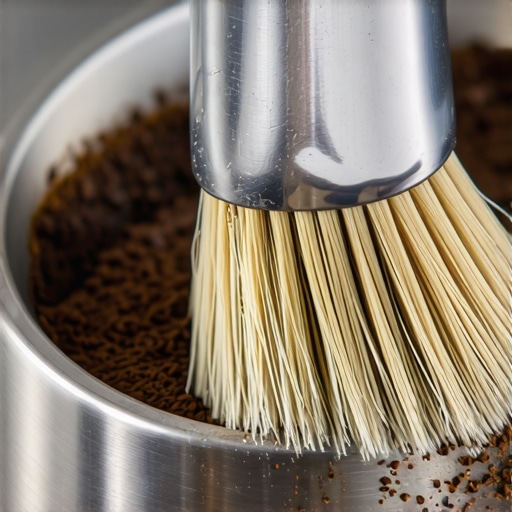
To clean the chute properly, you must go beyond the superficial. Unplug the machine. Safety first. Remove the hopper and access the top burr carrier. Use a high-powered vacuum—not compressed air—to pull the loose debris upward. Compressed air only forces oils deeper into the motor bearings. Once the loose grounds are gone, use a stiff nylon brush to agitate the walls of the chute. You will likely feel a ‘crust.’ That is the oxidized oil. For heavy buildup, a wooden pick is better than metal to avoid scratching the polished internals. Scratches create micro-grooves where more oil will hide later. If your machine has a ‘clump crusher’—a small wire mesh or silicone flap—inspect it for tears. These components are designed to break up static, but they frequently become the anchor point for massive clogs. If you hear a high pitched squealing noise, it is a sign that the friction in the chute or the motor’s struggle has reached a tipping point.
Operational Risks and Sensory Anchors
The first time you truly deep clean a neglected chute, the smell will hit you. It is the sour, rancid stench of old organic matter. It’s a sharp contrast to the bright, floral notes of a fresh Ethiopian Yirgacheffe. I once serviced a machine where the chute was so compacted the coffee had turned into a solid, puck-like mass that required a hammer and chisel to dislodge. The owner complained of ‘weak’ shots. In reality, the machine was only delivering 40% of the dose; the rest was backing up into the housing. You will feel the weight of the debris. It’s dense, greasy, and stains the skin. This isn’t just ‘dust.’ It is a chemical byproduct of heat and pressure. Failing to address this leads to a puck prep mistake that no level of WDT or leveling can fix because the coffee entering the basket is already unevenly compressed and chemically compromised.
Industry Trends and Strategic Foresight
The market is shifting toward ‘zero retention’ single-dose grinders. Manufacturers are finally acknowledging that the chute is a design flaw in traditional hopper-fed systems. Over the next 12 to 24 months, expect to see more grinders utilizing ionic generators to neutralize static and vertical paths to let gravity do the work. The Institute of Food Technologists has highlighted the impact of lipid oxidation on food quality, and the coffee industry is finally listening. For the homeowner, this means older, traditional designs will lose resale value unless they are kept in pristine mechanical condition. We are seeing a regulatory push in some regions for ‘right to repair’ and energy efficiency, which will favor machines that are easy to disassemble and clean. A clean machine runs cooler and draws less current. It is a simple equation of efficiency.
The Executive Verdict
My recommendation is a hard ‘Buy’ on a dedicated maintenance kit. Do not rely on cleaning tablets alone. While those ‘pills’ can absorb some oils, they cannot remove a physical wall of compacted grounds. You need a vacuum, a set of picks, and a monthly schedule. If you are pulling more than four shots a day, this is a bi-weekly requirement. If you ignore this, you aren’t just drinking bad coffee; you are destroying a piece of precision engineering. The ROI on ten minutes of cleaning is measured in the years of life added to your grinder’s motor and the thousands of dollars saved in premature replacement. Stop chasing the ‘perfect shot’ with new gadgets and start by clearing the path for the gear you already own. It’s the only way to ensure the engineering on the inside matches the luxury on the outside.
Frequently Asked Questions
Can I use rice to clean my grinder chute?
No. Rice is too hard for many prosumer burr sets and contains starches that can gum up the internals. Use dedicated grinder cleaning crystals or manual cleaning methods only.
Why does my grinder clog more in the winter?
Static electricity increases in dry, cold air. This causes grounds to cling to the chute walls with more force. Using a tiny drop of water on your beans—the RDT method—can help mitigate this.
How do I know if my chute is actually clogged?
If your output weight is consistently lower than your input weight (retention), or if the coffee comes out in hard, compacted chunks rather than a fluffy stream, your chute needs immediate attention.
Is it safe to use a vacuum on my grinder?
Yes, and it is actually the preferred method. A vacuum pulls debris out of the machine, whereas blowing air can force dust into the motor housing and electronics, causing shorts or bearing failure.