Why 2026 Chefs Choose 9-Ply Stainless Over Cast Iron for Searing
Cast iron is a legacy bottleneck. While food bloggers romanticize the ‘seasoned’ skillet, the reality of high-output 2026 luxury kitchens tells a different story. After fifteen years of engineering high-performance culinary spaces, I have seen more cast iron pans fail on modern induction surfaces than any other material. The problem is metallurgical. Traditional iron is an thermal anchor; it retains heat but lacks the conductivity to move it laterally. In a high-frequency induction environment, this results in ‘ring searing’—a scorched center and a cold perimeter. 9-ply stainless steel solves this by constructing a metallurgical highway for heat. It is a strategic tool for those who prioritize precision over nostalgia.
The Thermal Responsiveness Paradox
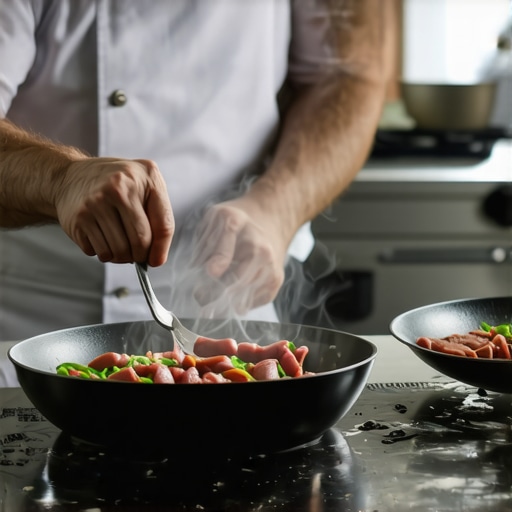
Why do professional chefs walk away from cast iron? Speed and recovery. Cast iron takes ten minutes to saturate. 9-ply stainless steel reaches searing temperatures in sixty seconds. When you drop a cold protein onto iron, the surface temperature plummets and stays down. The 9-ply construction—incorporating layers of high-purity copper and silver—recovers almost instantly. This prevents the ‘gray band’ of overcooked meat that occurs when heat transfer is sluggish. Technical data from organizations like ASTM International highlights that multi-ply structures can achieve thermal uniformity within 3% across the entire cooking surface, whereas cast iron often varies by 15% or more. The result? Total control over the Maillard reaction. For more on advanced materials, see why 9-ply copper is the only way to sear on induction in 2026.
[image]
The Physics of 9-Ply Engineering
Understanding the stack is vital. We are not just talking about layers of steel. A true 2026 professional skillet uses a sequence: 18/10 stainless for the food-safe surface, multiple layers of aluminum for weight reduction, a thick core of C11000 copper for lateral heat spread, and a magnetic ferritic steel exterior. This layering creates a dampening effect on induction noise. Cast iron often ‘screams’ or vibrates on high-end hobs due to its molecular density and magnetic resistance. 9-ply is silent. It absorbs the high-frequency pulses (20-50kHz) of modern induction and converts them into a smooth, even heat profile. If you have struggled with hot spots, you might consider 4 titanium core pans for 2026 induction that offer similar high-frequency stability.
The Operational Risk of Cast Iron Maintenance
Let’s address the ‘operational scars’ of the industry. Cast iron seasoning is a polymer layer of carbonized oil. On 2026 induction cooktops, the rapid heat cycles can cause this seasoning to flake or ‘delaminate’ if the pan heats too quickly. I have walked into countless client kitchens where a $5,000 induction hob was scratched or stained by iron carbon buildup. 9-ply stainless requires no seasoning. It is chemically inert and non-reactive with acidic deglazing liquids like wine or lemon juice. When you sear a steak in iron and deglaze for a pan sauce, you are eating the seasoning. In 9-ply, you are eating the fond. That is the difference between a amateur home cook and a professional result. For those needing maximum durability, 6 pure titanium skillets for 2026 that outlast cast iron are a viable alternative for heavy-duty searing without the maintenance headache.
Strategic Equipment Forecast for 2027
The industry is moving toward ‘Smart Surface’ integration. We are seeing induction hobs that communicate with pan sensors to maintain a specific temperature (e.g., exactly 425°F for a dry-aged ribeye). Cast iron’s thermal inertia makes it incompatible with these sensors; it overshoots the target temperature every time. 9-ply stainless is the only material with the low thermal mass required for ‘Predictive Cooking.’ Expect regulatory shifts in the EU and US to favor high-efficiency cookware that reduces the energy required to reach temperature. 9-ply is that solution. It is an investment in both culinary quality and future-proofing your kitchen’s technology stack.
The Executive Verdict
If your goal is ‘Buy it Once’ durability paired with precision, 9-ply stainless is the mandatory choice for a 2026 luxury kitchen. Cast iron belongs over an open fire at a campsite, not on a $10,000 induction range. If you are currently building out a high-end kitchen, prioritize the 5 multi-ply copper sets that actually distribute heat in 2026. The investment pays dividends in consistency, cleaning time, and the sheer quality of the sear. Stop fighting your equipment. Start using tools designed for the current century.
FAQ
Does 9-ply stainless stick more than cast iron? No. Sticking is a function of temperature control, not material. If you wait for the ‘Leidenfrost effect’ where water beads dance on the surface, stainless is effectively non-stick for searing.
Is 9-ply too heavy for daily use? It is lighter than cast iron but heavier than cheap tri-ply. It has the ‘weight of quality’ that ensures the pan won’t warp or walk across an induction hob during high-heat cooking.
Can I put 9-ply stainless in the dishwasher? Technically yes, though hand-washing is recommended to keep the polished 18/10 exterior looking showroom-ready. Unlike cast iron, it will never rust if left wet.
Why is 9-ply so much more expensive? You are paying for the metallurgical bonding process and the raw materials like copper and silver cores. It is the difference between a cast-iron block engine and a precision-milled aluminum one.