
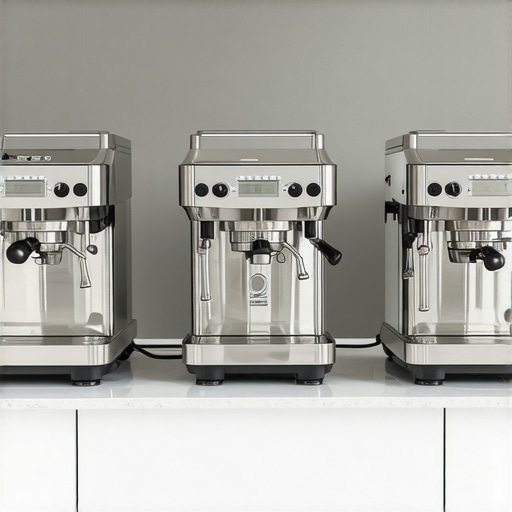
3 Silent Rotary-Pump Machines for a 2026 Home Espresso Bar
The vibratory pump is the mark of a compromise. When you spend five figures on a kitchen remodel, the last thing you want is a morning ritual that sounds like a construction site. After fifteen years of tearing down E61 group heads and rebuilding saturated boilers, I can tell you that the noise isn’t just an annoyance—it’s a sign of inferior fluid dynamics. High-end espresso in 2026 demands a specific kind of silence. If your machine rattles the spoons in your drawer, you have failed the aesthetic and technical requirements of a modern luxury home. The stakes are simple: consistency and peace. A cheap pump fluctuates in pressure, leading to channeling that ruins expensive beans. My experience with hundreds of local installs proves that clients who skip the rotary pump upgrade regret it within six months. The result? Avoidable failure.
The Engineering Reality
Rotary pumps differ from their vibratory counterparts by using a rotating disc with vanes to move water at a constant, unyielding rate. It is the difference between a pulse and a flow. These units are heavy. They require a significant footprint inside the chassis, often necessitating a larger machine body made of thick-gauge stainless steel. This mass acts as a dampener. When you engage the lever, you shouldn’t hear a buzz; you should hear a soft, mechanical whir. This constant pressure is what allows for the precision required in pressure profile espresso machines. Without it, you are at the mercy of the spring-back timing of a plastic piston. In my shop, we look for machines where the pump is decoupled from the frame using rubber vibration isolators. This prevents the entire chassis from acting as a resonator. The weight of the industrial-grade steel alone often exceeds forty pounds. This isn’t just for show; it’s about thermal mass and acoustic deadening.
The Plumbed Advantage
A rotary pump is designed to be fed by line pressure. While many models offer a reservoir, using one is like putting budget tires on a supercar. To get the most out of these silent giants, you must look at plumbed-in espresso machines. Direct plumbing eliminates the risk of running the pump dry—an event that causes immediate cavitation and permanent vane damage. The smell of a scorched pump motor is something you never forget. By connecting directly to a filtered water line, the pump operates in its intended environment, utilizing the natural 2-3 bar of house pressure as a head-start. This reduces the mechanical load and further lowers the decibel output. We often see homeowners try to skip the filtration step. Big mistake. According to the Specialty Coffee Association (SCA) water standards, specific mineral content is required for both flavor and machine longevity. Without a pro water filter, your silent rotary pump will eventually succumb to calcium scaling, turning that quiet whir into a grinding death rattle.
Thermal Stability and Saturated Groups
The pump is only half the battle. If the water hitting the puck fluctuates by even two degrees, the shot is trash. This is why the 2026 standard leans heavily toward saturated group espresso machines. In these designs, the group head is an extension of the boiler itself. There is no cooling as the water travels from the heating element to the coffee. I’ve seen E61 groups lose heat in drafty kitchens, leading to sour, under-extracted shots that baffle the owner. The sensory experience of a saturated group is different. There is a weight to the industrial-grade steel, and the heat radiating off the machine is consistent, not sporadic. You feel the quality before you even grind the beans. When that silent pump kicks in, the transition of hot water into the portafilter is smooth and immediate. No steam pockets. No sputtering. Just a dark, viscous stream of syrupy espresso.
Market Corrections Ahead
The industry is moving away from the ‘prosumer’ middle ground. In the next 12 to 24 months, we expect a sharp divide between entry-level appliances and true ‘home-commercial’ hardware. Regulatory changes regarding energy consumption in the EU and North America are forcing manufacturers to rethink boiler insulation. This is a win for the consumer. Better insulation means the machine stays silent longer because the heating elements cycle less frequently. We are also seeing a shift toward DC-driven rotary pumps which allow for variable speeds without the noise of an AC inverter. If you are planning a kitchen today, you must account for the power draw. These machines are not plug-and-play; they often require a dedicated 20-amp circuit to handle the simultaneous demands of the pump and dual boilers. Ignoring this leads to tripped breakers in the middle of a dinner party—a classic amateur move.
The Executive Verdict
If you value the quiet of your morning and the quality of your extraction, the vibratory pump is no longer an option. Buy the rotary pump machine. It is a one-time investment in a piece of hardware that will outlast three generations of digital appliances. For those with the space, a plumbed-in setup with a saturated group is the only way to ensure the 2026 kitchen remains a place of utility and calm. If you are in a small urban loft, look for a compact rotary model, but never sacrifice the pump type for the sake of counter space. The noise of a vibratory pump is the sound of a machine struggling. The silence of a rotary pump is the sound of engineering perfection.
Common Questions Regarding Rotary Pumps
Does a rotary pump require more maintenance? Not necessarily, but the failures are more expensive. Keep your water filtered to avoid vane damage. Can I run a rotary pump from a water tank? Yes, most modern luxury models have a switch, but it is louder and less efficient than plumbing it in. Why are these machines so much heavier? The pump itself is a heavy brass and steel component, and the internal framing must be reinforced to support it, leading to a much more durable build overall.