
How to Prevent Your Bread Dough from Climbing the Hook
Dough climbing is not an accident; it is a predictable mechanical failure of the C-hook design interacting with the rheology of non-Newtonian fluids. After fifteen years diagnosing high-end kitchen machinery, I have seen more motors scorched by ‘dough creep’ than by any other misuse. This phenomenon, known in physics as the Weissenberg Effect, occurs when elastic liquids—like your brioche or sourdough—wrap around a rotating rod. When that dough hits the planetary gears, the repair bill often exceeds the price of a mid-range appliance. Success requires understanding torque, hydration ratios, and the specific engineering limits of your equipment.
The Physics of Rheological Failure
Standard C-hooks fail because they rely on centrifugal force to throw the dough against the side of the bowl. High-protein flours create a gluten matrix so elastic that the normal stress of rotation pulls the mass inward and upward. This isn’t just annoying. It creates a thermal trap. When the dough climbs, the motor works against increased resistance without the cooling benefit of air circulation. If you notice your stand mixer getting hot during bread kneading, the internal friction of that climbing mass is likely the culprit. The load on the worm gear spikes. Metal shavings begin to migrate into the food-grade grease.
The Spiral Hook Advantage
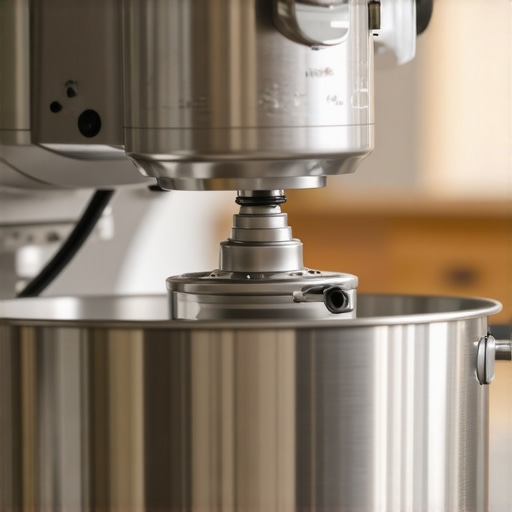
If you are serious about artisanal bread, the C-hook belongs in the recycling bin. Modern prosumer machines now utilize the spiral dough hook, which mimics the hand-kneading action of a master baker. The corkscrew geometry exerts downward pressure on the dough, forcing it back into the bowl’s base. This prevents the upward migration entirely. However, you cannot simply swap hooks without checking your clearance. A hook that sits too high leaves a ‘dead zone’ of unmixed flour, while one that is too low will score the stainless steel. You must learn how to adjust the tension on your stand mixer head to ensure the ‘dime test’ pass rate. Precision matters here. A millimeter of variance is the difference between a perfect boule and a mechanical seizure.
According to research standards from organizations like AIB International, the temperature of the dough during the mix is a critical quality control point. Climbing dough friction can raise temperatures by 5-10 degrees Celsius in minutes. This kills the yeast. It ruins the crumb. It is a cascading failure starting at the hook.
Material Stress and Mechanical Reality
The smell of ozone in a luxury kitchen is the scent of a dying capacitor. I remember a client with a custom-spec Italian mixer who insisted on kneading 80% hydration dough at speed four. The dough climbed, entered the attachment hub, and solidified. By the time we opened the casing, the gear teeth were sheared smooth. The result? Avoidable failure. When dough climbs, the center of gravity shifts. This is why you see your stand mixer walk across the counter. The vibration isn’t just a nuisance; it’s the machine screaming under a leveraged load it wasn’t designed to carry. You must monitor the bowl-to-hook ratio. Overloading the bowl by even 15% creates the ‘bridge’ necessary for the dough to grip the upper shaft and begin its ascent.
Future of High-Torque Domestic Mixing
The industry is moving toward brushless DC motors. These units provide constant torque even at low RPMs, which is essential for heavy hydration doughs. Within the next 24 months, I expect more ‘smart’ sensors to detect vertical load shifts on the drive shaft, automatically cutting power before dough reaches the internal housing. We are seeing a convergence between commercial-grade spiral mixers and domestic footprints. For those using older AC motor units, the strategy remains manual: use cold water to keep dough temperature down and reduce elasticity during the initial stages of the mix. Refer to NIST guidelines for precision measurements in culinary applications to ensure your hydration calculations are spot on.
Technical Verdict
Stop fighting the physics of the C-hook. If your dough is climbing, your hydration is likely too high for your current hook geometry or your speed is too high. Hold the speed to the lowest setting for the first six minutes of development. If the climb persists, use the 10-dollar tool trick: a silicone splash guard that acts as a physical barrier. But the real fix is mechanical. Move to a spiral hook. Adjust your head clearance. Protect your motor.
Frequently Asked Questions
Does flour type affect dough climbing?
Yes. High-protein bread flours develop stronger gluten networks that exert more ‘normal stress,’ making them far more likely to climb than all-purpose or pastry flours.
Should I oil my dough hook to stop the climb?
No. This is a temporary fix that interferes with the kneading process. If the dough can’t grip the hook, it can’t be stretched and folded properly, leading to poor gluten development.
Is climbing dough a sign of a broken mixer?
It is a sign of a design limitation, not necessarily a break. However, if left unchecked, it will lead to gear failure and motor burnout.