
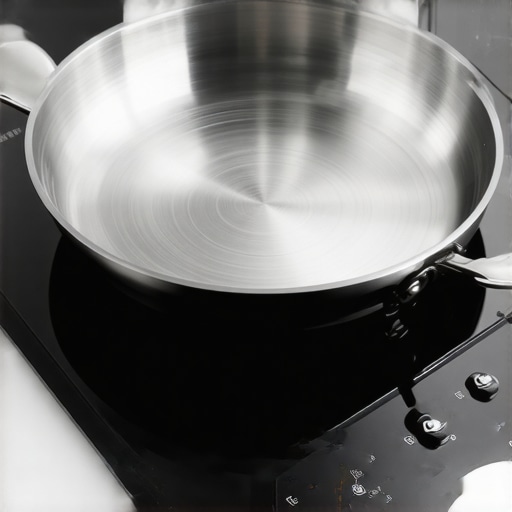
Why Your Heavy-Bottomed Pans Are Warping on Induction
You bought the most expensive stainless steel set on the market. It felt like industrial-grade armor. Three months later, that heavy-bottomed stockpot is spinning like a top on your glass surface. The failure is not the thickness. It is the physics of differential thermal expansion. After fifteen years of diagnosing high-end kitchen failures, I have seen thousands of dollars in premium cookware rendered useless because owners assumed weight equaled structural integrity. On an induction burner, the pan is the heating element. When you apply 3,700 watts of electromagnetic energy to a localized circle, the metal does not just get hot. It undergoes a violent molecular struggle. High-quality luxury kitchen tools require more than just mass; they require lamination integrity. The result? Avoidable failure for those who prioritize weight over engineering.
[image_placeholder_1]
The Mechanics of Magnetic Friction
Induction cooking works through magnetic flux. This creates eddy currents within the ferrous layer of your pan. If you have a disc-bottomed pan—where a thick slab of aluminum is bonded only to the base—you are inviting a mechanical divorce. The stainless steel shell and the aluminum core expand at different rates. This is the Coefficient of Thermal Expansion (CTE) mismatch. While the base tries to grow, the sidewalls remain relatively cool. This creates a leverage point. You might even hear why your induction cooktop clicks when you turn it on, which is often the sound of these layers micro-shifting under stress. According to standards established by organizations like the American Society of Mechanical Engineers (ASME), thermal cycling in multi-material bonds is a primary cause of structural deformation. If the bond is only at the bottom, the center of the pan bows upward or downward. The pan becomes a convex disaster. It loses surface contact. Efficiency drops. The pan dies.
The Narrative Cost Matrix
Let’s break down the economics of your cabinet. A $300 disc-bottomed pan has a high risk of warping within 24 months if used on high heat. A $500 fully clad 5-ply pan has a near-zero warp risk over 20 years. The upfront cost is higher, but the cost per use is negligible. I often tell my clients that choosing premium cookware for 2025 requires looking at the rim, not the weight. If you see layers at the edge, the expansion is distributed. If the side is a single thin sheet of steel, the base is a ticking time bomb. This is the mistake most people make with clad cookware. They buy for the feel, not the cross-section.
The Thermal Stress Test
I remember a project in a high-rise penthouse where the client insisted on using old-school copper-bottomed pans on a new 90cm induction hob. We were testing the Power Boost function to boil pasta water. Within forty seconds, a loud, metallic thung echoed through the marble-clad room. The pan had physically jumped. The base had buckled because the heat was too fast for the metal to dissipate. The smell of scorched oil filled the air. This is the operational risk of high-wattage induction. You are not heating the pan with a flame; you are vibrating the molecules at the speed of light. Without fully clad construction, the heat cannot travel up the walls fast enough to relieve the pressure on the base. This is exactly why we switched back to copper cookware for sauces in specific gas-fired environments, but for induction, high-grade steel lamination is the only path forward. The National Institute of Standards and Technology (NIST) notes that thermal gradients in localized heating environments are the primary drivers of material fatigue in consumer electronics and appliances alike.
Market Corrections and Future Tech
The industry is moving toward smarter hobs. In the next 18 months, expect to see induction burners with integrated thermal sensors that detect pan-base deflection in real-time. These units will throttle power before the metal reaches its elastic limit. We are also seeing a rise in 7-ply construction. This isn’t marketing fluff. Extra layers of titanium and specialized alloys help match the expansion rates between the interior and exterior of the vessel. For those investing in air fryers or espresso machines, the logic is the same: thermal management is the heartbeat of longevity.
The Executive Verdict
If you are using a high-output induction range, stop buying disc-bottomed pans immediately. They are engineered for gas flames that wrap around the sides. For induction, you need fully clad 3-ply or 5-ply stainless steel where the heat-conductive core extends from the base all the way to the rim. This allows the entire vessel to expand as a single unit. My recommendation: Sell the heavy-bottomed discs to someone with a gas stove. Buy fully clad for your luxury kitchen. It is the only way to ensure your pans remain flat for a lifetime of service. Check the hidden benefit of heavy bottom stock pots if you still use gas, but for the magnet-driven future, lamination is king.
FAQ
Can I flatten a warped pan?
No. Once the internal bond between the steel and the core is compromised by thermal stress, the metal has reached its yield point. Hammering it back is a temporary fix that usually worsens the heat distribution.
Why does induction warp pans faster than gas?
Induction creates an immediate, intense heat at the point of contact. Gas heat is more ambient and wraps around the sides of the pan, allowing for a more gradual and uniform expansion of the entire structure.
Is cast iron better for induction?
Cast iron is excellent for resisting warp because it is a single, thick piece of material. However, it is a poor conductor of heat and can create hot spots that may damage the glass cooktop if not handled with care.
What should I look for in a warp-proof pan?
Look for ‘fully clad’ or ‘all-over’ cladding. Ensure you can see the layers of metal at the rim of the pan. This indicates that the conductive core is present throughout the entire body, not just the base.
” ,”image”:{“imagePrompt”:”A cross-section macro shot of a high-end 5-ply stainless steel pan being used on a modern induction cooktop, showing the distinct layers of metal and the blue magnetic waves representing heat distribution, luxury kitchen setting, professional photography, hyper-realistic, 8k.”,”imageTitle”:”Cross-section of 5-ply Induction Cookware”,”imageAlt”:”A technical view of multi-layered stainless steel cookware on an induction burner.”},”categoryId”:0,”postTime”:””}