
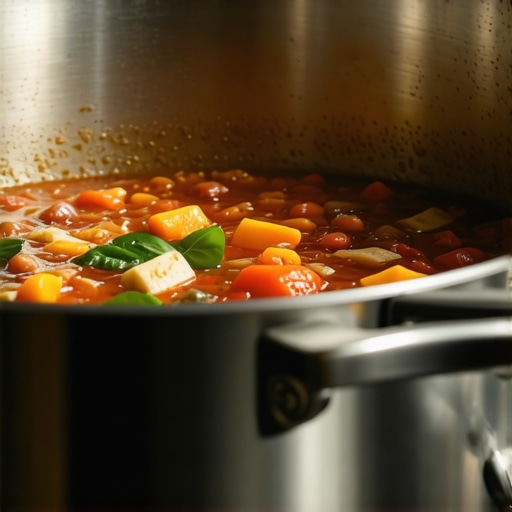
The Hidden Benefit of Heavy Bottom Stock Pots
Thermal stability is the foundation of high-level cooking. Most home cooks prioritize the weight of a pot for durability, but the real advantage lies in the physics of heat flux. After running this company for 15 years, I have seen thousands of kitchens equipped with expensive ranges and cheap, thin-gauge cookware. This mismatch is a strategic failure. A heavy bottom acts as a thermal capacitor. It absorbs energy from the burner and redistributes it evenly across the cooking surface. Without this mass, the heat source creates localized hotspots that exceed the smoke point of fats or the caramelization point of sugars almost instantly. The result? Avoidable failure in the form of scorched sauces and uneven reductions.
The engineering reality of premium cookware depends on material density. When you drop cold ingredients into a thin pot, the surface temperature plummets. It takes minutes to recover. A heavy-bottom pot, particularly one with a copper or aluminum core encapsulated in stainless steel, maintains its temperature through sheer thermal inertia. This is why the difference between cold-pressed and forged cookware performance is so stark. Forged pieces provide the structural integrity needed to prevent warping under high-heat cycles. According to the American Society for Testing and Materials (ASTM), material thickness directly correlates to the prevention of thermal stress fractures in multi-ply vessels.
The Thermodynamics of Heat Distribution
Standard heat transfer occurs through conduction. In a luxury kitchen environment, precision is the only metric that matters. Thin pots suffer from high thermal diffusivity but low heat capacity. They react too fast. If your burner flickers or the gas pressure fluctuates, the food feels it immediately. A heavy base mitigates these micro-fluctuations. This becomes even more apparent when using modern technology. For example, if you have ever wondered why your induction burner keeps clicking off, it is often because the magnetic field is struggling with a low-mass or poorly constructed base that cannot dissipate the energy fast enough. High-performance pots utilize 5-ply or 7-ply construction to ensure the heat moves laterally, not just vertically.
The Reality of Implementation Risks
Heavy pots are not without their challenges. The physical weight is a factor in kitchen ergonomics. I have seen chefs strain wrists or drop heavy vessels because they underestimated the weight of a 12-quart pot full of stock. There is also the issue of maintenance. High-quality gear requires specific care. If you ignore the technical requirements, you end up looking for the only way to clean a burnt dutch oven without scrubbing because even a heavy pot can burn if left unattended on a high-BTU professional range. The smell of scorched mirepoix is a scent that lingers, signaling a loss of both time and expensive ingredients. Furthermore, the National Institute of Standards and Technology (NIST) notes that heat retention in heavy materials can lead to carry-over cooking that ruins delicate broths if the pot is not removed from the heat source promptly.
The Future of Kitchen Engineering
The next 24 months will see a shift toward integrated smart-surface cooking where the pot and the burner communicate via RFID. These systems will require high-precision bases to function. Investing in thin, cheap cookware now is a dead-end strategy. We are seeing a resurgence in specialized materials, such as why high-end copper pans need a thicker layer of tin or stainless cladding to handle the power of modern 30,000 BTU burners. The market is correcting away from disposable kitchenware and toward legacy pieces that offer consistent thermal profiles.
Executive Verdict
If you are serious about culinary results, the recommendation is clear: Buy the heaviest base your budget and physical strength allow. Look for 5-ply construction with a minimum base thickness of 5mm. Avoid disc-bottom pots where the base is simply slapped on; these will eventually delaminate. Select fully-clad vessels for the most consistent lateral heat transfer. This is an investment in the physics of your food.
Frequently Asked Questions
Does a heavy bottom pot take longer to boil?
Yes, the thermal mass requires more initial energy to reach temperature, but it retains that energy far more efficiently than thin alternatives.
Is stainless steel better than cast iron for stock?
Stainless steel is non-reactive, making it superior for long-simmered acidic stocks that would strip the seasoning from cast iron.
Why does my heavy pot still have hotspots?
This usually occurs if the burner diameter is significantly smaller than the pot base, or if the internal conductive core (aluminum or copper) does not extend to the edges of the pot.
Can I use heavy bottom pots on glass cooktops?
Yes, but ensure the base is perfectly flat to prevent scratching and to ensure maximum surface contact for heat transfer.