
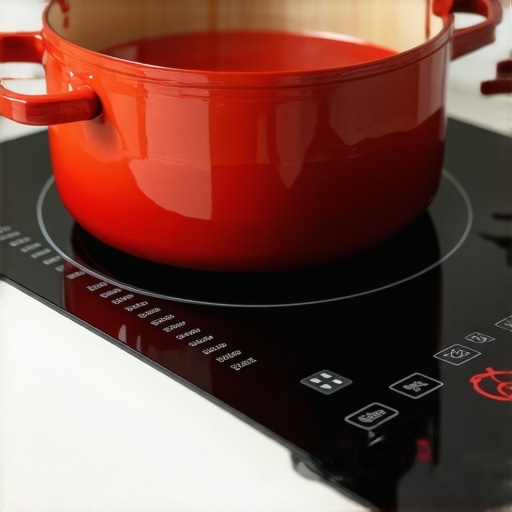
Why Your Induction Hob Doesn’t Work with Your New Dutch Oven
Your premium Dutch oven is a failure of physics, not a manufacturing defect. After 15 years of diagnosing high-end kitchen hardware, I have seen the same scene play out a thousand times: a homeowner buys a five-hundred-dollar piece of enameled cast iron, sets it on their high-performance induction cooktop, and… nothing. The lights flash. The hob clicks. The heat never arrives. The reality? Most high-end cookware manufacturers prioritize aesthetics over electromagnetic coupling efficiency. If the ferrous mass in the base of your pot isn’t within three millimeters of the induction coil, the oscillation fails. It is a hard limit. You are fighting against the laws of magnetism, and the magnet is losing.
The Engineering Reality
Induction cooking relies on magnetic flux to create eddy currents within the vessel itself. Unlike gas or traditional electric, the stove is not the heat source; the pot is. When you place a new Dutch oven on the glass, the sensor first checks for ‘pan detection.’ This is where the physics gets messy. Many luxury brands use thick layers of enamel on the bottom of the pot to prevent scratching. This creates a parasitic air gap. If that enamel is too thick, or if the cast iron has a low concentration of carbon, the magnetic field cannot penetrate the barrier effectively. The result? Thermal shutdown. The hob assumes there is no pan present because the resistance is too high for the circuit to complete. You might find the reason your induction hub won’t work with that one heavy pot is simply a matter of a few microns of porcelain.
The Mechanics of Thermal Warping
Precision matters. A Dutch oven that isn’t perfectly flat is a liability on an induction surface. Even a microscopic bow in the center of the pot—common in sand-casted iron—creates an uneven load for the induction coil. The sensors in modern luxury kitchen appliances are tuned to detect ‘localized overheating.’ If one part of the base is touching the glass and another is hovering 0.5mm away, the coil creates an uneven electromagnetic field. This triggers a safety lockout. I have seen clients try the saltwater test for finding leaks in your induction pan, only to realize the issue was a convex base. According to standards set by The Association of Home Appliance Manufacturers (AHAM), surface contact is vital for energy transfer efficiency. If your lid is rattling or the pot vibrates, you are losing energy. Sometimes the reason your dutch oven lid is not sitting flush is a symptom of the same casting inconsistencies that cause the base to fail on induction.
Market Corrections and Regulation
The industry is shifting. In the next 24 months, new energy efficiency mandates from bodies like ASTM International will likely force cookware brands to provide ‘Induction Coupling Ratings.’ Currently, the ‘induction-ready’ label is unregulated and often misleading. We are moving toward a world where ‘Smart Hobs’ will communicate directly with the pot to optimize frequency. Until then, you are at the mercy of the manufacturer’s casting quality. Cheap ‘disk-bottom’ pans often outperform luxury enameled iron because they use a bonded steel plate. However, why clad stainless steel is better than disk bottoms comes down to long-term durability and heat distribution, even if the disk-bottom pans ‘pair’ easier with the hob. You are paying for longevity, but the tradeoff is sensitivity.
The Executive Verdict
If your hob is rejecting your Dutch oven, do not call a repairman for the stove. Check the pot. Take a simple refrigerator magnet and see if it sticks aggressively to the center of the base. If the pull is weak, the enamel is too thick. If the pot wobbles on a granite countertop, the base isn’t flat enough for a high-end induction sensor. Strategy: Buy cookware that specifies ‘flat-ground base’ or ‘induction-optimized cast iron.’ Avoid pots with excessive decorative ridges on the bottom. The smoother the surface, the better the coupling. If you are stuck with a non-working pot, an induction interface disk can work, though it destroys the efficiency benefits of induction cooking.
Executive FAQ
Q: Can I use a cast iron pot that isn’t enameled?
A: Yes, raw cast iron is highly magnetic, but it can scratch the glass if you slide it. It couples better than enameled versions.
Q: Why does my hob make a buzzing sound with my Dutch oven?
A: That is the sound of the magnetic layers vibrating. It usually indicates that the pot is made of multiple layers that aren’t perfectly bonded.
Q: Is my induction cooktop broken if it works with some pans but not others?
A: No. It is likely the pan detection logic being too strict for that specific pot’s magnetic profile.