
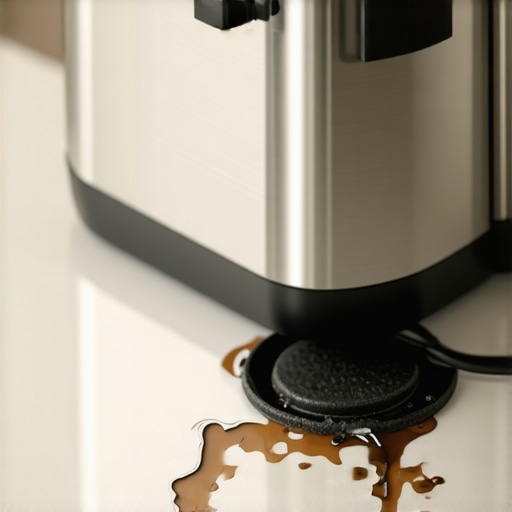
The Hidden Seal That Makes Your Espresso Machine Leak From Underneath
Water pooling under a three-thousand-dollar E61 group head isn’t an inconvenience; it’s a symptom of internal mechanical degradation. After fifteen years in the high-end appliance repair industry, I have seen every failure point imaginable, from cracked heat exchangers to calcified solenoid valves. Most owners assume a puddle means the drip tray was misaligned. They are wrong. When moisture manifests at the base of a prosumer machine, the culprit is almost always the boiler heating element gasket or the manifold O-ring. These components face constant thermal expansion and contraction cycles, reaching temperatures over 250 degrees Fahrenheit. The result? Eventual seal fatigue.
The Engineering Reality
Precision engineering demands tight tolerances. In high-end espresso machines, the interface between the boiler and the group head relies on a specific type of gasket, often made of Viton or high-grade EPDM. Unlike the cheap silicone found in big-box air fryers, these seals must withstand significant hydrostatic pressure. Understanding the real difference between boiler and thermoblock espresso systems helps pinpoint where these seals reside. In a dual boiler setup, the steam boiler runs at a higher pressure than the brew boiler. A micro-fissure in the heating element flange gasket will weep slowly, allowing water to track down the internal frame and exit through the lowest point of the chassis. It is a silent killer of electronics.
[IMAGE_PLACEHOLDER]
Thermodynamic Stress and Scale
Scale is the enemy of the technical purist. Calcium carbonate doesn’t just sit there; it acts as an abrasive. As the machine heats up, the metal expands. If scale has built up around the base of the heating element, it prevents the gasket from seating perfectly. This creates a high-pressure bypass. Preventing this requires using the best type of water for a prosumer espresso machine to avoid calcium precipitation. I have watched magnificent machines from Milan reduced to scrap because the owner ignored the ‘scent of fresh adhesive’—the smell of a scorched gasket—until the internal leak shorted the main control board. The cost-benefit of proactive gasket replacement is clear: a five-dollar O-ring versus a six-hundred-dollar logic board.
The Operational Risk of Improper Maintenance
There is a messy reality to machine ownership that most manuals ignore. If you find yourself frequently using the proper way to descale a high-end dual boiler machine, you might actually be accelerating the demise of your seals. Harsh descaling chemicals, while effective at removing scale, can degrade older rubber compounds. I once serviced a machine where the owner descaled every week with a citric acid concentration that was far too high. The gaskets had turned into a gummy residue that looked like melted licorice. The machine didn’t just leak; it hissed. The clank of the manifold during heat-up was the only warning before the main seal finally blew. Internal leaks also explain why your espresso machine pressure gauge is stuck at zero; if the pressure isn’t contained, the gauge has nothing to read.
Industry Trajectory and Technical Standards
Looking at the next 24 months, the industry is shifting toward lead-free brass and stainless steel internal components to meet stricter EU regulations. These materials have different thermal expansion coefficients than traditional copper. This means we are seeing a new generation of seals designed for higher torque and higher temperatures. According to reports from the Specialty Coffee Association (SCA), the trend toward ‘prosumer’ equipment in luxury kitchens has increased the demand for industrial-grade maintenance at the home level. We are seeing more homeowners invest in torque wrenches just to ensure their boiler bolts are tightened to factory specifications—0.5 Newton-meters of error can be the difference between a dry counter and a flooded kitchen.
The Executive Verdict
If your machine is leaking from the bottom, do not ignore it. It will not ‘self-seal.’ My recommendation is a ‘Fix’ strategy if the machine is under ten years old and a ‘Replace’ strategy only if the boiler itself shows signs of pitting or galvanic corrosion. The Actionable Strategy: Open the top cover (while the machine is unplugged and cool) and look for white, chalky tracks near the boiler base. If you see them, order a full gasket kit immediately. Do not wait for the electronics to fail.
Technical FAQ
Is a small leak really that dangerous? Yes. High-voltage components like the Gicar 3D5 controller are often mounted near the floor of the machine, making them primary targets for water damage. Can I use plumbing tape to fix the seal? Never. PTFE tape is for static plumbing threads, not for dynamic pressure seals inside a heating vessel. How often should I replace internal gaskets? For a machine used daily, a full internal inspection every 18 months is the professional standard. What is the most common seal to fail? The vacuum breaker valve O-ring. It’s the first to dry out because it sits at the very top of the steam boiler.