
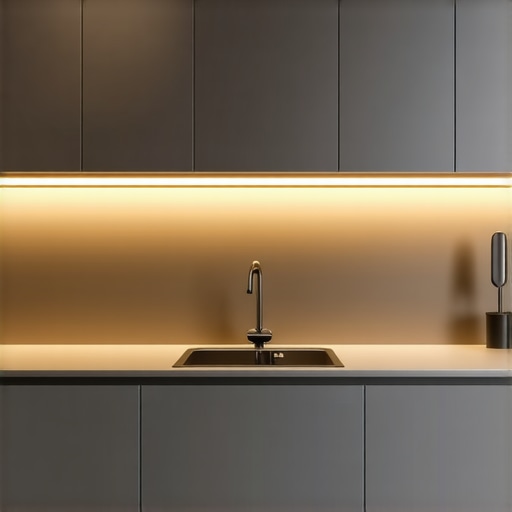
Why Your Modern Kitchen Needs Dimmable Under-Cabinet Lights
Lighting is the most ignored variable in kitchen performance engineering. After twenty years in the industry, I have watched homeowners spend eighty thousand dollars on custom cabinetry and professional-grade appliances only to ruin the utility of the space with binary lighting. On or off. That is the old way. Dimmable under-cabinet lighting is not a luxury; it is a technical necessity for anyone operating a high-performance culinary environment. If you cannot control the lumen output on your prep surface, you are not working in a kitchen—you are working in a warehouse.
The Technical Reality of Task Surface Illumination
When we talk about lighting, most people think about brightness. Professionals think about the Color Rendering Index (CRI) and thermal management. A standard LED strip bought at a big-box store often has a CRI of 80 or less. This makes your high-end ingredients look gray and unappealing. In a luxury kitchen, you need a CRI of 95 or higher to ensure the color of the meat or the clarity of your espresso shot is accurate. Dimmability allows you to manage the specific intensity required for tasks like crafting the perfect espresso without the blinding glare of a thousand suns bouncing off a polished marble backsplash. High-frequency pulse-width modulation (PWM) dimming ensures that when you lower the light, there is no flicker that causes eye strain during long prep sessions.
The Engineering Failure of Standard Installation
Most contractors slap LED tape under a cabinet and walk away. This is a mistake. Heat is the enemy of light quality. Without a proper aluminum extrusion to act as a heat sink, the diodes will shift color over 18 months, turning a crisp white into a sickly yellow. Furthermore, if you have deep counters, you need to understand the countertop depth secret to position your lights correctly. Placing them too far back creates a shadow at the front edge; too far forward and the glare hits your eyes. Using dimmers gives you the margin of error to adjust for ambient light changes throughout the day, compensating for the natural shadows cast by upper cabinetry.
The Operational Risk of High-Heat Environments
Steam is a silent killer for under-cabinet electronics. If you frequently use premium air fryers or boiling pots, the rising humidity will delaminate cheap adhesive backings on LED strips. I have seen countless ‘luxury’ installs where the lights are literally hanging by a wire within six months because the installer didn’t account for vapor pressure. We use mechanical clips and IP65-rated silicon-encased strips. This protects the circuitry from the inevitable splatter of a high-torque stand mixer. The result? A system that survives the rigors of a working kitchen rather than just looking good for the real estate photos.
Layered Lighting and the Circadian Shift
Modern kitchen design is moving toward human-centric lighting. This involves layering. You have your task lighting, your ambient lighting, and your accent lighting. By integrating dimmable under-cabinet lights with dimmable toe-kick lighting, you create a cohesive environment that transitions from a bright, high-energy prep space to a low-light social hub for evening wine. According to the Illuminating Engineering Society (IES), properly balanced luminance ratios reduce cognitive load, making the kitchen a less stressful place to work. In the next twelve months, expect to see more integration with Matter and Thread protocols, allowing your lights to adjust color temperature automatically based on the time of day.
The Executive Verdict
Do not settle for a basic toggle switch. The cost difference between a binary driver and a high-quality dimmable LED driver is negligible compared to the total project cost, but the functional impact is massive. If you are currently designing a space, ensure your backsplash design incorporates ways to hide outlets and lighting controllers for a clean look. My recommendation is simple: Buy high-CRI (95+), use aluminum channels for heat dissipation, and always specify a driver that supports 1% dimming. If your contractor suggests a ‘standard’ kit, find a new contractor.
Frequently Asked Questions
Does dimming an LED save energy?
Yes, decreasing the power sent to the LED diodes reduces energy consumption and extends the lifespan of the hardware by reducing heat output.
Why do my lights flicker when I dim them?
This usually indicates an incompatibility between the dimmer switch and the LED driver. You need a driver designed for ELV (Electronic Low Voltage) or MLV (Magnetic Low Voltage) dimming to ensure a smooth transition.
What color temperature is best for kitchen tasks?
For prep work, 3000K to 3500K provides a neutral white that is bright enough for precision without feeling like an operating room.
Can I add dimmable lights to existing cabinets?
It is possible, but retrofitting often requires creative ways to hide the driver and the wiring. Professional installation is recommended to ensure code compliance with the National Electrical Code (NEC).