
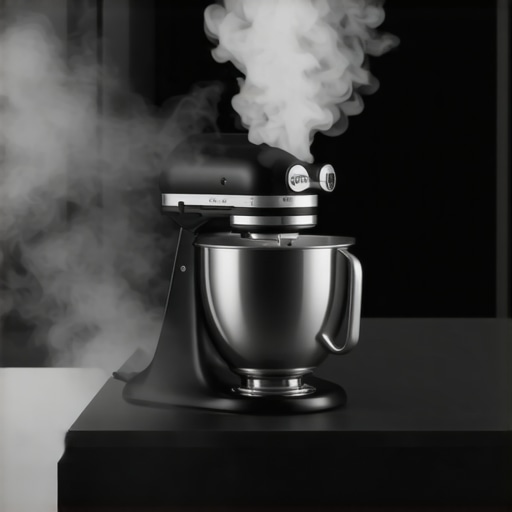
The Real Reason Your Stand Mixer Smells Like Burning Plastic
The acrid scent of ozone and scorched polymers hitting your nostrils mid-knead is not a sign of a machine ‘breaking in.’ It is a mechanical distress signal. After fifteen years of diagnosing hardware failures in premium cookware and high-end espresso machines, I have seen every way a motor can fail. Most owners assume a burning smell means the motor is dead. The reality is often more nuanced, involving the chemistry of food-grade lubricants and the physics of torque. If you ignore that smell, you are not just risking a batch of dough; you are likely melting a sacrificial gear or carbonizing your motor brushes.
The Engineering Reality of Thermal Overload
Most luxury kitchen stand mixers rely on a planetary gear system. This design allows the attachment to rotate while orbiting the bowl. Inside, a series of gears—often a mix of brass and high-strength nylon—transfer power from the motor. When you overload the machine with low-hydration dough, friction increases exponentially. The smell you detect is frequently the food-grade grease reaching its smoke point. This grease is designed to lubricate, but under extreme pressure, it begins to undergo phase separation. The liquid oil bleeds out, leaving a thick, waxy residue that creates even more friction. It is a feedback loop of failure.
Another common culprit is the carbon brushes. These small blocks of carbon conduct electricity to the spinning part of the motor. In new machines, these brushes must ‘seat’ themselves. If they are slightly misaligned, they create excessive sparking—an electrical arc. This produces ozone, which has a sharp, clinical, burning smell. However, if the smell persists after the first few hours of use, you are likely maintaining the carbon brushes incorrectly or running the machine past its duty cycle. This is especially true in units that lack an internal cooling fan, a common cost-cutting measure even in expensive brands.
The Sacrifice of the Nylon Gear
Modern engineering often includes a ‘fail-safe’ point. In many stand mixers, this is a nylon worm gear. It is designed to be the weakest link. Why? Because if the mixer hits an obstruction or the dough is too stiff, it is cheaper to replace a ten-dollar plastic gear than a three-hundred-dollar motor. When this gear begins to strip or shave under high heat, it releases a distinct, sickly-sweet plastic odor. This is the ‘operational scar’ of many home bakers who attempt high-stress dough testing without understanding the torque limits of their specific model. The result? Total mechanical disconnect.
The Sensory Markers of Imminent Failure
You need to trust your senses. A healthy mixer should hum with a consistent, rhythmic vibrance. A failing mixer has a ‘strained’ pitch—a higher-than-normal whine that suggests the motor is struggling to maintain RPMs. I recall a client with a professional-grade unit who insisted on mixing double batches of heavy bagel dough. The smell was the first warning. Then came the ‘clank’ of the planetary assembly. By the time I opened the casing, the internal grease had turned into a black, carbonized sludge, and the nylon gear had literally melted into the housing. You can often hear unusual motor whines before the smell even starts. That is your window to stop and let the machine cool.
Strategic Foresight for Appliance Durability
The industry is shifting. We are seeing a move away from traditional AC motors toward DC motors in the ultra-premium segment. DC motors offer higher torque at lower speeds and generally run cooler, which mitigates the ‘burning plastic’ risk. However, they are more complex to repair. Over the next 24 months, expect tighter energy regulations to force manufacturers to use thinner lubricants and tighter tolerances, which may actually increase the frequency of thermal shutdowns if users don’t adapt their techniques. For those invested in a luxurious kitchen, understanding the duty cycle of your equipment is becoming non-negotiable.
Executive Verdict
If your mixer smells like burning plastic, stop immediately. Check the bottom of the motor housing; if it is hot to the touch, you have exceeded the thermal limit. For users in this situation, I recommend a ‘Sell’ on your current mixing habits and a ‘Buy’ on a more methodical approach. Always start at the lowest speed for heavy loads. If the smell is constant even under light loads, your brushes are likely damaged or the gear timing is off. Do not wait for the machine to seize. A proactive grease replacement and brush check can extend the life of a premium mixer by a decade. Use high-temp, food-grade synthetic grease—not the cheap mineral stuff found in budget kits.
Common Questions Regarding Mixer Odors
Is a burning smell normal during the first use?
Yes, a faint smell can occur as the motor brushes seat and protective coatings on the electrical coils heat up. It should dissipate within 15–20 minutes of cumulative run time.
Can I fix a stripped gear myself?
If you are comfortable with a screwdriver and snap-ring pliers, yes. Most planetary mixers are modular. However, ensure you remove all old grease, as plastic shards from the failed gear will act as an abrasive and ruin the new parts.
How long should I let my mixer cool down?
Standard consumer-grade mixers have a duty cycle of about 10 minutes of heavy kneading followed by 20-30 minutes of rest. Professional DC-motor units can often go longer, but even they benefit from a ‘cool down’ period to preserve the lubricant’s integrity.