
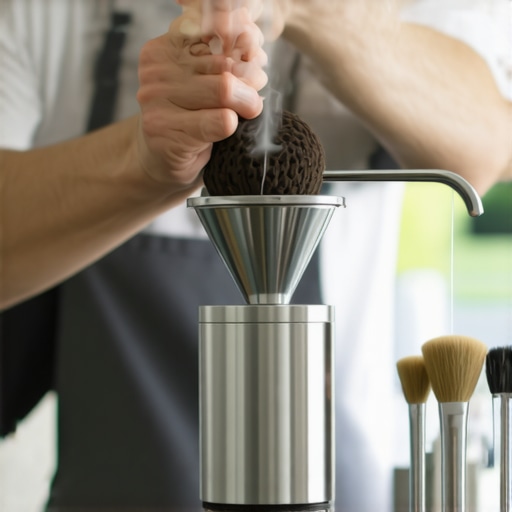
How to Properly Deep Clean Your Burr Grinder for Better Flavor
Neglecting the internal chamber of a high-end burr grinder is a fast track to ruinous flavor profiles. After fifteen years in the luxury kitchen space, I have seen five-thousand-dollar setups producing espresso that tastes like burnt rubber and old crayons simply because the owner ignored the oils. Every bean you grind leaves behind a microscopic layer of lipids. These lipids oxidize. They turn rancid. The result? Total profile degradation. If you are serious about your espresso machines, you must treat the grinder as a precision instrument, not a set-it-and-forget-it appliance.
The technical truth most owners miss is the impact of ‘fines’ and ‘retained grounds.’ These tiny particles wedge themselves into the screw threads and the carrier housing. Over time, they compress into a hard, carbonized shell. This isn’t just about taste; it is about mechanical integrity. A clogged grinder forces the motor to work harder, increasing heat. Heat is the enemy of the coffee bean. When your burrs run hot, they pre-cook the grounds before they even hit the portafilter. You are looking for clarity, but you are getting thermal chaos. For more on the mechanical side of things, understanding how to clean coffee oil buildup inside your grinder burrs is the baseline for any serious home barista.
The Engineering Reality
Burr alignment is a game of microns. When you allow old grounds to build up behind the moving burr, it can actually tilt the carrier. This creates uneven particle distribution. You get ‘boulders’ and ‘dust’ in the same dose. The dust over-extracts and turns bitter, while the boulders under-extract and turn sour. It is a flavor schism. To prevent this, a deep clean requires a full teardown of the burr assembly. This is where the technical purist excels. You need a stiff nylon brush and a vacuum. Do not use water. Steel burrs, even those with specialized coatings, do not enjoy moisture. Moisture leads to oxidation, and oxidation leads to pitting. Once a burr is pitted, it is garbage. The friction coefficients change, and your grind consistency dies.
We often see static issues as a secondary symptom of a dirty grinder. As oils build up, they create a surface that holds onto static-charged particles. If you find your kitchen counter covered in chaff, it is likely a sign of internal filth. Addressing why some coffee grinders create too many static sparks often starts with a thorough cleaning of the exit chute. This chute is the most common point of failure for luxury grinders. It is a narrow passage where oils act as a glue, trapping old grounds until they eventually fall into your fresh dose like a toxic time bomb.
Implementation Risks and Friction Points
The messy reality? Most people strip the screws or cross-thread the grind adjustment collar during reassembly. I have stood in many local kitchens where a client tried to ‘fix’ their grinder and ended up with a paperweight. The weight of the industrial-grade steel components in a prosumer grinder can be deceptive. One wrong move and you’ve misaligned the primary drive shaft. You will know it happened when you hear that high-pitched, metallic whine. That is the sound of money disappearing. If you are uncomfortable with the internal mechanics, use a dedicated cleaning tablet, though these are mere stopgaps compared to a manual scrub. They absorb oils but cannot remove the compacted ‘pucks’ of old coffee hiding in the dead space of the housing.
Consider the the grind setting change you must make for lighter roasts as a factor in your cleaning frequency. Light roasts are denser and more brittle. they produce more fines. If you drink Nordic-style roasts, you need to clean twice as often as someone drinking oily, dark Italian roasts. The dark roasts provide the oil, but the light roasts provide the grit. Both are equally dangerous to your flavor profile and the longevity of your motor.
Market Corrections Ahead
In the next 24 months, I expect to see a surge in ‘zero-retention’ grinder technology becoming the standard for the luxury kitchen. We are moving away from massive hoppers toward single-dosing workflows. This change is driven by the industry’s realization that stale beans in a hopper are a liability. Regulatory standards regarding food-safe lubricants in kitchen appliances are also tightening. This means the days of using any old grease on your adjustment threads are over. You need high-viscosity, food-grade silicone, or you risk contaminating your morning cup with petroleum byproducts. The Specialty Coffee Association has already begun emphasizing the ‘clean machine’ protocol as a non-negotiable for competitive brewing.
The Executive Verdict
My recommendation is simple. If you use your grinder daily, a deep-clean must occur every four to six weeks. A quick vacuum once a week is the bare minimum. If you ignore this, you are wasting the potential of your luxury kitchen. Treat your grinder with the same respect as your espresso machine’s group head. The ROI is immediate: clearer acidity, sweeter notes, and a motor that won’t die three years early. If you are tasting bitterness that won’t go away regardless of your grind setting, your burrs are likely choked. Clean them today.
Frequently Asked Questions
Can I use rice to clean my burr grinder? No. Rice is too hard for many small motors and contains starches that can gum up the internal components. Stick to dedicated cleaning pellets or a manual brush.
How do I know if my burrs are dull? Feel the edges. If they feel like a butter knife rather than a pocket knife, they are done. Also, if your espresso takes significantly longer to grind than it did a year ago, that is a sign of dulling steel.
Is it necessary to recalibrate after cleaning? Yes. Every time you remove the burr carrier, your ‘zero point’ will shift slightly. Always run a small test batch to find your dial-in point again before wasting your premium beans.
Will cleaning my grinder fix a sour taste? It might. If the sourness is caused by old, under-extracted boulders falling into your dose from the retention chute, a clean will solve it. However, sourness is often a temperature or grind size issue.