
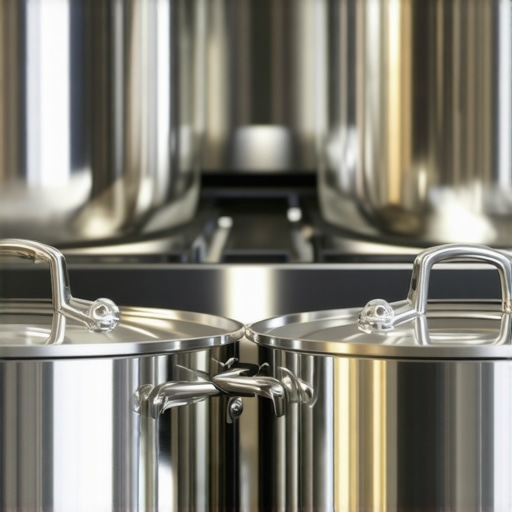
Pitting isn’t a surface blemish. It is a microscopic breach of the protective chromium oxide layer that keeps your soup pots from tasting like iron shavings. Most home chefs assume that ‘stainless’ means ‘invincible.’ It does not. After running this company for 15 years, I have seen thousands of dollars of 18/10 stainless steel pots rendered useless by simple table salt. When you add salt to cool water, it sinks. It sits on the bottom. It attacks. This is chloride pitting, an electrochemical process that eats through the passive layer of the steel. The industry calls it a standard. I call it a vulnerability.
The Metal Choice That Prevents Pitting in Your Soup Pots
The answer is 316Ti stainless steel. While the majority of premium cookware brands rely on 304 grade (commonly known as 18/10), 316Ti introduces two specific elements that change the survival rate of your kitchen gear: molybdenum and titanium. Standard stainless steel relies on chromium to form a passive film. However, salt ions—specifically chlorides—are aggressive. They find the tiny inclusions in 304 steel and tunnel inward. The result? Those small, dark pinpricks on the bottom of your pot that never scrub off. By selecting 316Ti, you are utilizing a metal originally designed for high-stress chemical processing. The molybdenum provides the defense against salt, while the titanium prevents the chromium from depleting during high-heat manufacturing. If you are investing in high-end kitchen systems for 2025, you must look beyond the brand name and verify the alloy grade. Understanding the difference between bonded and layered cookware metals is the first step in identifying these high-performance alloys. I have stood in professional kitchens where even the most expensive 3-ply sets were failing because the chef didn’t understand the chemistry of salt. But with 316Ti, the margin for error is wider. According to the Specialty Steel Industry of North America (SSINA), molybdenum significantly improves the pitting resistance equivalent number (PREN) of the alloy.
The Chemistry of the Passive Layer
Every piece of stainless steel cookware relies on a ‘passive’ film. This is a thin layer of chromium oxide that forms instantly when the metal meets oxygen. In a 304-grade pot, this film is vulnerable to chloride attack. Once a chloride ion penetrates the film, the iron underneath begins to dissolve. This creates an acidic environment within the pit, which accelerates the corrosion. It is a self-sustaining cycle of destruction. The addition of titanium in 316Ti prevents ‘sensitization.’ During welding or high-heat bonding of the pot’s base, carbon can react with chromium, leaving the pot’s structure unprotected. Titanium steps in to bind with that carbon first. This keeps the chromium where it belongs: protecting the surface. This is the same reason why high-quality 3-ply cookware often outperforms 7-ply sets that use inferior outer alloys. The technical truth is that more layers do not compensate for weak metallurgy. In my experience, a single layer of 316Ti in contact with your food is worth more than five layers of standard 18/10.
Operational Risks During Heavy Reductions
The smell of a 24-hour bone broth is a luxury, but the reality of what that broth does to your pot is a stress test. Long-term exposure to acidic liquids like tomato sauce or salted stocks is where the ‘operational scars’ of a pot become visible. I once had a client bring back a $500 stock pot that looked like it had been shot with birdshot. They had used it for one season of pickling and brining. The 18/10 steel couldn’t handle the localized chloride concentration. This is the messy reality. 316Ti handles these environments without the need for preventing white spots on your enameled cookware techniques that usually apply to lower-grade surfaces. The weight of industrial-grade steel and the scent of a simmering reduction shouldn’t be ruined by the fear of metal degradation. Professional standards, such as those maintained by ASTM International, highlight that molybdenum-bearing steels are the only choice for high-chloride environments.
Market Trends Toward Medical Grade Materials
The next 18 months will see a shift. As consumers become more aware of material purity, we will see more ‘medical-grade’ alloys entering the kitchen space. We are already seeing this in high-end espresso machines where 316-grade boilers are replacing copper or brass. Manufacturers are realizing that the ‘disposable’ nature of mid-tier stainless isn’t sustainable for the luxury market. The supply chain is pivoting. The cost of raw molybdenum has fluctuated, but the demand for ‘forever’ pots is driving brands to adopt these alloys despite the higher price point. If you already use high-torque stand mixers or the latest air fryers, you already value performance. Apply that same rigor to your pots.
The Executive Verdict
If you are building a legacy kitchen, buy for the alloy, not the marketing. Look for the ‘316Ti’ or ‘Titanium’ stamp on the base of the pot. If a brand won’t disclose their specific steel grade, assume it is standard 18/10. My recommendation is a ‘Buy’ on 316Ti for any vessel used for stocks, soups, or brining. Use your standard stainless for boiling pasta water and skip the expensive marketing fluff. The engineering reality is simple: titanium and molybdenum prevent the pits that kill your cookware.
Common Metallurgy Questions
Does 316Ti cook faster? No. It doesn’t change the thermodynamics of heat transfer. The speed of the pot depends on the copper or aluminum core. The 316Ti is there purely for chemical resilience.
Can I use metal utensils on 316Ti? Yes. Unlike non-stick coatings, 316Ti is a solid alloy. You cannot scratch off the protection because the protective properties are part of the metal’s molecular structure.
Why is 316Ti more expensive? Raw material costs for molybdenum and titanium are high. Furthermore, the steel is harder to work with during the stamping and polishing phases of manufacturing.