
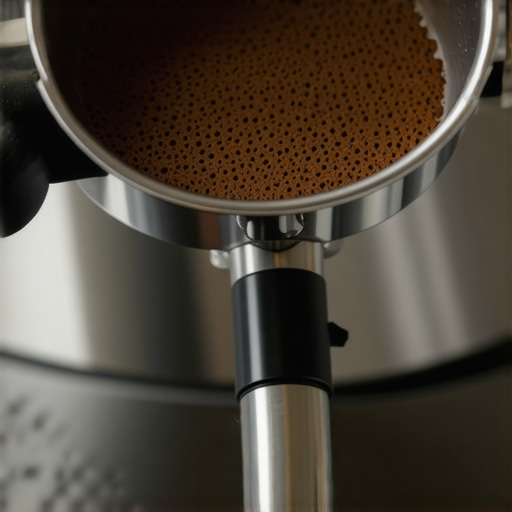
A stuck espresso puck is more than a minor morning annoyance. It signals a failure in volumetric management that compromises the precision of your extraction. After fifteen years of diagnosing high-end commercial and home setups, I can tell you that a puck suctioned to the shower screen usually points to an imbalance between your coffee dose and the physical capacity of your portafilter basket. If you are operating a machine within a high-performance luxury kitchen environment, you expect consistency. The reality? You are likely choking the machine by ignoring the necessary headspace. This isn’t just about cleaning. It is about fluid dynamics and the mechanical behavior of the three-way solenoid valve. Ignoring this leads to premature wear on your group gasket and inconsistent flavor profiles that no amount of expensive beans can fix.
How to Stop Your Espresso Puck from Sticking to the Shower Screen
The core of the problem lies in the expansion of coffee grounds during the extraction phase. When hot water hits the dry bed of coffee, the grounds swell as they absorb moisture and release CO2. If there is no gap between the coffee and the metal screen, the expanding puck presses firmly against the shower screen. The result? A mechanical bond. When the shot finishes, the three-way solenoid valve opens to relieve pressure, creating a sudden vacuum. This vacuum pulls the wet, expanded puck upward, locking it against the dispersion block. To fix this, you must understand the Headspace Math. Every basket has a maximum capacity that is often lower than the number stamped on the side. If you are using a 18g basket, but your specific bean density causes it to sit high, you are overdosing. Reducing your dose by even 0.5 grams can provide the atmospheric buffer required to break the suction before it starts.
The Solenoid Valve Vacuum Effect
Professional grade espresso machines rely on a 3-way solenoid valve to evacuate excess water and pressure from the group head instantly after a shot. This rapid evacuation is what dries the puck. However, if the puck is already touching the screen, the valve effectively tries to suck the entire mass of coffee into the internal plumbing. This creates a suction cup effect. You might notice your puck looks soggy or has a distinct ‘bolt’ mark in the center from the shower screen screw. These are sensory anchors of a system under stress. You can hear the distinct ‘thunk’ of the valve; if that sound is followed by a puck that refuses to drop, your clearance is non-existent. Proper grinder maintenance and dial-in procedures must account for this physical volume. Just as you wouldn’t overload air fryers and expect even airflow, you cannot overload a portafilter and expect clean water dispersion.
The Risk of Organic Oil Buildup
Coffee is an oily substance. Under nine bars of pressure, those oils are forced into the microscopic holes of your shower screen. Over time, these oils act as an adhesive. If you haven’t performed a backflush with a dedicated detergent in the last week, the screen is likely coated in a sticky resin. This is the ‘dirty truth’ of home brewing. The smell of rancid coffee oils is unmistakable when you remove the screen for cleaning. In a professional setting, this is unacceptable. In a luxury home, it is a silent quality killer. Use a puck screen—a thin, secondary stainless steel mesh—to act as a physical barrier. This keeps the group head pristine and adds a layer of resistance that helps prevent the vacuum from grabbing the main puck body. It is a simple tool that solves a complex mechanical failure.
Future Industry Shifts in Extraction
The industry is moving toward high-precision, nanocoated shower screens that repel water and oils. Brands like IMS and VST are leading this change. In the next 12 to 24 months, I expect to see more machines integrating ‘soft infusion’ cycles that slowly ramp down pressure to prevent the violent vacuum snap that causes sticking. We are also seeing a shift in premium cookware and appliance design that prioritizes user maintenance. The era of the ‘set and forget’ espresso machine is ending. Precision requires participation. You should also keep an eye on local water quality reports, as mineral scaling can affect the solenoid valve’s efficiency, making the suction problem worse over time.
The Executive Recommendation
My verdict is clear: decrease your dose and increase your cleaning frequency. If you are using a high-quality 18g basket, try 17.2g. The flavor won’t suffer, but your workflow will. Check the ‘nickel test’ by placing a coin on top of your tamped puck; if the screen leaves an impression on the coin when you lock the portafilter, you have zero headspace. Buy a precision shower screen with a non-stick coating. It is the most cost-effective upgrade you can make this year. Stop fighting the physics of your machine and start working with the volume of your basket.
Frequently Asked Questions
Does a darker roast make the sticking worse? Yes. Darker roasts are more porous and expand more significantly when wet compared to light roasts. You must often dose lower with dark roasts to maintain the same headspace.
Is a wet puck the same as a stuck puck? Not necessarily. A wet puck usually indicates a lack of pressure or a slow-acting valve, while a stuck puck is almost always a volumetric issue where the coffee physically bridges the gap to the screen.
Will a puck screen affect the taste of my coffee? If kept clean, it actually improves extraction by ensuring the water hits the coffee bed more evenly, acting like a second dispersion block. Just ensure you adjust your temp slightly to account for the extra thermal mass.