
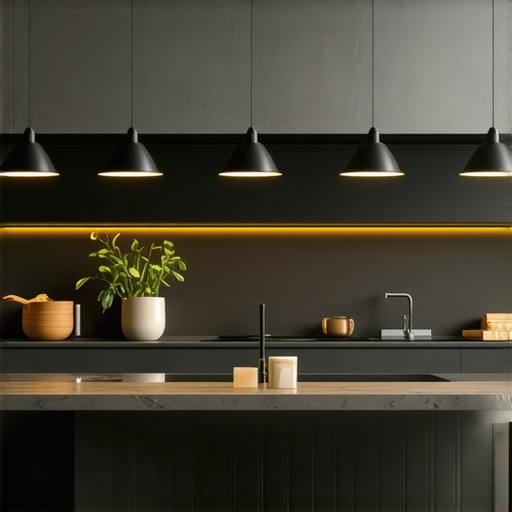
Why Your Kitchen Island Needs More Than One Pendant Light
Installing a single pendant light over a sprawling kitchen island is a technical oversight that prioritizes basic illumination over functional physics. After fifteen years of designing luxury kitchens and seeing hundreds of failed lighting layouts, the verdict is clear. One light creates a focal point of shadow rather than a field of work. Most homeowners treat lighting like furniture, but it is an industrial tool. If you are operating high-end hardware like espresso machines or preparing complex proteins, you need uniform light distribution, not a singular spotlight that cast shadows over your hands. This isn’t just about style. It is about the ergonomics of a high-performance environment.
The Physics of Beam Spread and Task Coverage
The engineering reality of kitchen lighting rests on the concept of overlapping cones of light. A single fixture, no matter how powerful, has a fixed beam angle. When you are standing at the island, your body naturally blocks the light source if it is directly behind or above you, creating a ‘dead zone’ on the granite. By installing a series of three or more pendants, you achieve cross-illumination. This eliminates the harsh contrast between the bright center and the dim edges of your prep area. Professionals refer to this as achieving proper foot-candles on the work surface. According to standards set by the Illuminating Engineering Society (IES), a kitchen task area requires significantly higher light levels than a dining space. A single bulb cannot generate the necessary intensity without becoming blindingly bright or generating excessive heat near your face. When you use a kitchen that actually works for two cooks, the shadow interference from a single light source becomes an immediate operational hazard.
The Engineering Reality of Visual Weight
Design is the byproduct of structural balance. A ten-foot island with one small pendant looks like an unfinished thought. It lacks the visual weight required to ground the room. When we calculate the ‘Golden Ratio’ for islands, we look at the total length and subtract roughly 24 inches for clearance at both ends. Filling that remaining space with a rhythmic sequence of lights creates a sense of permanence and architectural intent. There is also the matter of electrical infrastructure. Running a single junction box is easy, but it limits your future-proofing. We always recommend a multi-port canopy or separate junction boxes spaced exactly 30 inches apart. This allows for a wider field of light that interacts better with other light sources, preventing the cabinet lighting mistake that makes your marble look yellow. If the light isn’t balanced, even the most expensive stone will look muddy under the uneven glow of a lone bulb.
Shadows and the Strobe Effect During High Speed Mixing
The messy reality of kitchen work involves fast-moving parts. If you are using powerful stand mixers on high speeds, a single point of light can create a stroboscopic effect. The blade or whisk moves at a frequency that, when combined with the 60Hz flicker of a lone LED bulb, creates visual confusion. It is disorienting. It is dangerous. By having multiple light sources hitting the bowl from different angles, you cancel out those shadows and flickering artifacts. You see the texture of the dough, not the ghost of the whisk. I have seen clients complain about headaches during long baking sessions, only to realize their eyes were straining against the ‘pumping’ light effect of a single, underpowered pendant. The smell of hot electrical components or the weight of a heavy brass fixture shouldn’t be your only sensory cues; you need the visual clarity that only a linear lighting array provides.
Strategic Foresight for Smart Home Integration
The industry is moving toward circadian lighting protocols and hyper-localized dimming. In the next 12 months, we expect to see more integration with Matter and Thread smart home standards. A single light is a binary switch; a series of lights is a system. You can zone your lighting. Dim the outer pendants for a soft evening glow while keeping the center task light bright for a quick coffee. This level of control is impossible with a single fixture. Furthermore, the National Electrical Code (NEC) has tightened rules around kitchen island circuits, and integrating your lighting into these smart zones is the only way to maintain a modern property value. Having power outlets on every side of the island is standard now, and smart, multi-pendant lighting is the next non-negotiable benchmark.
The Executive Verdict
If your island is longer than four feet, a single pendant is an architectural failure. For islands between five and seven feet, use two large pendants or three medium-sized ones. For anything over eight feet, four is the minimum. My recommendation is to pull the trigger on a three-fixture layout with a high CRI (Color Rendering Index) of 90 or above. This ensures your food looks like food and your workspace remains safe. Don’t let a contractor talk you into a single center-point light just because it’s easier to wire. The extra labor for the additional junction boxes is the best ROI you will find in a kitchen remodel.
FAQ
How high should the pendants hang?
The standard is 30 to 36 inches above the countertop. If you are taller than average, bias toward 36 to ensure you aren’t staring directly into the shrouds.
What is the best spacing for three lights?
Measure the island length, divide it into four equal sections, and place the lights at the three internal marks. This ensures even distribution without crowding the edges.
Can I mix different pendant styles?
No. In a luxury kitchen, consistency is the hallmark of professional design. Use identical fixtures to create a clean horizontal line that guides the eye.
Do I need a separate dimmer for the island lights?
Always. Task lighting needs to be intense during prep and atmospheric during dining. Without a dedicated dimmer, you lose the ability to shift the room’s mood.