
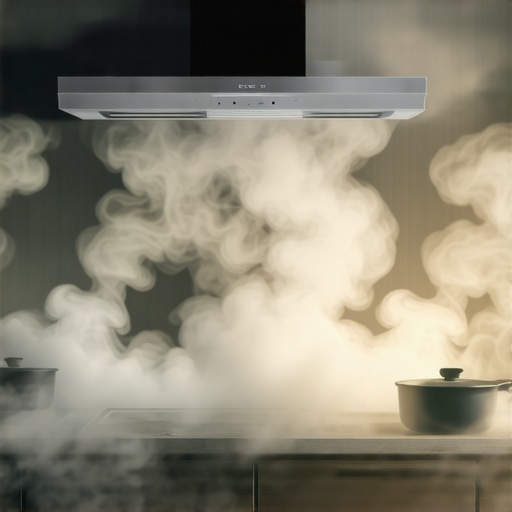
Why Your Kitchen Hood Doesn’t Actually Clear Out Any Smoke
The range hood in your luxury kitchen is likely a $5,000 paperweight. Most homeowners prioritize the aesthetic of brushed stainless steel over the brutal physics of cubic feet per minute (CFM) and static pressure. After fifteen years diagnosing ventilation failures in high-end estates, I can tell you that a hood’s failure usually starts in the walls, not the motor. You spend a fortune on luxury kitchen upgrades and premium cookware, yet you tolerate a system that allows atomized grease to coat your custom cabinetry. The result? Avoidable failure. It is not just about the smell; it is about the long-term degradation of your home’s air quality and surfaces. When you sear a dry-aged ribeye on a 30,000 BTU burner, the smoke is not a polite guest. It is an aggressive byproduct that requires velocity and a clear path to the exit. Most systems provide neither.
The Engineering Reality of Air Displacement
Static pressure is the silent killer of kitchen ventilation. You can buy a blower rated for 1,200 CFM, but if your contractor ran a 6-inch flexible duct with three 90-degree elbows, that rating is a lie. Flexible ducting creates turbulence. Turbulence creates resistance. Resistance kills airflow. Every bend in the pipe adds what we call ‘equivalent feet’ to the run, making the motor work harder while moving less air. For high-performance cooking, rigid galvanized steel is the only acceptable material. If you find your house smelling like lunch at 9:00 PM, your capture zone is likely insufficient. The hood should overhang the cooking surface by at least 3 inches on each side. Without this overhang, the thermal plume—that rising cone of heat and steam—simply bypasses the intake and curls around the edge of the hood. This is why you still see smoke despite the fan being on its highest setting. Also, the type of filtration matters. Mesh filters are notorious for clogging and dropping efficiency. Professional-grade baffle filters, however, use centrifugal force to strip grease from the air, maintaining better airflow even when dirty. This is the same principle that helps you learn how to stop your air fryer from making your whole house smokey—you must control the source and the path. According to the Home Ventilating Institute (HVI), proper duct sizing and installation are the primary factors in effective residential ventilation.
The Hidden Risk of Make-up Air
Modern homes are built like airtight vaults. This is great for energy bills but terrible for high-power ventilation. If you pull 1,000 cubic feet of air out of the kitchen, 1,000 cubic feet of air must come back in from somewhere. In an airtight house, the hood starts competing with your fireplace or water heater for air. This can lead to backdrafting, where carbon monoxide is pulled into the living space. This is not a theoretical risk; it is an operational reality. If your hood sounds like it is struggling, try opening a nearby window. If the performance suddenly improves, your home is ‘starving’ for air. High-output luxury kitchens require a dedicated Make-up Air (MUA) system that syncs with the hood to maintain neutral pressure. It is an expensive addition, but skipping it is a strategic error. You wouldn’t use low-quality oil in a high-end pan, so why would you starve your ventilation system? For example, understanding why you should never use olive oil for high-heat air frying relates back to the particulate matter your hood must handle. High smoke-point oils are better for your pans and your air quality.
The Strategy of Active Maintenance
Grease is a secondary fuel source. When it accumulates in your ducts, it poses a fire risk that most homeowners ignore. I have seen stainless steel hoods that look pristine on the outside but are lined with a flammable ‘tars’ on the inside. Regular cleaning of baffle filters in a high-end dishwasher is a start, but it isn’t enough. You need to verify that the exterior wall cap or roof vent is not obstructed by bird nests or debris. A blocked exit means zero displacement. If you are noticing a decline in performance, check the solenoid and the damper. Much like how you need to know how to fix the clogged filter in your high-end dishwasher, maintaining the ‘exit’ of your kitchen’s waste products is non-negotiable for a functioning high-end space.
Market Corrections and Future Tech
The industry is moving toward induction, which generates less ambient heat but just as much grease and steam. The next 18 months will see a surge in ‘smart’ ventilation that adjusts CFM based on sensor-detected particulate matter. However, no amount of smart tech can overcome a poorly installed 4-inch duct. If you are building or renovating, demand a straight-run, rigid duct with a minimum 8-inch diameter. Ensure your builder follows ASHRAE Standard 62.2 for residential ventilation. This is the difference between a kitchen that looks like a showroom and one that functions like a professional workspace.
The Executive Verdict
If your hood is underperforming, do not replace the motor yet. Check the ducting first. If you have flexible ducting, rip it out and replace it with rigid metal. Ensure your filters are baffles, not mesh. If you have a high-BTU range, invest in a Make-up Air system. Anything less is just noise.
Frequently Asked Questions
Why is my range hood so loud but not sucking smoke?
This is usually caused by high static pressure. If the duct is too small or too long, the air can’t move, and the motor vibrates against the resistance, creating noise without airflow.
Do I really need a 1200 CFM hood?
Only if your cooking habits or range output require it. For most pro-style gas ranges, 600-900 CFM is plenty, provided the ductwork is correctly sized and installed.
Can I use a recirculating hood in a luxury kitchen?
No. Recirculating hoods do not remove heat or moisture; they only filter some grease and odors through charcoal. They are an admission of architectural defeat.
How often should I clean my baffle filters?
In a high-use kitchen, every two weeks. If they feel sticky to the touch, they are already reducing your hood’s efficiency.