
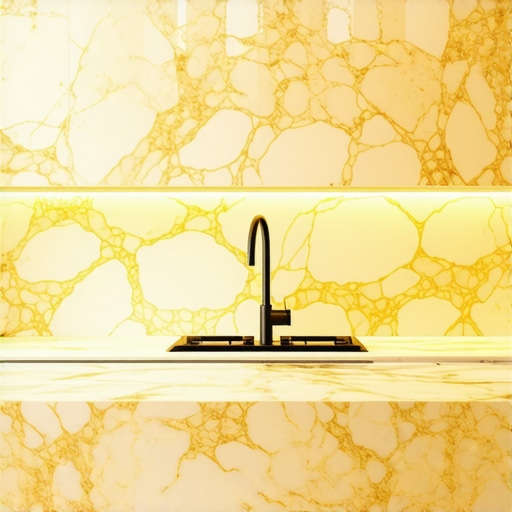
The Cabinet Lighting Mistake That Makes Your Marble Look Yellow
Buying $30,000 slabs of Calacatta marble only to have them look like aged nicotine stains under your cabinets is a professional failure I see far too often. After sixteen years in high-end kitchen architecture, I have witnessed homeowners obsess over the stone’s veining while ignoring the spectral power distribution of their LEDs. Most people assume ‘white light’ is a universal constant. It is not. If you select a light source with a low Color Rendering Index (CRI) or a poorly calibrated Correlated Color Temperature (CCT), you are effectively painting your counters with a yellow filter. This happens because certain LED phosphors fail to represent the blue and violet ends of the spectrum, leaving only the muddy yellows and greens to bounce off your natural stone. The stake here is not just aesthetic. It is financial. A kitchen that looks ‘dirty’ because of poor lighting degrades the perceived value of every luxury kitchen element you have installed.
The Physics of Spectral Distortion
Natural stone is a mineralogical composite. Marble like Carrara contains trace amounts of iron. When you hit that iron with light lacking ‘R9’ saturated red values or a balanced blue peak, the stone appears sickly. Cheap LED strips, the kind often bundled with standard cabinetry packages, usually peak in the yellow-green frequency. This creates a visual dissonance. You expect a crisp, cool white, but the reality is a dingy amber. High-quality lighting requires a CRI of at least 95, with a specific focus on the R9 through R12 values. Without these, even your premium cookware will look lackluster when sitting on the counter. The technical reality? Cheap diodes cannot mimic the full spectrum of daylight. You are essentially starving your stone of the light frequencies it needs to look expensive.
We must also discuss the ‘binning’ process of LED manufacturers. Within a single production run, diodes vary in color. Premium manufacturers sort these into tight bins to ensure consistency. Lower-tier brands mix them. This results in one section of your counter looking crisp and the next looking like a lemon. It is the same lack of precision that causes luxury kitchen upgrades to fail the eye test. If you are investing in the best material for a durable kitchen workspace, you cannot afford to skimp on the photons hitting it. According to the Illuminating Engineering Society (IES), the interaction between light and surface reflectance is the most overlooked variable in residential design.
Thermal Failure and Color Shift
Heat is the enemy of light quality. Most under-cabinet lighting is installed on the underside of the box, often near heat-generating appliances like espresso machines or high-output air fryers. When an LED strip gets hot, its color temperature shifts. This is ‘lumen depreciation’ accompanied by ‘chromaticity shift.’ The result? Your lighting moves toward the yellow or green spectrum over time. Professional installations require aluminum channels to act as heat sinks. Without them, that ‘daylight’ strip you bought will turn into an ‘incandescent’ nightmare within eighteen months. I have seen countless clients complain that their luxury granite countertops are suddenly developing dark spots or yellow hues, only to find the LEDs are literally cooking themselves. The heat ruins the phosphor coating on the diode. The fix is not a new counter; it is a thermal-managed lighting system.
Reflectance is another trap. Polished marble acts as a mirror. If you use ‘dotted’ LED strips, you will see every individual diode reflected in the stone. It looks cheap. It looks like a DIY project gone wrong. To avoid this, you need COB (Chip on Board) LEDs or high-density strips paired with a thick opal diffuser. This creates a ‘solid’ bar of light. This level of detail separates a showroom-quality kitchen from a standard remodel. Consider how light hits your stand mixers. A solid bar of light creates a clean highlight; a dotted strip creates a distracting mess of pinpricks.
The Market Shift Toward Tunable White
The industry is moving toward ‘Human Centric Lighting’ or ‘Tunable White’ technology. This allows you to adjust the Kelvin temperature throughout the day. In the morning, you want 4000K to wake up and see the true blue-white of your marble. In the evening, you might drop to 2700K for a warmer atmosphere. However, the risk with tunable systems is ‘Color Tracking.’ Poorly designed controllers will skip the middle of the spectrum, making your kitchen look purple or green during the transition. The Natural Stone Institute emphasizes that the ambient environment is part of the stone’s ‘performance.’ If you do not control that environment, the stone will not perform.
Local building codes are also tightening around energy efficiency. In many jurisdictions, you are required to use high-efficacy lighting. The mistake is thinking ‘efficient’ means ‘good color.’ Many Title 24 compliant lights have terrible color rendering. You must verify the TM-30-18 reports for any lighting fixture. This report provides a much more accurate picture of color fidelity and gamut than the old CRI system. It is the difference between a kitchen that feels ‘medical’ and one that feels ‘magical.’ Utilizing the lighting trick that makes small kitchens look massive requires an understanding of how light interacts with vertical and horizontal planes simultaneously.
Executive Verdict on Cabinet Lighting
If you are currently designing a kitchen or looking to fix a ‘yellow’ marble problem, the strategy is clear. Sell your cheap, off-the-shelf LED rolls. Buy high-CRI (95+), COB-style LED strips with a 3000K or 3500K fixed temperature if you want to avoid the complexities of tuning. Ensure every strip is mounted in an aluminum channel for heat dissipation. This is a non-negotiable step for anyone who owns premium cookware for 2025 and expects their environment to match the quality of their tools. If your marble already looks yellow, check the CCT first. If it is 2700K, that is your culprit. Swap to 3000K and watch the yellow vanish. The result? A kitchen that looks like the investment you actually paid for.
Frequently Asked Questions
Will 4000K lighting make my marble look too blue?
On white marble with grey veining, 4000K provides the most ‘true’ color, but it can feel sterile in a residential setting. 3000K to 3500K is generally the ‘sweet spot’ for luxury homes.
Can I just use smart bulbs in my existing fixtures?
Smart bulbs often have poor CRI compared to dedicated architectural LED strips. They also rarely fit into the slim profiles needed for effective under-cabinet tasks.
How do I know if my LEDs are high CRI?
Check the packaging for a CRI or Ra value. If it is not listed, or if it is below 90, it is unsuitable for natural stone applications.
Does the backsplash material affect the lighting color?
Yes. Light reflects off the backsplash onto the counter. If you have a warm-toned backsplash, it will amplify the yellow cast on your marble. You may need a cooler light source to compensate.