
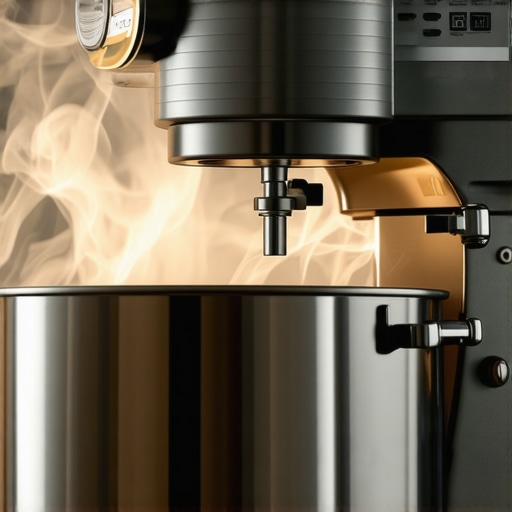
The Real Reason Your Stand Mixer Motor Smells Like It’s Burning
That acrid, metallic stench wafting from your mixer’s ventilation slats isn’t just a sign of hard work; it is the olfactory signature of mechanical distress. Most high-end kitchen enthusiasts assume a premium price tag guarantees immunity from overheating, but physics doesn’t care about branding. After twenty years in the industry, I have seen more $800 machines sidelined by simple thermal neglect than by actual part failure. The stakes are high: once you smell the ozone and scorched copper, you are likely minutes away from permanent winding damage or a seized armature. This smell usually signals that the motor is drawing excessive current to overcome friction, or the carbon brushes are arcing against the commutator. If you value your investment in premium cookware and high-end tools, understanding the internal combustion of your appliance is mandatory. Ignoring it leads to a catastrophic loss of torque. The result? Avoidable failure.
The Engineering Reality of Fractional Horsepower Motors
Inside most luxury stand mixers, you find a universal motor or a DC motor designed for high torque at low speeds. These motors rely on a series of copper windings wrapped around a steel core. When you push the machine too hard—perhaps with a stiff pizza dough—the resistance against the motor increases. This creates heat. To combat this, a small internal fan spins to move air across the components. However, when the load exceeds the motor’s rated capacity, the heat builds up faster than the fan can dissipate it. This leads to the breakdown of the varnish insulation on the copper wires. That sweet yet sharp burning smell is literally the chemical decomposition of that insulation. It is a one-way street. Once the varnish melts and wires touch, you get a short circuit. The machine loses power, and eventually, it won’t start at all. Many users find that why your stand mixer motor struggles with low hydration bread dough is directly linked to this thermal accumulation. Professional standards set by the Association of Home Appliance Manufacturers (AHAM) emphasize that duty cycles must be respected to maintain internal component integrity.
The Mechanical Friction and Grease Breakdown
It isn’t always the electricity. Sometimes, the smell is organic. High-end mixers use food-grade grease to lubricate the planetary gear assembly. Over years of use, or intense heat cycles, this grease can begin to separate. The liquid oil leaches out of the thickener and can actually drip onto the motor brushes. When that oil hits the sparks produced by the carbon brushes, it smokes. It creates a greasy, burnt odor that is distinct from the ozone smell of electrical failure. If you haven’t performed a regrease in five years, the friction in the transmission increases the load on the motor, creating a feedback loop of heat. This is why why your stand mixer gears are grinding and how-to-regrease-them is a critical maintenance skill for any serious home baker. You are essentially asking a motor to push through sludge instead of slick, lubricated gears. This is where the ‘operational scars’ of a business owner come in: we see machines come in with ‘burnt motors’ that actually just needed $20 worth of fresh grease and a good cleaning.
The Thermal Stress Test and Implementation Risks
I recall a client in a high-volume residential kitchen who insisted on making double batches of bagels every Sunday. The mixer was a top-tier model, yet it smelled like a tire fire every week. Upon inspection, the carbon brushes were pitted and the commutator was blackened with soot. This is ‘commutation failure.’ The brushes are designed to wear down, but when they get too hot, they can weld themselves to the holder or crack. When this happens, the sparking becomes constant rather than intermittent. You’ll see a blue glow through the vents. That glow is a 3,000-degree arc of electricity. It destroys the motor’s balance and leads to the reason your stand mixer keeps overheating after 10 minutes even when it’s empty. The risk here is simple: if you don’t stop the moment you smell that heat, you aren’t just replacing a $30 set of brushes; you’re replacing a $250 motor assembly. Safety standards from UL Solutions mandate thermal cutoffs in modern machines, but older or specialized luxury models might allow the motor to cook itself to death before the fuse blows.
Market Corrections and the Future of Brushless Tech
The industry is currently shifting. In the next 24 months, we expect to see a surge in brushless DC (BLDC) motors in the luxury kitchen space. These motors eliminate the friction and sparking of carbon brushes, significantly reducing the ‘burning smell’ risks. However, they introduce complex electronics—inverters and controllers—that are sensitive to heat in different ways. While the mechanical smell might vanish, the risk of ‘frying’ a circuit board remains if the ventilation is blocked. We are also seeing stricter energy regulations that force manufacturers to use thinner wires to increase efficiency, which unfortunately makes them more susceptible to thermal damage if used outside of their design parameters. If you are looking to elevate your baking: the ultimate guide to stand mixers, look for machines with higher wattage ratings but also larger cooling fans. Speed isn’t the metric; heat management is the metric.
The Executive Verdict
If your mixer smells like it’s burning, STOP. Do not ‘just finish the batch.’ My recommendation is a ‘Sell’ on the idea that these machines are indestructible and a ‘Strong Buy’ on preventative maintenance. If the smell is electrical (ozone), check your brushes. If the smell is greasy (old oil), it’s time for a gearbox overhaul. For anyone working with heavy doughs, use the lowest speed possible; torque is your friend, but speed is what generates the heat. If you are in a situation where the smell persists even under light loads, the motor is already partially shorted and requires professional replacement. Don’t wait for the smoke to become visible.
Frequent Questions About Motor Health
Is it normal for a new mixer to smell? Yes, a ‘new’ smell is often just the factory coatings on the motor windings curing during the first few uses. It should dissipate within 20 minutes of total run time. If it persists, it’s a defect.
Can I use my mixer for 30 minutes straight? Most consumer-grade luxury mixers have a 10-minute duty cycle for heavy loads. Running longer than this without a ‘rest’ period causes the heat to soak into the core where the fan can’t reach it.
Does the speed setting matter for the smell? Counterintuitively, higher speeds can sometimes keep the motor cooler because the fan spins faster. The most dangerous state is a low-speed, high-torque grind where the fan isn’t moving enough air to compensate for the massive electrical draw.