
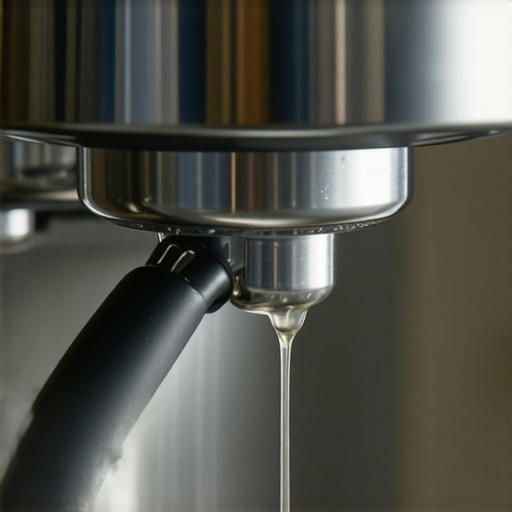
Why Your Espresso Shots Start Fast and Then Choke the Machine
Running a luxury kitchen consultancy for fifteen years teaches you one thing: physics doesn’t care about the price tag of your gear. You buy the most expensive espresso machines on the market, expecting perfection, yet you face the dreaded ‘choke.’ The shot starts as a gushing, watery mess for the first five seconds and then slows to a painful, agonizing drip. It is a mechanical failure of the puck structure. This isn’t a minor annoyance. It is a sign of internal hydraulic bypass followed by a total collapse of the particle matrix. If you don’t fix this, you are putting unnecessary strain on your machine’s solenoid valves and pump seals.
The Engineering Reality of Fines Migration
When you engage the pump, 9 bars of pressure hit a dry bed of coffee. In a flawed puck, the smallest particles—we call these ‘fines’—are physically transported by the water flow toward the bottom of the basket. This is fines migration. Initially, the water finds paths of least resistance, causing that fast start. But as those microscopic particles hit the filter holes, they create a literal silt fence. The flow stops. You aren’t just making bad coffee; you are witnessing a structural failure. High-end bottomless portafilters often reveal this through visible channeling before the inevitable clog. The pressure builds, the pump pitch shifts to a strained whine, and the extraction dies.
The Physics of Basket Geometry and Heat
Most owners of premium cookware and high-end appliances understand heat retention, but they ignore the thermal dynamics of the portafilter. If your basket is cold, or if you are using a low-quality stamped basket, the metal expands unevenly. This creates gaps at the edges. Water, being lazy, rushes through these gaps. As the coffee swells with hydration, it expands and slams shut those gaps, leading to the ‘choking’ effect. This is why soggy espresso pucks are so common when the initial flow is too fast. You have essentially created a plug of compressed silt at the base of your basket. According to the Specialty Coffee Association (SCA) technical standards, grind uniformity is the primary defense against this hydraulic imbalance.
The Hidden Cost of Pump Fatigue
Every time your machine chokes, the bypass valve has to work overtime to redirect that 9-bar pressure back into the reservoir. Over a year, this wears down the spring tension in your over-pressure valve (OPV). I have seen $5,000 machines need complete valve rebuilds because the owner constantly fought ‘fast-then-slow’ extractions without adjusting their technique. It is the same logic as redlining a car engine while the brakes are on. You might also notice that espresso tasting like burnt rubber often accompanies this issue, as the stagnant water in the group head overheats while trying to force its way through the blockage.
Market Corrections and the Rise of Precision Tools
The industry is moving away from the ‘just grind finer’ mantra. In the next 18 months, expect a surge in specialized puck screens and high-extraction baskets as standard kit for any luxury kitchen. These tools are designed to distribute water impact more softly, preventing the initial ‘washout’ of the puck. We are also seeing a shift toward ‘low-retention’ grinders that minimize the static charge that often causes the clumping leading to these extraction hurdles. If you aren’t using a dual-boiler machine with PID temperature control, your ability to compensate for these physical shifts is severely limited.
The Executive Verdict
If your shots are starting fast and then choking, stop moving the grind dial immediately. Your problem is puck integrity. Check your tamping pressure—it must be level, not just heavy. Examine your basket for blocked holes. Switch to a precision basket with laser-cut holes to ensure the flow remains consistent from start to finish. My recommendation? Invest in a WDT tool to de-clump the grounds before tamping. This breaks up the silt nests that cause the choking. The result? Avoidable failure turned into a repeatable, professional standard.
Frequently Asked Questions
Q: Can old beans cause the shot to choke?
A: No, old beans usually gush. Choking is almost always a result of too many fines or poor distribution causing a collapse of the puck mid-shot.
Q: Is my pump broken if it gets quiet during a choke?
A: Not necessarily. Most vibratory pumps get quieter when they hit maximum pressure and can no longer move water. It is a sign of resistance, not failure—yet.
Q: Does tamping harder fix a fast start?
A: Rarely. Beyond 25-30 lbs of pressure, coffee is fully compressed. If it still gushes, your grind is too coarse or your distribution is uneven.
“