
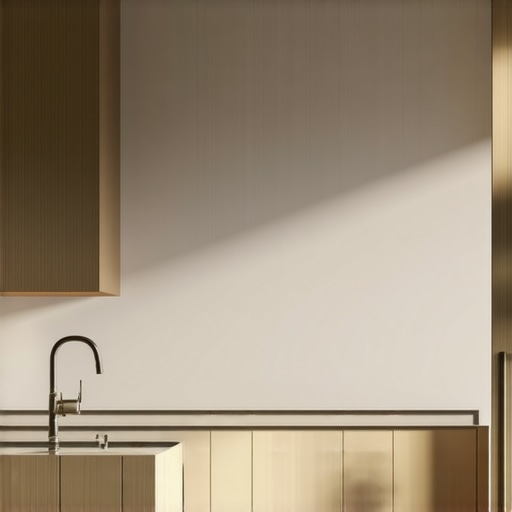
The Lighting Trick That Makes Small Kitchens Look Massive
Lighting is not an accessory. In the world of high-end design, light is a structural element as real as the marble on your island. Most homeowners treat it as an afterthought, a few recessed cans thrown into a ceiling grid. That is a strategic error. After fifteen years in the luxury kitchen space, I have seen multimillion-dollar renovations feel claustrophobic because of poor lumens management. The thesis here is simple: to make a small kitchen look massive, you must eliminate visual friction through vertical illumination and shadow eradication. It is about the bounce, not just the bulb.
The Engineering Reality of Light Layers
If you rely solely on overhead downlights, you create a ‘cave effect.’ Light hits the floor, leaving the upper corners of your cabinetry in darkness. This effectively shrinks the room to the size of the floor mat. The trick is the uplight. By installing high-output LED strips atop your wall cabinets and directing them toward the ceiling, you erase the hard line where the wall meets the roof. This creates the illusion of infinite height. It changes the geometry of the space. To do this right, you need to understand Color Rendering Index (CRI). A CRI of 90+ is non-negotiable. Without it, your premium cookware looks muddy and your stone countertops lose their depth. I recommend checking the standards set by the Illuminating Engineering Society for proper foot-candle requirements in task areas.
The ROI of Task and Ambient Fusion
Shadows are spatial thieves. When you stand at your counter to use your espresso machines, your body blocks the overhead light, casting a shadow right where you need to work. This creates ‘visual noise’ that makes a kitchen feel cluttered and small. The solution is integrated under-cabinet lighting. This is where most people fail by using cheap, puck-style lights. They create ‘hot spots’ on the backsplash. Instead, use continuous diffusion channels. This provides a wash of light that pushes the wall back, making the workspace feel deeper. Implementing the under-cabinet plug strip trick keeps the backsplash clean, further reducing the visual clutter that plagues small footprints.
Implementation Risks and The Messy Reality
I remember a project in a high-rise downtown where the client insisted on 5000K ‘Daylight’ bulbs. The result? The kitchen felt like a cold surgical suite. The polished chrome of their stand mixers didn’t sparkle; it glared. The wood grain in the custom cabinetry looked gray. We had to strip it all out. The sweet spot is 3000K. It provides warmth while maintaining the crispness needed for tasks. Another failure point is dimming. If your LEDs flicker when you turn them down, you have a driver mismatch. It is a technical failure that ruins the ‘luxury’ feel. You need ELV (Electronic Low Voltage) dimmers for most high-end tape lights to avoid that annoying 60Hz hum that drives chefs crazy.
Market Corrections and Future Tech
The industry is moving toward ‘Human Centric Lighting’ (HCL). This means your kitchen light temperature shifts automatically from a cool, energizing 4000K in the morning to a warm 2700K in the evening. In small kitchens, this adaptability is vital. It allows the space to serve multiple roles without feeling stagnant. We are also seeing a shift away from massive pendant lights. While beautiful, large pendants act as visual anchors that ‘stop’ the eye. In a tight space, you want the eye to travel. Use clear glass or minimal silhouettes. Often, the best lighting for open-concept kitchens involves ‘invisible’ sources where you see the light, not the fixture. Also, ensure you haven’t forgotten the proper ventilation lighting, as the hood is a primary light source for your cooking surface.
The Executive Verdict
Buy into the layered approach. Hold off on the expensive decorative pendants until your architectural lighting (uplights, under-cabinets, and toe-kick lights) is perfected. If you have a small kitchen, your strategy should be: Uplight the ceiling to create height, wash the backsplash to create depth, and use toe-kick lighting to make the cabinets appear to ‘float.’ This three-point attack is the only way to defy the physical square footage of the room.
FAQ
Q: Can I use battery-powered lights for this?
A: No. Battery units lack the lumen output and color consistency required to manipulate spatial perception. Hardwired systems are the only professional choice.
Q: Will bright lights make my kitchen feel hot?
A: Not with LEDs. Modern LED strips have excellent thermal management, though they still require aluminum channels to act as heat sinks for longevity.
Q: What is the most common lighting mistake?
A: Using too many recessed cans. This creates a ‘Swiss cheese’ ceiling and uneven pools of light. It is about the quality of the light bounce, not the number of holes in your ceiling.