
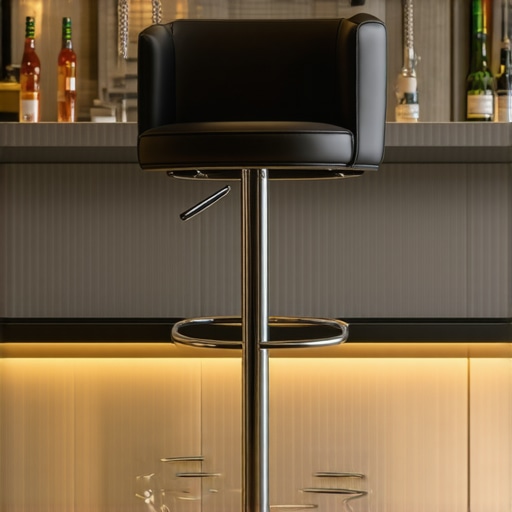
How to Fix the Wobble in Your Luxury Bar Stools
A wobbly bar stool is not merely an annoyance; it is a sign of mechanical fatigue that threatens the structural integrity of your furniture and the safety of your flooring. After fifteen years of designing and maintaining high-end kitchen environments, I have observed that most owners treat instability as a minor nuisance until a leg shears off or a floorboard is gouged. Physics does not care about the price tag of your walnut or brushed steel stools. Gravity and lateral torque act on every fastener with clinical indifference. If your seating is not perfectly level, every shift in weight becomes a micro-hammer, slowly destroying the joinery. The result? Avoidable failure.
The Engineering Reality
The primary cause of instability in premium seating is rarely a leg being ‘too short.’ Instead, it is usually a combination of floor variance and fastener relaxation. Luxury kitchens often feature natural stone or hand-scraped hardwoods, materials that possess inherent topographical irregularities. You might have perfectly level cabinets on an uneven floor, but your stools lack that permanent anchorage. Wood is a dynamic material. It breathes. When the humidity in your kitchen shifts from the steam of a dishwasher to the dry air of an HVAC system, the wood fibers around your bolts compress and expand. This cycle eventually loosens the friction fit. You can hear it—a sharp, rhythmic tick every time you sit down. That sound is the metal bolt eating away at the kiln-dried hardwood. I recommend using a torque wrench to ensure even tension across all structural points, usually 4 to 6 Newton-meters for most residential luxury hardware.
The Failure of Standard Methods
Off-the-shelf felt pads are the enemy of precision. They compress at different rates, meaning a stool that feels stable on Monday will tilt by Thursday. Worse, they trap grit. Think about the abrasive nature of kitchen dust. Once trapped in a felt pad, it acts like 80-grit sandpaper against your finish. If you must use a shim, it should be a rigid, non-compressible material like high-density polyethylene or adjustable brass glides. Before you adjust anything, check your layout. Often, stools are crowded into spaces where the floor transition strips cause the tilt. If you find most kitchen islands are too narrow for serious food prep, they are likely too narrow for proper stool clearance as well, forcing users to sit at odd angles that maximize lateral stress on the stool legs. This stress is what leads to the ‘clack’ of a failing mortise and tenon joint.
Market Corrections Ahead
The furniture industry is shifting toward modular components. In the next 18 months, we expect to see more high-end manufacturers adopting aerospace-grade thread-locking compounds as standard. This shift addresses the second-order effect of modern flooring: the extreme hardness of porcelain tile. When a heavy stool hits a hard tile surface repeatedly due to a wobble, the vibration travels up the leg and vibrates the screws loose. Choosing the best countertop material for heavy kitchen appliances is a common concern, but the floor material is what dictates the maintenance schedule of your seating. According to standards set by the Business and Institutional Furniture Manufacturers Association (BIFMA), stability is a factor of both base width and center of gravity. If your stool is wobbly, you are likely operating outside of those safety tolerances.
The Executive Verdict
Fixing a wobble requires a systematic approach. First, identify the source: is it the floor or the stool? Place the stool on a known flat surface, like a granite countertop, to isolate the issue. Second, inspect the joinery. If the wood itself is stripped, a simple tightening will not suffice; you will need to inject a two-part epoxy or a structural wood adhesive. Third, replace generic glides with adjustable, threaded leveling feet. If your stools are high-value, do not DIY the structural repairs with wood glue from a big-box store. Use industrial-grade resins. Hold off on buying new stools if the frame is solid; a professional restoration of the joints is almost always a better ROI than buying modern replacements with inferior internal hardware.
Expert Questions and Answers
Can I just sand down the longest leg?
Absolutely not. Sanding a leg is a permanent solution to a temporary problem. If the floor is the issue, or if the stool eventually settles, you will be left with a permanently lopsided piece of furniture. Use shims or adjustable glides instead.
Why does my stool only wobble when someone is sitting in it?
This indicates structural flex. The joints are likely loose, allowing the legs to splay under load. You need to disassemble the stool and re-seat the fasteners with thread-locker or fresh adhesive.
Is it okay to use WD-40 on squeaky, wobbly stools?
No. WD-40 is a solvent, not a long-term lubricant. It will eventually attract dust and gunk up the mechanism. Use a dry PTFE spray or a lithium-based grease for metal-on-metal contact points.
What is the most durable joint for a bar stool?
A pinned mortise and tenon joint is the gold standard. It provides the largest surface area for adhesive bonding and a physical mechanical stop that prevents the leg from pulling out under tension. Refer to the Wood Database for expansion rates of different species to understand how your specific stool might react to kitchen humidity.