
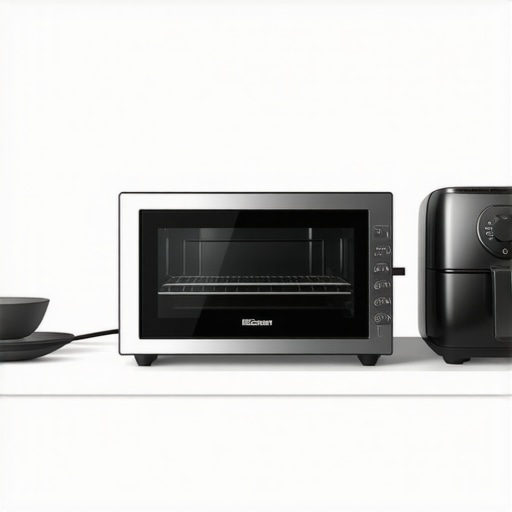
The Truth About High-End Toaster Ovens vs Small Air Fryers
You are being sold a lie by marketing departments that prioritize buzzwords over thermal dynamics. The appliance industry took the existing technology of convection, shrank the cavity, accelerated the fan, and rebranded it as a revolution. I have spent fifteen years designing high-performance kitchens and testing the limits of luxury kitchen equipment. Most of what you hear about air fryers is a half-truth that ignores the engineering reality of heat transfer. The result? High-end homeowners end up with cluttered countertops and inferior browning because they chose a plastic gadget over a precision instrument.
The stake here is not just the five hundred dollars you might drop on a new unit. It is the architectural integrity of your kitchen and the literal flavor of your food. I have seen countless clients regret the purchase of a small air fryer once they realize it cannot handle a standard roasting chicken or a legitimate tray of roasted vegetables. The physics of air frying and convection baking are identical; the only variables are velocity and volume. Understanding these mechanics is the difference between a soggy mess and a perfect Maillard reaction.
The Engineering Reality
A small air fryer is essentially a high-velocity convection heater. It uses a powerful fan to circulate hot air rapidly around food placed in a small, often perforated basket. This proximity to the heating element creates an aggressive environment that dries the surface of food quickly. While this is effective for frozen fries, it often leads to the failure of the crispy wing test because the lack of moisture retention results in tough, stringy protein rather than a succulent interior. The airflow is so turbulent that it can actually blow light ingredients around the chamber, a design flaw the industry rarely discusses.
Contrast this with a high-end toaster oven—or more accurately, a countertop convection oven. These units utilize larger heating elements, often made of high-grade quartz or ceramic, which provide more consistent radiant heat. The internal volume is greater, allowing for a more stable thermal mass. When you open the door of a small air fryer, the temperature drops almost instantly to room level. A heavy-duty toaster oven, built with insulated walls and thick glass, retains its core temperature. This stability is why serious cooks prefer them for delicate tasks. If you want to succeed, you must calibrate your smart oven for precise pastry baking rather than relying on the erratic cycles of a low-cost air fryer.
The Thermal Inertia Gap
Modern air fryers are plagued by thin-walled construction. They rely on the constant movement of air because they have almost no thermal inertia. This is a technical truth: a lightweight appliance cannot hold heat. In a professional setting, we look for mass. Mass means recovery time. If you load a cold steak into a cheap plastic air fryer, the heating element has to work overtime to compensate. In a high-end toaster oven, the internal racks and stone-lined or heavy-gauge metal walls help maintain the environment. The engineering reality is that premium cookware behaves differently when the ambient air temperature fluctuates wildly.
There is also the matter of material safety. Many small air fryers utilize non-stick coatings that cannot handle high-heat cycles over the long term. I have seen these coatings flake off after only six months of heavy use. If you are concerned about your health, you should investigate the truth about PFOA-free coatings in modern air fryer baskets before making a purchase. The high-end toaster oven market typically uses stainless steel or high-density enamel, which offers a much longer service life and better safety profile under intense thermal stress.
Operational Risks and Scars
I remember a specific installation for a client in a high-rise luxury condo. They insisted on a top-of-the-line air fryer that looked sleek but had a poorly designed exhaust port. Within three months, the heat output had discolored their custom cabinetry and caused the adhesive on their backsplash to fail. This is the operational risk of high-heat, high-velocity appliances in tight spaces. Small air fryers vent a massive amount of hot, moisture-laden air through a single point. If that point is directed at a cabinet or a wall, damage is inevitable. Toaster ovens generally vent more traditionally, allowing for better heat dissipation into the room rather than concentrating it against your expensive finishes.
Maintenance is the second-order effect no one likes to discuss. Have you ever tried to clean the fan of a small air fryer? It is a nightmare of grease-coated blades and inaccessible crevices. Over time, that grease goes rancid and smokes. This is why many users complain that their air fryer smells like burnt plastic or old oil. Toaster ovens, with their wider openings and removable racks, are significantly easier to maintain. You can actually reach the heating elements to wipe them down, preventing the accumulation of carbonized food particles that ruin the flavor profile of your next meal.
Market Corrections Ahead
The next 24 months will see a massive consolidation in this space. We are already seeing the emergence of the “Air Fryer Toaster Oven” hybrid, which is effectively a toaster oven with a high-speed fan mode. This is the industry admitting that the standalone air fryer is a limited tool. According to data from the Association of Home Appliance Manufacturers, the growth in the multi-function segment is outstripping single-purpose air fryers. Consumers are waking up to the fact that they don’t need two appliances that do 90% of the same thing. The regulatory landscape is also shifting, with stricter standards on the off-gassing of polymers used in cheap kitchen gadgets.
The Executive Verdict
If your daily routine involves reheating frozen snacks or cooking for one person, a small air fryer is a passable, albeit flimsy, tool. For everyone else—the entertainers, the families, the culinary enthusiasts—the high-end toaster oven is the superior investment. It offers better thermal stability, greater capacity, and a longer lifespan. My recommendation? Buy the best countertop convection oven you can afford. Look for units with at least four heating elements and a fan that can be toggled between standard and high-speed modes. Stop chasing the trend and start respecting the physics of cooking.
Technical FAQ
Can a toaster oven really air fry?
Yes. Air frying is just convection cooking with higher air speed. If a toaster oven has a powerful enough fan and a perforated basket, the results are identical to a dedicated air fryer.
Why do air fryers cook faster?
The small cavity and high air velocity strip away the boundary layer of cool air that surrounds food. This increases the rate of heat transfer, but often at the cost of uneven cooking in thicker proteins.
Are small air fryers a fire hazard?
Any high-heat appliance has risks, but small air fryers often lack the heavy insulation of high-end ovens. The National Fire Protection Association notes that improper clearance around these units is a common cause of kitchen fires.
Do I need a special pan for a toaster oven?
To maximize airflow, use a dark, low-sided pan or a mesh basket. This allows the air to circulate under the food, mimicking the air fryer effect without the structural limitations of a small plastic bucket.