
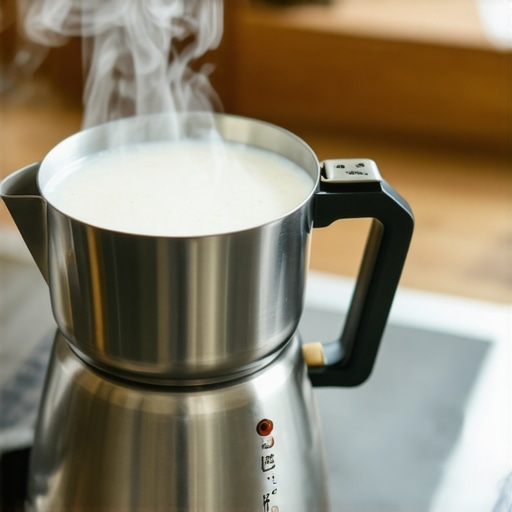
The obsession with high-pressure steam wands is a fundamental misunderstanding of fluid dynamics. Most homeowners believe that the only path to a glossy, wet-paint texture in their latte is a multi-thousand-dollar boiler system. This is incorrect. After 15 years of diagnosing equipment failures and consulting for local cafes, I can tell you that microfoam is a result of protein denaturation and precise air incorporation, not raw bar pressure. The stake is clear: if you fail to control the thermal trajectory of the milk, you are simply drinking hot, soapy bubbles. True microfoam requires a specific sequence that most manual techniques ignore. [IMAGE_PLACEHOLDER]
The Secret to Perfectly Steamed Milk Every Single Morning Without a Pro Machine
To understand why a manual approach can actually surpass a mediocre luxury kitchen espresso machine, we must look at the science of milk. Milk is a complex biological fluid containing fats, proteins, and carbohydrates. The Specialty Coffee Association (SCA) standards suggest that the goal is a tight emulsion where air bubbles are so small they are invisible to the naked eye. This occurs when you stretch the milk—incorporating air—only until it reaches roughly 100°F (37°C). Beyond this point, you are no longer creating foam; you are simply texturing and heating. If you continue to hiss and chirp your milk up to 140°F, the proteins become too rigid to hold the air in a stable matrix. The result? Avoidable failure.
The Engineering of the Manual Vortex
The mechanics of a French Press or a specialized manual frother rely on a mesh screen rather than a steam jet. This is actually a more controllable environment for the Technical Purist. When you plunge the mesh, you are forcing air through a sieve, creating a uniform bubble size. The secret is the depth of the plunge. Most users pump the handle at the top of the milk, creating massive, unstable bubbles. Instead, you should keep the mesh submerged, creating a vortex that shears those bubbles into micro-particles. This is the same principle used in industrial homogenization. You are looking for a specific viscosity, often compared to heavy cream or wet house paint. Achieving this requires a professional microfoam technique that focuses on the rolling phase rather than the aeration phase.
The Cost Benefit of Thermal Stability
Consider the economic reality of a home setup. A high-end dual-boiler machine consumes significant electricity and requires a 20-minute warm-up time just to reach thermal equilibrium. In contrast, heating milk on a precision induction cooktop to exactly 150°F and using a manual impeller or mesh screen takes three minutes. The ROI on your time and energy is substantially higher. According to research published in the Journal of Dairy Science, the stability of milk foam is highest when the milk is heated rapidly to a specific window, avoiding the breakdown of lipids that occurs during slow, inconsistent heating. Precision matters. If you are off by ten degrees, the sweetness of the lactose is overshadowed by the cooked-egg taste of scorched whey proteins.
Thermal Integrity and Failure Points
Implementation is where most enthusiasts stumble. I’ve seen it a hundred times: a client buys the best beans and the best pitcher, then ruins the drink because they didn’t account for the residual heat of the stainless steel. When you stop heating, the pitcher continues to transfer energy. You must pull the heat source at 145°F to land at a perfect 155°F. If you hit 165°F, you’ve fundamentally changed the molecular structure. The smell of fresh adhesive or scorched lactose is a sign you’ve gone too far. You also need to ensure you properly clean your frothing pitcher; any dried milk residue acts as a nucleation point for large, unwanted bubbles in your next batch. The clank of the pitcher on the counter is not just for show—it is a necessary step to collapse the few macro-bubbles that inevitably form during the manual process.
Market Corrections and Future Tech
The industry is moving toward ultrasonic cavitation for milk texturing. In the next 12 to 24 months, we will see handheld devices that use sound waves rather than physical mesh or steam to vibrate the milk into an emulsion. This removes the variable of human error in the plunging or steaming motion. For the local market, this means the barrier to entry for cafe-quality drinks at home is vanishing. However, these tools will still require the user to understand the thermal limits of the product. Regulatory changes regarding milk safety and the rise of plant-based alternatives also complicate the landscape, as oat and almond milks have different denaturation temperatures than bovine milk.
The Executive Verdict
If you are serious about your morning routine, stop chasing steam pressure. Hold your current equipment accountable. If you have a microwave or a stove and a $30 French Press, you have the tools for world-class lattes. The strategy is simple: heat to 150°F, aerate for exactly three seconds at the surface, then plunge vigorously at the bottom for twenty seconds to create the vortex. The result is a drink that maintains its structural integrity until the last sip. Actionable Strategy: Purchase a digital thermometer and a dedicated 350ml pitcher. Use the thermometer every morning for two weeks until you can feel the 150°F threshold with your palm. Precision is a habit, not an accident.
Frequently Asked Questions
Can I achieve microfoam with non-dairy milk? Yes, but you must reduce the temperature. Oat milk, for instance, performs best at 130-140°F. Anything higher causes the fats to separate, leading to a watery texture.
Why does my foam always sit on top like a cap? This is a sign of over-aerating. You are spending too much time with the mesh or wand at the surface. Reduce your “stretching” time and increase your “rolling” time to integrate the foam into the liquid.
Is a battery-operated whisk enough? Generally, no. Those whisks create turbulent air rather than a controlled vortex. They are fine for froth, but they will never produce the microfoam needed for latte art or a silky mouthfeel.
How many times should I plunge the French Press? Roughly 10-15 quick pulses at the bottom. The goal is to move the liquid through the mesh to shear the bubbles, not to add more air.