The Knife Sharpening Error That is Quietly Eating Your Steel
Most luxury kitchen owners are destroying their three-hundred-dollar Japanese steel. It is a tragedy of convenience. After running this company for 15 years, I have seen custom Miyabis and high-carbon Henckels turned into useless shims by well-meaning home chefs. The thesis is straightforward: most consumer-grade sharpening methods are designed for soft, disposable steel, and using them on high-end alloys is an act of mechanical sabotage. If you are using a pull-through sharpener with those aggressive tungsten carbide V-notches, you are not sharpening. You are peeling. You are literally stripping away the life of the blade, creating a jagged, weak edge that will fail under the slightest lateral pressure. The stake here is longevity. A properly maintained high-carbon blade should last a lifetime, but the wrong friction-heavy technique can reduce its lifespan to five years. The result? Avoidable failure.
The Rockwell Hardness Trap
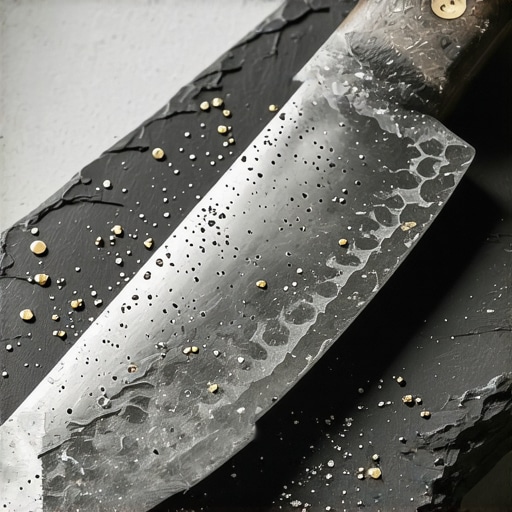
Understanding the molecular lattice of your blade is where we begin. Professional-grade knives usually sit between 58 and 64 on the Rockwell Hardness Scale (HRC). This hardness allows for a steeper, more acute edge, but it also makes the steel more brittle. Generic sharpening tools exert too much downward force. When you drag a 62 HRC blade through a fixed-angle ceramic disc, you risk micro-chipping the apex. I’ve heard the sound—the faint, metallic ‘tink’ of a thousand-dollar set losing its integrity. Instead of a refined edge, you get a serrated mess that catches on tomato skins. Beyond the edge itself, the best way to store high-end chef knives without dulling the blade is a necessary part of this maintenance cycle, because a sharp edge is useless if it is clattering against other steel in a drawer.
Friction and the Heat Affected Zone
Let us discuss the physics of the grind. Friction produces heat. On a microscopic level, the very tip of your knife is incredibly thin—often only a few microns wide. High-speed electric sharpeners can generate localized heat exceeding 400 degrees Fahrenheit in milliseconds. This is enough to ‘draw the temper’ of the steel. When you draw the temper, you soften the metal. You might think you have a sharp edge, but because the steel is now soft, that edge will roll over the first time it hits a cutting board. It is a invisible degradation. You cannot see the soft spots, but you will feel them when the blade stops performing. High-performance magnetic strips for easy access can help prevent accidental impact, but they cannot fix a blade that has been thermally compromised.
Abrasive Grit Mismanagement
The progression of grit is a science, not a suggestion. I see people jump from a 220-grit coarse stone directly to a honing rod. This is a fundamental misunderstanding of metalwork. You must refine the scratches left by the previous abrasive. If you leave deep 220-grit gouges in the steel, those gouges act as stress concentrators. Eventually, the blade cracks at those points. Professional sharpeners follow the standards set by organizations like the American Bladesmith Society, moving from coarse to medium to fine, then finishing with a leather strop loaded with diamond paste. This process aligns the ‘burr’ and creates a mirror polish that glides through proteins. If you are working with reactive metals, preventing rust on high-carbon steel is just as important as the grit you choose, as oxidation can eat into your refined edge overnight.
The Industrial Reality of Thinning
Every time you sharpen, you remove metal. This changes the geometry of the knife. Over time, the area directly behind the edge becomes thicker. If you do not ‘thin’ the primary grind, your knife will eventually feel dull even when the edge is razor-sharp. It becomes a wedge rather than a slicer. This is where most home enthusiasts fail. They focus only on the secondary bevel and ignore the overall architecture of the blade. It requires a steady hand and a low-grit stone to move the shoulders of the knife back. It is messy work. The smell of wet stone and steel slurry is a staple in my workshop, a reminder that real maintenance is a tactile, industrial process. While some might suggest a professional microplane is a better investment for certain prep tasks, nothing replaces a correctly thinned and sharpened chef knife for heavy-duty work.
Future Proofing Your Blades
The industry is moving toward even more exotic alloys—think ZDP-189 or Vanax. These steels are incredible for edge retention but are nearly impossible for a novice to sharpen. As we look toward the next 24 months, we are seeing a shift toward specialized sharpening services that use water-cooled slow-speed grinders like the Tormek system. Local regulations regarding professional kitchen safety are also tightening, placing a higher premium on blades that can pass the ‘paper test’ without effort. We are also seeing a resurgence in hand-forged tools, where the smith’s signature is as much a mark of quality as the steel itself. The second-order effect of this trend is a decline in the popularity of ‘gadget’ sharpeners as consumers realize their high-end investments deserve better treatment.
The Executive Verdict
If you own premium cutlery, stop using pull-through sharpeners immediately. They are the fast-food equivalent of tool maintenance. My recommendation is a Buy/Hold strategy on high-quality whetstones (1000 and 6000 grit) or a scheduled professional service every six months. If you are in a situation where the knife feels like it is ‘pushing’ food rather than cutting it, do not apply more pressure. Stop. Re-evaluate your edge. Investing 20 minutes a month in manual sharpening will save you the five hundred dollars you would spend replacing a ruined set. FAQ: Can I use a honing rod daily? Yes, but a rod realigns the edge; it does not remove metal to create a new one. Is an electric sharpener ever okay? Only if it has adjustable angles and high-quality flexible belts, though manual stones are still superior. How do I know if my knife is ruined? If the edge has visible chips or if the steel has turned blue/black from heat, it requires professional regrinding. Are Japanese knives harder to sharpen? They require more precision because the steel is harder, but they take a much finer edge than Western blades.