
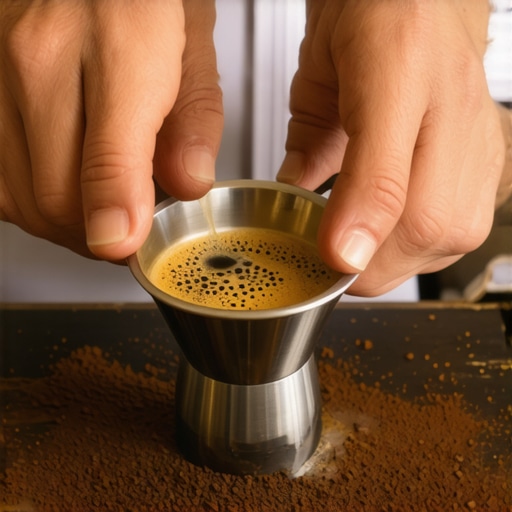
Standard spouted portafilters provide a false sense of security. They funnel multiple streams into one, masking the fact that half your puck might be bone dry while the other half is being over-extracted at high temperatures. In a luxury kitchen environment, precision isn’t a luxury; it’s the baseline. If you haven’t switched to a naked portafilter, you are flying blind. The technical truth? Water is lazy. It finds the path of least resistance with ruthless efficiency. If your tamp is even one degree off-axis, the water will bypass the compressed coffee and create a high-velocity channel. The result? A thin, sour, and watery mess that offends the palate of anyone who knows the difference between a real ristretto and burnt bean juice.
Why Bottomless Portafilters Reveal Your Worst Tamping Habits
The transition to a bottomless portafilter is the moment of reckoning for any home barista. For fifteen years, I have consulted on high-end kitchen installs where the hardware far outpaces the operator. A spouted portafilter hides the ‘tigering’—the beautiful marbling of the crema—but more importantly, it hides the spray. When you see a high-pressure stream shooting toward your cabinet, you have witnessed a catastrophic failure in puck density. This is exactly why your espresso shot is sputtering and destroying your morning flow. The physics of 9 bars of pressure are unforgiving. If your coffee grounds are not distributed with mathematical uniformity, the water will drill a hole through the puck. This is channeling. It turns a potential god-shot into a bitter disaster. You cannot hide this with a bottomless setup. Every flaw is naked. Every mistake is visible.
The Physics of Resistance
Espresso is essentially an exercise in fluid dynamics. The basket acts as a containment vessel where the coffee bed creates the resistance necessary to build pressure. If that resistance is non-uniform, the extraction is uneven. Most enthusiasts think tamping harder is the fix. It is not. Pressure is secondary to distribution. If you have more coffee on the left side of the basket than the right, no amount of tamping pressure will equalize that density. Water will always rush through the less dense side. The result? Over-extraction and under-extraction happening simultaneously in the same basket. To combat this, you should use a distribution tool for every single shot to ensure uniformity before the tamper even touches the grounds. The metallic click of the tamper hitting the basket rim should be a signal of perfect levelness, not a desperate attempt to fix a lopsided mound of grinds.
Identifying the Dead Spot
Look at the bottom of the basket during the first five seconds of the pull. Are there areas where no coffee is flowing? Those are dead spots. They represent air pockets or over-compressed regions where water cannot penetrate. Conversely, if you see one single blonde stream flowing faster than the rest, that is a high-velocity channel. Both indicate a failure in puck preparation. The sensory experience of a perfect shot is distinct: the smell of sweet, caramelized sugars and the weight of a viscous, syrupy body. When it goes wrong, you smell burnt lipids and ozone. Achieving the former requires absolute precision. According to the Specialty Coffee Association (SCA) extraction standards, consistency is the only path to quality. These precision scales for coffee are non-negotiable for serious extraction because a variance of even 0.5 grams changes the entire resistance profile of the puck. If your dose is off, your tamp is irrelevant.
The Hidden Costs of Poor Distribution
Beyond the taste, poor technique has a physical cost. I have seen countless espresso machines with damaged group head gaskets because the user was trying to over-tighten the portafilter to stop the spray. The spray from a channeled shot isn’t just a mess; it’s an abrasive jet of hot water and grit. It eats into your seals. It stains your honed granite. It turns a ten-thousand-dollar espresso machine into a high-pressure squirt gun. The technical purist understands that the equipment is only as good as the maintenance and the method. If you are seeing the puck prep mistake that causes your espresso to spray everywhere, it is time to reassess your vertical tamping angle. Most people tamp with a curved wrist. This is a recipe for a slanted puck. You must tamp with a straight line from your elbow to the tamper. Anything else is an invitation for disaster.
Strategic Implementation for Your Luxury Kitchen
The industry is shifting. We are seeing a move toward automated puck prep even in residential settings. Machines are becoming smarter, but they still cannot compensate for a low-quality grinder or an inconsistent operator. In the next 24 months, expect to see more integrated WDT (Weiss Distribution Technique) tools built directly into high-end grinders. For now, the bottomless portafilter remains the ultimate diagnostic tool. It is the only way to verify that your technical skills match your hardware. The ROI of a bottomless portafilter isn’t in the aesthetic; it’s in the education. It forces you to be better. It demands respect for the craft. If you can pull three identical shots in a row on a naked portafilter, you have mastered the basics of home barismo. If you can’t, you are just making expensive mistakes.
The Executive Verdict
Buy the bottomless portafilter. It will be frustrating for the first week. You will likely spray coffee on your shirt and your walls. But that frustration is the sound of you actually learning. My recommendation? Pair it with a high-quality distribution tool and a calibrated tamper. If you are serious about espresso, there is no other way. This is a ‘buy’ for anyone who values the engineering of a perfect shot. It is a ‘hold’ for those who prefer the convenience of super-automatics. Stop hiding behind spouts. The truth is in the basket. Based on technical reports from the Italian Espresso National Institute, the visual feedback of the extraction is the most reliable indicator of chemical balance. If it looks wrong, it is wrong. Fix the prep, and the flavor will follow.
Frequently Asked Questions
Does a bottomless portafilter change the taste of the coffee? No, not directly. It simply allows you to see the extraction so you can fix the errors that are ruining the taste. However, many find the crema is thicker because it doesn’t have to travel through the metal spouts which can trap heat and oils.
Why does my portafilter spray when I use the bottomless one? This is almost always due to channeling. Your coffee grounds are not distributed evenly, or your tamp is crooked. High-pressure water is finding a hole in the puck and shooting through it.
Is a bottomless portafilter harder to clean? Actually, it is easier. There are no spouts for old coffee oils to hide in. A quick wipe and a rinse, and it is ready for the next shot.
Can I use a bottomless portafilter on any machine? You must match the size (usually 58mm for prosumer machines) and the lug pattern of your specific machine’s group head. Always check your manufacturer’s specs before purchasing.