
The Benefits of a Magnetic Knife Strip for Quick Tool Access
Knife storage is rarely the centerpiece of a renovation, yet it is the pulse of the culinary workspace. After fifteen years designing high-end culinary environments, I have observed a recurring failure: the $10,000 cutlery set buried in a dark, moisture-trapping wooden block. This is more than a design flaw; it is a degradation of the tools themselves. In a modern luxury kitchen, where premium cookware and high-end air fryers compete for every square inch of the island, the vertical plane remains underutilized. Transitioning to a magnetic strip is a strategic shift toward ergonomics and metallurgical preservation.
Traditional knife blocks are effectively petri dishes. Standard cleaning protocols cannot reach the interior of the deep, narrow slots where bacteria and moisture thrive. According to the National Sanitation Foundation (NSF), kitchen tools must be accessible for inspection and easy to sanitize. A magnetic strip exposes the entire blade to the air, ensuring rapid evaporation of residual moisture. This is especially vital for the proper way to store high-carbon knives to prevent rust. High-carbon steel is susceptible to micro-pitting if trapped in a damp environment for even a few hours. The strip eliminates this risk by keeping the steel in an open-air, visible state.
The Engineering of Magnetic Pull Force
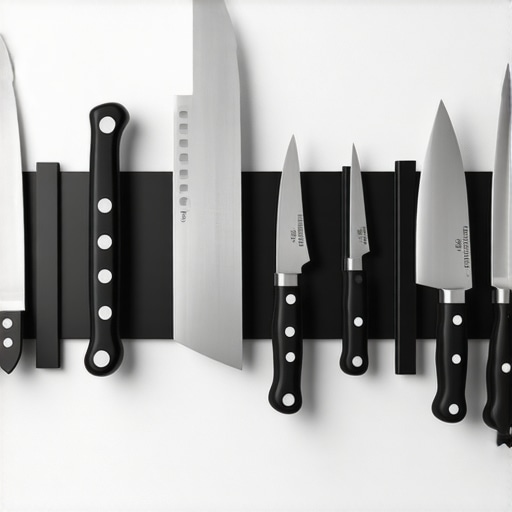
Not all magnetic strips are created equal. The difference between a tool that stays put and a $800 chef’s knife chipping its tip on a quartz countertop lies in the Gauss rating and the type of magnet used. Neodymium (N42 or N52 grade) magnets are the industry standard for a reason. They provide a high-saturation magnetic field that penetrates through the thickest bolsters of premium cookware. Cheap ceramic magnets often fail because their pull-force is uneven, leading to ‘blade tilt’—a dangerous situation where the handle swings downward. [image_placeholder_1] When you ditch the knife block for a magnetic strip, you are investing in the safety of your workspace. A professional installation involves embedding the magnets behind a thin veneer of walnut or silicone to prevent metal-on-metal scratching, which is a common complaint with basic stainless steel strips.
Erasing Motion Waste in Food Prep
Kitchen efficiency is measured in seconds and steps. The ‘Triangle’ layout is outdated; modern design focuses on ‘Work Zones.’ Having your primary tools within a 24-inch reach of your cutting board is a technical requirement for high-output cooking. This is the same principle applied to why we see luxury kitchen upgrades focusing on accessibility. Reaching for a block requires a vertical lifting motion that is repetitive and ergonomically inferior to the lateral ‘grab-and-twist’ of a magnetic strip. For those who frequently switch between prep tasks—using stand mixers for dough while simultaneously dicing aromatics—this speed is indispensable. It is the difference between a fluid workflow and a disjointed one.
Structural Installation and Load Bearing Reality
The failure of a magnetic strip is almost always an installation error, not a magnetic one. Heavy cleavers and long serrated blades exert significant torque. Standard drywall anchors will pull out over time due to the constant shear force of removing and replacing knives. I always insist on mounting into wall studs or using heavy-duty toggle bolts capable of handling 50 lbs of tension. The weight of the industrial grade steel in a professional set is substantial. If your backsplash is tile or stone, diamond-tipped bits are required for a clean penetration that doesn’t crack the surrounding surface. This is a technical truth: the mounting hardware is as important as the magnet itself.
The Future of Integrated Culinary Architecture
We are seeing a shift toward ‘hidden’ magnetic strips integrated directly into the backsplash material or tucked under high-end cabinetry lighting. This minimalist approach allows the beauty of the stone to shine while maintaining the functional benefits of quick access. Just as espresso machines are being built into cabinetry, the tool storage of the future is invisible until needed. This aligns with the broader trend of reducing ‘visual noise’ in the kitchen. Pairing a high-quality magnetic strip with a high-quality end-grain cutting board creates a professional station that rivals any Michelin-star prep area. In the next 24 months, expect to see smart-strips that can detect if a knife has been properly sanitized before being returned to the rack.
Executive Strategy for Tool Management
If you own high-end knives, the block is your enemy. The magnetic strip is the professional choice for hygiene, speed, and blade longevity. My recommendation is a wood-encased neodymium strip mounted at precisely 54 inches from the floor for the average user. This height balances visibility and safety. Avoid the discount strips found in big-box stores; their lack of magnetic saturation is a liability for heavy knives. Invest in a solution that matches the quality of the tools it holds. For those who have invested heavily in their kitchen, this is the logical final step in workflow optimization.
Frequently Asked Questions
Will a magnetic strip magnetize my knives? Over long periods, a slight residual magnetism can occur, but it has zero effect on the cutting performance or the structural integrity of the steel. It is a non-issue for home and professional use.
Is it safe if I have children in the house? Safety is a matter of placement. A magnetic strip can be mounted higher than a block, keeping blades well out of reach of small hands, whereas a block sits on the counter where a child can easily reach the handles.
Can I store ceramic knives on a magnetic strip? No. Ceramic blades are non-ferrous and will not adhere. For those using a mix of materials, a hybrid rack with both a magnetic face and a small shelf is the appropriate technical solution.