Why You Need a High-Quality Tamping Mat to Protect Your Counters
Owning a luxury kitchen equipped with professional-grade espresso machines and premium cookware carries a hidden risk that many homeowners ignore until the damage is visible. After fifteen years of designing high-end coffee stations, I have seen too many thirty-thousand-dollar slabs of Calacatta marble ruined by the simple act of pulling a morning shot. The issue is not the machine; it is the physics of tamping. When you apply thirty pounds of downward force onto a stainless steel portafilter resting on a stone edge, you are creating a point-load stress that most natural stones cannot withstand indefinitely. A high-quality tamping mat is not a mere accessory. It is a fundamental piece of engineering designed to distribute force and save your investment from costly structural failure.
The Physics of Downward Pressure
Every time you engage in puck preparation, you are focusing significant energy into a tiny surface area. If you are making the common puck prep mistake that causes your espresso to spray everywhere, you might be tempted to press even harder to compensate for uneven distribution. Without a high-density silicone barrier, that force travels directly through the metal ear of the portafilter into the countertop. This repeated impact leads to micro-fissures. You might not see them today, but over six months, those microscopic cracks expand, especially in porous stones or high-resin quartz. The result? Avoidable failure. Professional baristas use mats with a Shore A hardness rating specifically calibrated to absorb this kinetic energy without bottoming out.
Structural Integrity of Stone Surfaces
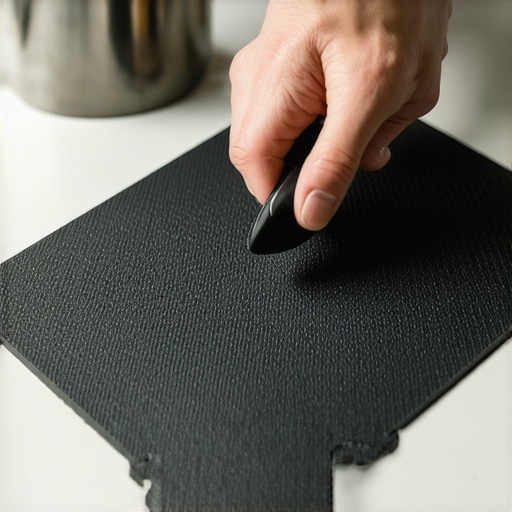
Many homeowners believe that because they have the countertop material that actually survives a hot cast iron pan, it can handle a bit of coffee prep. This is a dangerous assumption. Heat resistance and impact resistance are two entirely different mechanical properties. A tamping mat creates a protective buffer that prevents the metal-on-stone ‘clack’—the sound of your countertop losing its finish. According to the Natural Stone Institute, edge chipping is the most frequent repair in luxury kitchens, often caused by heavy objects or concentrated pressure on the overhang. A wrap-around corner mat provides a 90-degree shield, ensuring the most vulnerable part of your stone remains intact.
[IMAGE_PLACEHOLDER]
Material Density and Force Absorption
The marketplace is flooded with cheap, thin rubber mats that provide a false sense of security. These bargain-bin items fail because they lacks the necessary thickness to provide true deceleration of the portafilter. You need food-grade silicone with a minimum thickness of 10mm. This density ensures that the mat does not compress to a point where the metal eventually touches the stone. When you manage high-end appliances like luxury stand mixers or air fryers, you understand that the interface between the machine and the home is where wear happens. If you stop rinsing your portafilter with cold water between shots, the metal stays hot, and that heat combined with pressure can further accelerate the degradation of low-quality countertop sealants. A heavy mat acts as a thermal and mechanical insulator.
The ROI of Surface Protection
Think of a tamping mat as a cheap insurance policy for your luxury kitchen. A custom stone repair can easily exceed fifteen hundred dollars, whereas a professional-grade mat costs less than a single bag of specialty beans. Beyond the financial aspect, there is the functional benefit of stability. A mat with a high coefficient of friction prevents the portafilter from sliding during the tamp, which is essential for achieving the level tamping required by the Specialty Coffee Association (SCA) standards. Slippage causes uneven extraction, but it also causes scratches. Those fine swirls on your granite are often just dried coffee oils and metal dust from tamping directly on the surface.
Market Trends in Home Barista Stations
We are seeing a massive shift toward integrated coffee bars within residential layouts. The next 24 months will see more homeowners ditching the ‘appliance garage’ for open, professional-style workstations. As espresso machines become more powerful and portafilters become heavier, the mechanical stress on cabinetry and counters will increase. We are also tracking regulatory changes in food-grade material certifications; soon, only platinum-cured silicone will be the standard for high-heat environments. Choosing a mat that meets these foresight standards today means you won’t be replacing it when the industry catches up.
The Final Grade
My recommendation is clear: if you own an espresso machine, you must own a corner-style, heavy-duty tamping mat. Do not settle for flat sheets of rubber. Look for mats with a raised ‘overflow’ rim to catch stray grounds and a thick edge guard. If your kitchen features a honed finish or a delicate marble, this is non-negotiable. Protect the stone, stabilize your shot, and preserve the resale value of your luxury kitchen. The engineering reality is simple: metal always wins against stone unless you put a high-tech polymer in between them.
FAQ
Can I just use a kitchen towel instead of a mat?
No. A towel offers zero impact protection and slides easily, which increases the risk of an uneven tamp and countertop scratching. It also absorbs moisture, which can damage stone sealants over time.
What is the best material for a tamping mat?
Platinum-cured, food-grade silicone is the gold standard. It remains stable at high temperatures, does not off-gas, and has the specific density required to absorb tamping forces.
How do I clean a high-quality tamping mat?
Most are dishwasher safe, but a simple rinse with warm water and a soft brush is usually sufficient. Avoid harsh chemicals that can break down the silicone’s surface tension.
Does the shape of the mat matter?
A corner mat (or ‘drop’ mat) is superior because it protects the front edge of your counter where the portafilter naturally rests during the tamping process.