
The Proper Way to Store High-Carbon Knives to Prevent Rust
High-carbon steel is a temperamental masterpiece. After manufacturing and sharpening thousands of blades over the last 15 years, I have seen more professional-grade steel ruined by poor storage than by actual use on the line. Most home cooks buy a luxury Japanese gyuto or a custom 1095 carbon steel slicer and treat it like a standard stainless steel blade. That is a five-hundred-dollar mistake. High-carbon steel lacks the chromium content—typically 12% or more in stainless—that provides a passive layer of protection against oxygen. Without that barrier, your blade is in a constant state of wanting to return to the earth as iron oxide. If you are serious about your kit, the standard kitchen drawer or a cheap wooden block is effectively an execution chamber for your edge.
The Chemical Reality of Iron Oxidation
To understand storage, you must understand the mechanics of the surface. When liquid water or even high atmospheric humidity contacts the iron in the steel, an electrochemical process begins. Electrons move from the anode (the steel) to the cathode (the water/oxygen interface). The result is red rust (Fe2O3). This is distinct from the ‘patina’—a stable layer of magnetite (Fe3O4) that develops over time and actually helps protect the blade. I tell my clients that a patina is a scar; rust is an infection. According to technical reports from ASM International, the rate of corrosion doubles with every 10-degree Celsius increase in temperature, meaning your knife stored near a steam oven is at 4x the risk. The goal of storage is the total exclusion of moisture and the stabilization of the surface chemistry.
[image_placeholder_1]
Why Wood Blocks Destroy Fine Edges
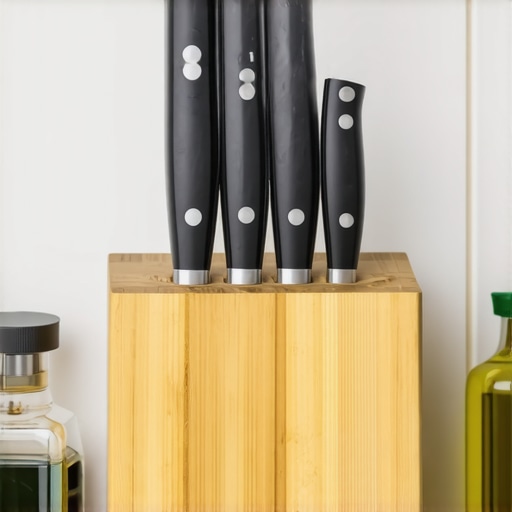
The traditional wood block is a relic of 20th-century marketing, not engineering. Wood is a hygroscopic material; it breathes and retains moisture. If you slide a knife into a wood slot, you are trapping any micro-moisture from the air—or worse, from a blade that wasn’t 100% dry—against the steel in a dark, stagnant environment. This leads to pitting corrosion, which eats deep into the blade’s core. Furthermore, the friction of the edge against the wood every time you draw the knife causes micro-chipping in brittle, high-HRC (Rockwell Hardness Scale) steels. Many people don’t realize that why you should ditch the knife block for a magnetic strip is rooted in both hygiene and metallurgical preservation. You need airflow. Stagnant air is a catalyst for decay.
The Magnetic Strip Efficiency Metric
A wall-mounted magnetic strip is the gold standard, provided it is executed correctly. However, not all strips are equal. A bare metal strip can scratch a polished blade or cause ‘galvanic corrosion’ if the metals are dissimilar. I always recommend a wood-clad magnetic strip. The wood provides a soft landing, while the magnets hold the spine, not the edge. It is vital to ensure the magnets are strong enough to prevent the knife from sliding, as a falling high-carbon blade often results in a snapped tip. Be aware that why most magnetic knife strips fall off the wall often comes down to improper mounting on backsplash tiles—a risk that can cost you a prized collection. When the knife is on a strip, it stays dry because the kitchen’s ambient air circulates around the entire surface area, preventing the moisture traps found in sheaths or drawers.
The Seasoning Protocol for Long-Term Integrity
Storing the knife dry is only half the battle. You must create a physical barrier. For my personal collection, I use food-grade Camellia oil (Tsubaki oil). It is a non-polymerizing oil, meaning it won’t get gummy or rancid like vegetable oils. Just as why pro chefs still use heavy carbon steel skillets for their superior heat properties, they also know that steel needs to be ‘fed.’ Before placing your knife on the strip for the night, apply a single drop of oil and buff it until the blade looks dry but has a faint sheen. This microscopic layer of oil prevents oxygen from reaching the iron atoms. If you find the process tedious, you are using the wrong tool for your lifestyle. High-carbon steel is for the disciplined. For those using carbon steel in their cookware as well, the best oil for seasoning carbon steel pans often translates well to knife maintenance, provided it is food-safe and stable.
Seasonal Humidity and Steel Integrity
The local climate plays a massive role that most national retailers ignore. If you live in a coastal area or a region with high summer humidity, your storage needs to be more aggressive. I have seen knives rust overnight in July because the owner left them out after a late-night prep session. In these environments, even a magnetic strip might not be enough. You may need a dedicated knife roll with silica gel packets or a felt-lined kydex sheath that has been treated with a corrosion inhibitor. Research from Knife Steel Nerds highlights that even high-end ‘super steels’ with higher alloy content still face edge degradation in high-humidity environments through a process called ‘edge rolling’ caused by micro-corrosion at the very apex of the sharpening bevel.
The Executive Verdict
If you own high-carbon knives, your strategy must be: Clean, Dry, Oil, Display. If you are currently using a drawer, stop. If you are using a dishwasher, you have already failed the tool. My recommendation for a high-traffic luxury kitchen is a wood-covered magnetic strip placed away from the sink and stove. For knives that are part of a rotation and won’t be used for more than 48 hours, a light coat of Camellia oil is mandatory. This isn’t about aesthetics; it is about preserving the molecular structure of the edge you paid for. If you cannot commit to a 30-second wipe-down after every use, stick to high-end stainless steels like VG-10 or AEB-L. Carbon steel is a partnership, not a convenience.
FAQ
Q: Can I use mineral oil from the pharmacy?
A: Yes, food-grade heavy mineral oil is acceptable, though it is more viscous and can attract dust more easily than Camellia oil.
Q: Is a leather sheath good for storage?
A: No. Leather is tanned using salts and acids which can actively pull moisture from the air and cause severe pitting on carbon steel. Use wood (saya) or kydex.
Q: My knife has a grey tint; is that rust?
A: No, that is likely a patina. If it is flat, grey, or blue and doesn’t rub off on a paper towel, it is protective. If it is orange, textured, or ‘fuzzy,’ it is red rust and needs immediate removal.
Q: How often should I re-oil a knife on a magnetic strip?
A: In a standard home environment, once a week is sufficient if the knife isn’t being used. If used daily, oil it after every cleaning.