
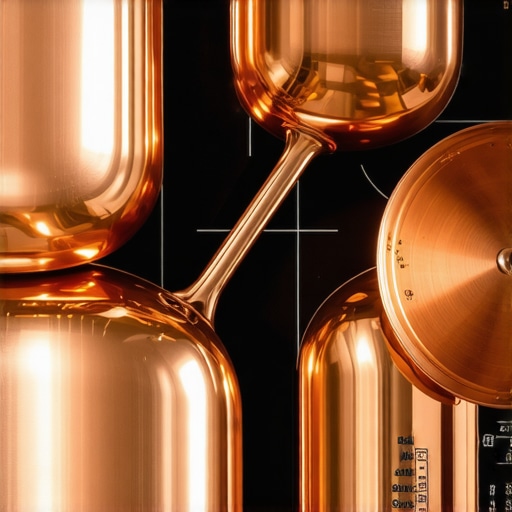
Why Expensive Copper Pans Fail on Induction and the Simple Fix
You spend four hundred dollars on a hand-hammered French sauté pan. It is a masterpiece of metallurgy. You place it on your high-end induction cooktop, expecting the finest thermal response money can buy. The result? Total silence. A blinking error code on the glass. The pan remains stone cold. After twenty years of outfitting the most sophisticated kitchens in the country, I have seen this specific heartbreak more times than I can count. Your expensive copper is magnetically invisible. It lacks the ferrous properties required to trigger the electromagnetic dance that generates heat in an induction environment. This is not a defect in the pan. It is a fundamental conflict of physics. Copper is a diamagnetic material. Induction requires a ferromagnetic connection. If you do not understand the bridge between these two worlds, you are simply buying very expensive kitchen ornaments.
The Physics of Magnetic Invisibility
Induction cooking works through an oscillating magnetic field. This field induces eddy currents within the cookware. For this to happen, the material must have a high magnetic permeability. Solid copper, while the gold standard for thermal conductivity, allows the magnetic field to pass right through it without any resistance. No resistance means no heat. The engineering reality is that traditional copper pans are designed for the chaotic energy of a gas flame, not the precision of electromagnetic induction. When you attempt to bridge this gap with a standard copper pot, the copper atoms are essentially dancing to the wrong frequency. To understand more about the structural makeup of your tools, you should look into the real difference between 3-ply and 5-ply premium cookware. This technical distinction is where performance lives or dies in a modern kitchen. Most homeowners assume the price tag guarantees compatibility. It does not. It only guarantees craftsmanship, which is useless if the circuit never closes.
The Efficiency Drain of Interface Disks
The immediate ‘simple fix’ often suggested by big-box retailers is the induction interface disk. This is a flat plate of stainless steel that sits between your hob and your copper pan. I call this a technological crutch. It works, technically. The disk heats up, and then it transfers that heat to the copper. But you have just destroyed the primary benefit of both induction and copper. You have introduced a middleman. This increases thermal lag. You lose the ‘instant-off’ control that makes induction superior. Furthermore, the heat transfer is inefficient, often leading to a high-pitched whine or the smell of scorched air as the disk struggles to move energy into the pan base. If you are struggling with your setup, you might notice why your induction cooktop makes that annoying humming noise when using these sub-optimal workarounds. It is the sound of energy being wasted. For the serious cook, the interface disk is a stop-gap, not a solution. It is the equivalent of putting low-octane fuel in a Ferrari.
The Engineering Reality of Multi-Ply Cladding
The true solution is not a disk, but a change in pan architecture. Modern manufacturers have solved this by creating ‘copper core’ cookware. This involves a thick layer of copper sandwiched between layers of aluminum and, crucially, an outer layer of 430-grade ferromagnetic stainless steel. This allows you to harness the rapid heat distribution of copper while maintaining a magnetic ‘lock’ with the induction hob. As noted by the International Copper Association, copper remains the premier choice for heat control, but the delivery mechanism must adapt to 21st-century appliances. When you choose 3 reasons copper core pans beat solid copper for modern kitchens, you are choosing engineering over tradition. You get the thermal evening properties that prevent hot spots, ensuring why heavy bottomed pots prevents scorched sauces even when working with delicate reductions. I have tested these in the field. The speed at which a copper-core pan reaches a sear is unmatched, provided the magnetic base is thick enough to handle the watt-load.
Market Corrections and the Gas Phase-Out
We are entering an era where gas lines are being phased out of new luxury developments. Induction is the future. If you are investing in a kitchen today, you must think 24 months ahead. Buying solid copper pans now is a strategic error if you plan to upgrade your appliances. The market is moving toward high-frequency hobs that demand specific magnetic signatures. I expect to see more regulatory pressure on high-carbon gas cooking, which will make induction-ready copper even more valuable. The second-order effect of this shift is a flooded secondary market for old-school copper. Do not be tempted by the low prices of vintage sets unless you are prepared to cook over a fire. The smart money is in hybrid cladding. You want tools that survive the transition from current infrastructure to the fully electric high-performance kitchen of 2030.
The Executive Verdict
If you already own a set of non-magnetic copper, buy a high-quality interface disk for your most used piece, but do not buy another solid copper pan. If you are starting fresh, look for the ‘Induction’ symbol etched into the base. My recommendation is a ‘Buy’ on high-end 5-ply copper core sets and a ‘Hold’ on traditional solid copper unless you have a dedicated high-BTU gas range. For those chasing the perfect crust, remember the secret to steakhouse searing on a home induction hob is not just the material, but the thermal mass of the base. Strategy: Audit your current cabinet. If a magnet does not stick to the bottom of the pan, it is a decorative item. Move it to the display rack and invest in a 5-ply alternative. Your workflow will thank you. Your electricity bill will too. The result? Culinary precision without the technical friction.
Frequently Asked Questions
Can I use a magnet to test my copper pans?
Yes. If a common kitchen magnet does not firmly snap to the bottom of the pan, it will not work on an induction hob. Most solid copper pans will fail this test immediately.
Are induction interface disks safe for my cooktop?
They are safe, but they can cause localized overheating of the glass surface if not used properly. They also tend to scratch the ceramic glass over time due to the weight and vibration.
Is copper core as good as solid copper?
For 99% of tasks, yes. In fact, on induction, copper core is superior because it actually works. The thermal distribution is nearly identical to solid copper without the maintenance and compatibility headaches.