
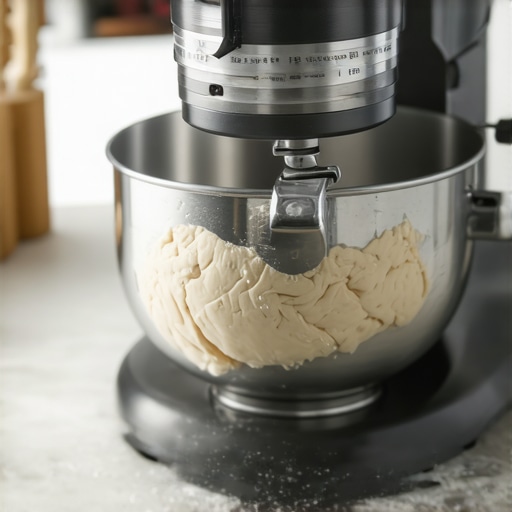
A stand mixer migrating across a luxury countertop isn’t a quirk. It is a failure of mechanical damping. After 25 years in the premium kitchen space, I’ve seen the aftermath of the walk: shattered ceramic bowls, chipped marble edges, and burned-out capacitor boards. When you’re dealing with substantial power tethered to a 28-pound frame, physics eventually wins if the friction coefficient doesn’t hold. The vibration isn’t just an annoyance; it is a structural threat to the appliance’s internal alignment and your kitchen’s surfaces.
The Physics of Torsional Stress in Bread Dough
Bread dough represents the ultimate stress test for any motor. As the dough hook rotates, it encounters varying resistance, creating a rhythmic pulse of kinetic energy. In high-end machines, the difference between AC and DC motors determines how that energy manifests. DC motors provide constant torque at low speeds, which is what bread requires. Conversely, AC motors often pulse to maintain RPMs under load, inducing the very oscillation that causes the machine to walk. If the machine’s feet cannot grip the surface, that energy translates into lateral movement. This is why high torque motors matter for heavy dough; they manage the resistance without the erratic surges that overcome the machine’s static weight.
[IMAGE_PLACEHOLDER]
The Failure of Standard Suction Feet
Many owners believe the rubber feet are permanent stabilizers. They aren’t. Over time, flour dust and grease from the kitchen environment coat these pads, turning a high-friction grip into a low-friction slide. Once the suction is compromised, the machine begins its transit. This is often exacerbated by uneven countertop surfaces. Even a microscopic tilt in a granite slab can dictate the direction of the mixer’s movement. I’ve walked into kitchens where the owner was using a damp towel under the machine—a cardinal sin that reduces friction to near zero once the water acts as a lubricant.
The Engineering Reality of Gear Lash and Vibrational Transfer
When you hear a rhythmic thud, you are hearing gear lash. This is the minute gap between the teeth of the gears. As the dough hook hits the heavy side of the dough mass, the gears slam together. If your machine isn’t equipped with dampening, this shock travels directly to the base. This is why you should only buy stand mixers with all-metal gears. Metal housings and gears provide the mass necessary to absorb these micro-shocks. Plastic gears may be quieter initially, but they lack the density to keep the machine anchored, leading to premature failure and more aggressive counter-walking.
Implementing Mechanical Damping Solutions
To stop the movement, you must address the interface between the mixer and the counter. The most effective method is a dedicated silicone stabilization mat. Unlike a towel, these mats increase the surface area of the friction. Another trick involves the height of the dough hook. If the hook is too low, it creates excessive downward pressure, which can actually lift the rear of the mixer during the upward phase of the rotation, breaking the seal of the rear feet. You can often calibrate your whisk or hook to ensure it isn’t bottoming out and causing this vertical lift. According to industry data from the Association of Home Appliance Manufacturers, improper clearance is a leading cause of localized motor strain.
Market Corrections and Manufacturer Shortcuts
The industry is shifting. For the last decade, manufacturers have prioritized aesthetic over mass. Lighter cast-zinc or aluminum housings are replacing the heavy iron frames of the past. While this makes the machines easier to move for storage, it ruins their stability for bread making. In the next 12 to 24 months, expect to see more smart mixers with built-in accelerometers that automatically throttle the motor if they detect excess vibration. This is a digital fix for a mechanical problem, and in my experience, digital overrides often fail before the mechanical components do. If you see signs that your mixer is overheating, the vibration is likely the precursor to a thermal shutdown.
The Executive Verdict
If your mixer walks, stop the cycle immediately. Clean the feet with isopropyl alcohol to restore the grip. If the machine continues to migrate, your dough hydration is likely too low for the speed setting, or the machine lacks the internal mass for the task. Invest in a heavy-duty silicone mat and keep the speed at level 2—never higher for kneading. This is an operational requirement, not a suggestion. If you ignore the walk, you’re not just risking a mess; you’re inviting a total gear train collapse.
Common Stabilization Questions
Why does my mixer only walk when making sourdough?
Sourdough typically has a lower hydration or a stronger gluten structure than standard white bread, which increases the resistance against the hook and amplifies the torsional forces.
Can I use a rubber mat from the hardware store?
Yes, provided it is food-grade and doesn’t off-gas. Some industrial rubbers can stain light-colored quartz or marble countertops.
How do I know if my gears are already damaged from walking?
Listen for a change in pitch or a metallic clicking. You can also check for gear failure symptoms by looking for grey or black grease leaking from the planetary head.