
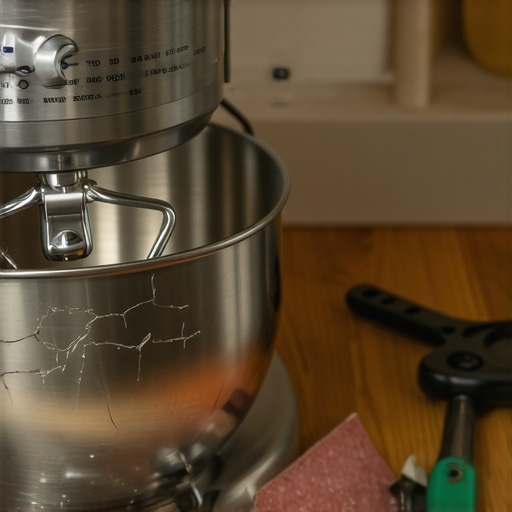
Why Your Stand Mixer Bowl is Chipping and How to Fix It
A chipped stand mixer bowl represents a catastrophic failure of precision engineering that most owners ignore until it is too late. After fifteen years in the high-end appliance sector, I have diagnosed thousands of luxury kitchen setups where minor negligence led to total mechanical breakdown. Chipping is not a cosmetic quirk. It is the physical manifestation of impact-induced spalling. When the beater head repeatedly strikes the bowl surface, the kinetic energy must go somewhere. The result? Fragments of enamel or ceramic in your batter. This is an operational risk that compromises food safety and destroys the integrity of your equipment.
The root cause is almost always a lack of proper calibration. Every machine that leaves the factory requires a specific beater-to-bowl clearance. If this gap is too small, the metal attachment grinds against the base. If you hear a rhythmic, metallic clicking during a high-speed whisking session, you are witnessing the slow destruction of your investment. This isn’t just about the bowl. These micro-impacts travel up the planetary shaft, causing the internal transmission to work against itself. Often, owners find their stand mixer gears are grinding because the vibration from bowl strikes has displaced the internal lubricant. This leads to heat friction and, eventually, a seized motor. Precision is the only thing standing between a perfect meringue and a repair bill.
The Mechanics of Beater-to-Bowl Clearance
To understand the fix, you must understand the ‘Dime Test’—a technical benchmark for the industry. You drop a standard coin into the bowl and run the mixer on low speed. The beater should move the coin roughly half an inch with every rotation. If the coin doesn’t move, the gap is too large. If the coin is pinned against the side, the gap is too small. Adjusting the height screw on the neck of the mixer is the primary solution. A quarter-turn clockwise usually provides the necessary relief. Ignoring this simple calibration is the leading reason why your bowl keeps getting stuck or developing deep gouges in the finish.
Material science plays a massive role in durability. Ceramic bowls offer aesthetic appeal but lack the structural resilience of 304-grade stainless steel. When the dirt under your stand mixer base builds up, it can actually tilt the bowl by a fraction of a millimeter. In a machine where clearances are measured in microns, that tilt is enough to initiate contact. Stainless steel bowls will dent or scratch, but ceramic and glass will shatter or flake. For those running heavy-duty doughs, understand that high-torque scenarios cause the head of a tilt-head mixer to lift slightly. This ‘head-bounce’ is a primary driver of chipping. If you are struggling with low-hydration bread dough, the upward pressure forces the beater into the sides of the bowl with violent force.
The Engineering Reality of Component Failure
The sensory anchors of a failing mixer are unmistakable. You smell the ozone of a struggling motor. You feel the heat radiating from the planetary assembly. You see the grey streaks in your frosting. Those streaks? That is metal-on-metal wear. According to the National Sanitation Foundation standards, any surface that exhibits pitting or chipping is no longer food-safe. Once the protective coating is breached, the underlying substrate—often cast aluminum or carbon steel—is susceptible to oxidation. Fixing this requires more than just a new bowl; it requires a systematic reset of the mixer’s geometry. If the base plate is loose, no amount of height adjustment will stop the chipping. The stability of the locking mechanism is the foundation of the entire operation.
Strategic Foresight for the Luxury Kitchen
Looking at the next 24 months, the market is shifting toward ‘smart’ mixers with load sensors. These sensors will theoretically shut down the motor if they detect the resistance of a bowl strike. However, until that tech is universal, the responsibility lies with the operator. We are seeing a trend where manufacturers reduce the gauge of the steel in their bowls to lower production costs. This makes them more prone to warping under heat or heavy loads. My advice to clients is simple: invest in a heavy-gauge, aftermarket stainless steel bowl and perform a clearance check every six months. Regulatory changes regarding PFOA and PTFE coatings mean that newer non-stick bowls may be even more delicate than the ones they replace.
The Executive Verdict
If your bowl is currently chipping, stop using it. The risk of ingesting sharp particulates is too high. Replace the bowl with a high-polish stainless steel variant and recalibrate your height screw immediately. For those in high-volume environments, consider a bowl-lift model over a tilt-head; the structural rigidity of the twin arms drastically reduces the chance of misalignment. The longevity of your premium cookware depends on your willingness to respect the physics of the machine. Precision isn’t optional.
Frequently Asked Questions
Can I sand down a chipped ceramic bowl?
No. Sanding breaches the structural glaze and exposes porous material that traps bacteria. Replace the unit.
Why does my mixer only chip when making bread?
Bread dough exerts high vertical force, causing the mixer head to flex upward and then snap back down, striking the bowl base.
Is a glass bowl more durable than ceramic?
Glass is more prone to catastrophic shattering from thermal shock or impact, whereas ceramic tends to flake. Neither matches the durability of steel.
How often should I check the beater clearance?
Perform the ‘Dime Test’ every six months or whenever you notice a change in the sound of your machine.