Why Your Kitchen Needs More Than One Cutting Board
A single cutting board in a luxury kitchen is more than a minor inconvenience; it is a fundamental breakdown in culinary logistics. After 15 years of designing high-end culinary environments and specifying everything from commercial-grade stand mixers to prosumer espresso machines, I have seen that the humble board is the most neglected tool in the arsenal. Homeowners invest five figures in premium cookware and air fryers but treat their prep surface as a singular, catch-all utility. This is a strategic error. A single board creates a bottleneck that compromises food safety, flavor integrity, and the lifespan of your most expensive cutlery.
The Physics of Surface Porosity and Blade Retention
The interaction between a forged steel blade and a prep surface is pure engineering. When you use a high-carbon Japanese knife on a generic, worn-out plastic board, you are effectively destroying the edge geometry. Hardness matters. We measure it on the Janka scale for woods, but in the realm of synthetic materials, we look at density and recovery. A dedicated board for proteins should be non-porous and high-density. Conversely, your produce board requires a different grip profile. If you are still using those thin, warped sheets, you should consider why you should swap your plastic cutting boards for TPE. Thermoplastic Elastomers offer a self-healing surface that won’t harbor the microscopic bacteria colonies that typical HDPE boards do after a few months of heavy use.
Technical truth: Wood is not your enemy, but it is a specialist tool. End-grain maple or walnut acts like a vertical bundle of straws. The knife blade slides between the fibers rather than severing them. This preserves the edge. However, using that same end-grain board for raw poultry is a sanitation nightmare. Once salmonella or E. coli enters those vertical fibers, you are relying on the natural antimicrobial properties of the wood tannins, which have a limit. You need a separate, dishwasher-sanitizable station for proteins to maintain a professional standard of hygiene.
The Cross-Contamination Reality
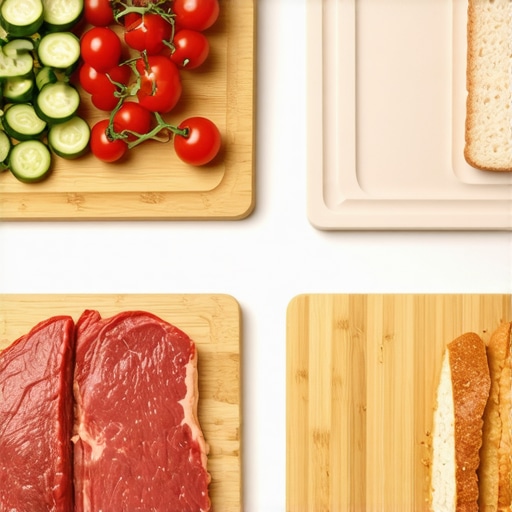
Imagine the smell of fresh garlic. Now imagine it infused into a ripe cantaloupe. This is the sensory failure of the single-board kitchen. High-sulfur aromatics like onions and leeks leave behind volatile organic compounds that bond with porous surfaces. No matter how much you scrub, a board used for aromatics will ghost those flavors into the next item. In professional scullery layouts, we advocate for a tri-board system: one for proteins, one for aromatics, and one for clean produce and breads. This prevents the ‘allium ghosting’ that ruins delicate desserts or fruits prepared for a morning spread.
Safety is the primary driver here. According to the USDA Food Safety and Inspection Service, cross-contamination is a leading cause of foodborne illness in the home. A dedicated color-coded or material-coded system is the only way to eliminate human error during high-speed prep. If your board moves during this process, the risk of injury increases exponentially. You can mitigate this by learning how to stop your cutting board from sliding on the counter, a technical necessity for any serious chef.
The Economics of Specialized Prep Surfaces
The cost of a high-end knife set often exceeds the cost of a luxury air fryer. Protecting that investment is a matter of ROI. If you use a single, hard glass or stone board, you are dulling your blades 50% faster than on a proper wood or TPE surface. This leads to more frequent professional sharpening, which removes metal and shortens the life of the tool. In my experience, a ‘Technical Purist’ approach to boards saves thousands in the long run. Just as you wouldn’t use the wrong pan for induction—which you can test by understanding the pan thickness test—you shouldn’t use the wrong board for your knives.
The Stress Test: What Happens When You Fail to Specialize
I recall a client in a high-rise luxury apartment who insisted on a single, massive marble slab for all kitchen prep. It looked stunning. It was also a disaster. The marble was too hard, causing her bespoke German knives to chip. Worse, the slab was porous enough to absorb beet juice, creating a permanent purple stain that ruined the aesthetic of her premium cookware. The weight of the industrial-grade steel knives hitting that stone was a discordant clatter that ruined the kitchen’s ambiance. We eventually transitioned her to a modular system. We used high-performance synthetics for high-moisture tasks and end-grain wood for dry prep. The result? A functional, quiet, and sanitary workspace. Even high-end non-stick surfaces have their limits, similar to how ceramic non-stick pans lose their slide over time if mistreated; cutting boards follow a similar decay curve when misapplied.
The 2025 Market Shift: Beyond the Standard Board
The industry is moving toward integrated prep stations. We are seeing a surge in ‘workstation sinks’ where boards are designed to sit on integrated ledges. This is a strategic move to contain the ‘wet zone’ of the kitchen. In the next 12 months, expect to see more boards infused with silver ions for permanent antimicrobial properties and boards featuring built-in digital scales for precision baking. As we integrate more tech into the kitchen, the board remains the physical interface between the chef and the ingredient. It cannot be an afterthought.
The Executive Verdict
Buy a system, not a board. If you are serious about your kitchen’s performance, you need a minimum of three surfaces. One: A large, heavy end-grain wood board for all dry vegetable prep and slicing (it stays on the counter). Two: A medium-sized TPE or high-grade plastic board for raw proteins (it goes in the dishwasher). Three: A small, nimble board for quick tasks like lemons for an espresso-based drink or garnishes for a cocktail. This setup protects your health, your flavors, and your expensive cutlery.
Frequently Asked Questions
Can I use one side of the board for meat and the other for vegetables?
No. This is a common operational failure. Juices from raw meat can easily migrate to the ‘clean’ side via the counter surface or during handling. Use separate boards entirely.
How often should I oil my wooden boards?
Once a month is the industry standard. Use food-grade mineral oil. If the wood looks thirsty or light in color, the structural integrity is at risk of cracking.
Are glass cutting boards ever acceptable?
Never. Glass is harder than knife steel. Using a glass board is essentially a commitment to dulling your knives instantly. They are decorative platters, not prep surfaces.
What is the best material for raw chicken?
High-density polyethylene (HDPE) or TPE. Both are non-porous and can withstand the high heat of a dishwasher cycle, which is necessary to kill pathogens.