
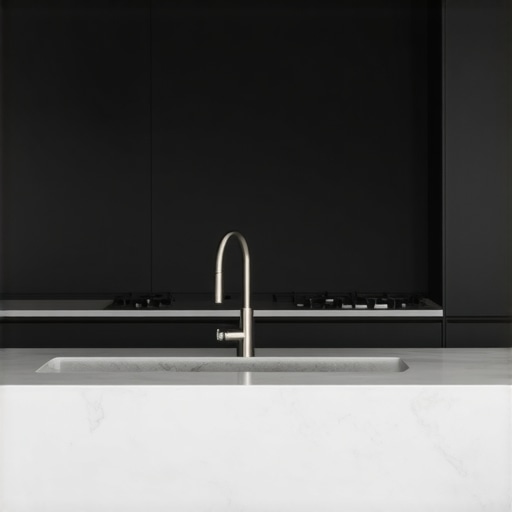
Why Your Kitchen Island Needs a Dedicated Prep Sink
An island without a water source is just a very expensive table. In two decades of overseeing high-end residential builds, I have seen homeowners spend $200,000 on cabinetry only to find their workflow bottlenecked because they refused to run a half-inch copper line to the center of the room. The stake here is not just convenience; it is the fundamental efficiency of a professional-grade kitchen. When you are juggling the preparation of a multi-course meal, crossing the primary traffic lane to rinse a single stalk of celery is a failure of design. It creates friction. It invites accidents.
The Mechanical Reality of Zone-Based Design
Modern culinary spaces have evolved beyond the traditional work triangle. We now design in zones. A dedicated prep sink creates a secondary workstation that allows the primary sink to remain a cleanup hub. This separation is essential when you have a household that utilizes premium cookware or multiple espresso machines. The physics of the space change. By installing a sink on the island, you effectively double the usable square footage of your prep area. Most people ignore the drainage slope requirements. A secondary sink requires a 1/4-inch-per-foot drop for the waste line, often necessitating a specialized venting solution like an AAV (Air Admittance Valve) if you cannot tie back into the main stack. Understanding why your kitchen sink needs an offset drain is vital here, as it preserves the precious storage space underneath that island for your heavy-duty stand mixers. This isn’t about luxury; it’s about hydraulic logic.
Consider the cost-benefit of this installation. At the framing and rough-in stage, adding an island sink might cost between $1,500 and $3,500 depending on your slab or crawlspace access. Attempting to retro-fit this after the quartzite counters are installed? You are looking at a $10,000 disaster involving concrete cutting or floor demolition. The math favors the proactive.
When Implementation Hits the Reality of Use
Things break when they are poorly planned. I’ve walked into kitchens where the prep sink was so small it was effectively a birdbath. If you cannot fit a medium-sized colander in it, it is a waste of stone. Then there is the splashing. High-arc faucets look stunning but, without a deep basin, they turn your luxury kitchen island into a splash zone. I remember a project in the hills where the client insisted on a shallow hammered-copper sink. Beautiful? Yes. Functional? No. Every time they rinsed greens for the air fryers, the surrounding marble was soaked. The result? Premature etching of the stone. You need a minimum depth of 8 inches. Furthermore, the noise of a garbage disposal inside an island can be deafening in an open-concept home. You must specify sound-dampening insulation or a high-torque, low-RPM motor to avoid ruining the ambiance of the dining area.
Integrating this with other tools is key. Proper prep efficiency relies on proximity. If the sink is more than three steps from your primary cutting surface, you’ve missed the mark. This is an operational risk that national design chains often miss because they focus on the render, not the recipe.
Future Market Shifts and Regulatory Foresight
Looking at the next 24 months, we are seeing a massive shift toward integrated water filtration at the prep site. High-end buyers no longer want bottled water; they want chilled, sparkling, and boiling water on tap. According to the National Kitchen & Bath Association (NKBA), multi-functional water stations are a top priority for 2025 renovations. We are also seeing stricter municipal codes regarding “island venting.” Some jurisdictions are moving away from island loops in favor of more robust mechanical venting. This affects your ROI of a high-end kitchen renovation. A kitchen that is not up to the 2025 code will face valuation dings during the inspection phase of a sale.
The Executive Verdict
If your island is longer than six feet, a prep sink is a mandatory requirement, not an option. It is the difference between a kitchen that works and a kitchen that looks like it works. My recommendation: prioritize a deep, under-mount stainless steel basin with an offset drain. This configuration maximizes your cabinet storage and provides the durability needed for high-acid food prep. Avoid trendy materials like thin-gauge fireclay for the island; stick to 16-gauge steel or composite granite. The strategy is simple: build for the workflow you want, not the one you currently tolerate.
Frequently Asked Questions
Does a prep sink really add resale value?
Yes. In the luxury tier, buyers look for dual-operator capabilities. If two people can cook without bumping into each other, the home sells faster and at a premium.
What is the ideal size for an island sink?
Aim for at least 15 to 18 inches in width. Anything smaller becomes a glorified glass rinser and loses its utility for washing produce or filling large pots.
Is a garbage disposal necessary for a prep sink?
It is highly recommended. Prep sinks handle the bulk of organic waste—peelings, scraps, and trimmings. Without a disposal, you will be constantly clearing the drain strainer, which defeats the purpose of a high-efficiency zone.
Will an island sink take up too much storage?
Not if you plan correctly. By using an offset drain and compact plumbing, you can still fit pull-out trash bins or a localized water heater in the cabinet below.