
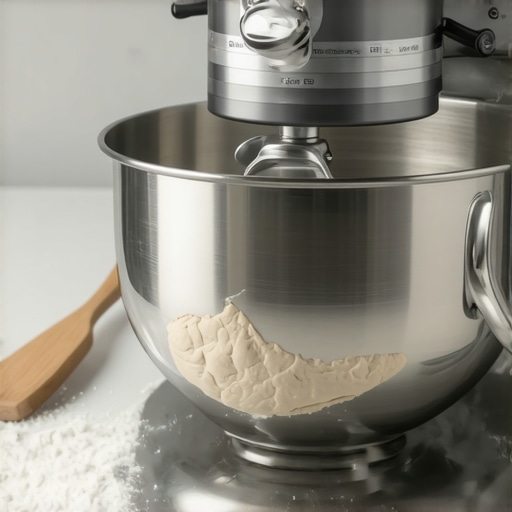
Why Your Dough Always Sticks to the Stand Mixer Bowl
Dough sticking to the bowl is not a minor annoyance; it is a mechanical failure that compromises the structural integrity of your bread. After fifteen years of diagnosing high-end kitchen failures, I have seen thousands of home bakers blame their recipes when the real culprit is a fundamental misunderstanding of surface tension and motor torque. The financial loss of wasted organic flour and ruined sourdough starters adds up, but the loss of texture is the true cost. If your dough is climbing the hook or clinging to the stainless steel walls like industrial adhesive, you are fighting a losing battle against physics.
The mechanics of kneading require a precise balance between the friction of the bowl and the elasticity of the gluten network. Most premium cookware manufacturers opt for highly polished 18/10 stainless steel because it looks magnificent in a luxury kitchen. However, that mirror finish can actually create a vacuum effect with high-hydration doughs. When the dough cannot ‘grip’ the side to be pulled back by the hook, it simply smears. This is why many professional-grade machines feature a brushed interior. The microscopic texture provides the necessary resistance to allow the dough to pull away from the surface during the development phase. You might find that why your stand mixer needs a spiral hook specifically for sourdough is the technical missing link in your setup, as the spiral geometry pushes dough downward rather than pulling it up.
The Hydration Friction Matrix
Hydration levels are the primary driver of sticking. A 60% hydration dough behaves predictably. Move that to 80% for a ciabatta or a modern sourdough, and the rules change. At these levels, the water is not fully bound within the flour’s protein structure during the initial mix. This free water creates a capillary bridge between the dough and the bowl. To fix this, you must understand the ‘Technical Truth’ of temperature. Friction during the kneading process raises the dough temperature. As the dough warms, the lipids soften and the gluten becomes more relaxed—and more adhesive. According to research from the Bread Bakers Guild of America, even a three-degree shift in final dough temperature can be the difference between a clean bowl and a sticky disaster.
The Engineering Reality of Motor Torque
Heat is the enemy. Standard AC motors found in entry-level machines struggle with heavy, wet doughs. They compensate for the load by drawing more current, which generates internal heat that transfers through the transmission and down the planetary head into your dough. This secondary heating accelerates the sticking problem. This is exactly why every serious home baker needs a high-torque DC motor. DC motors run cooler and maintain consistent RPM under heavy loads, preventing the thermal creep that ruins dough consistency. The result? A cleaner release and a better crumb.
Implementation Risks and Mechanical Failures
What happens when you ignore these signals? I’ve seen it often. A client calls because their machine is whining. The smell of ozone—burning motor brushes—fills the air. They were trying to force a 1000g batch of stiff rye through a machine with nylon gears. The gears stripped. The batch was lost. But the technical failure started with the dough sticking. When dough sticks, it creates uneven drag. This oscillation puts immense lateral stress on the center post. You must monitor the ‘clank’ of the planetary head. If it is shifting more than a few millimeters, your dough is not kneading; it is anchoring. You need to learn how to stop your stand mixer from overheating during heavy bread dough kneading before you cause permanent mechanical damage.
Market Corrections and Future Trends
The industry is moving toward intelligent sensors. In the next 12 to 24 months, we expect to see more luxury kitchen appliances incorporating infrared dough temperature sensors and load-sensing logic. These systems will automatically adjust RPM or pause the cycle to prevent the dough from reaching the ‘adhesive threshold.’ This is a necessary evolution as home bakers move toward more complex, high-hydration recipes that were previously the domain of commercial bakeries using massive spiral mixers. We are also seeing a shift in bowl materials, with more ceramic and specialized coated options entering the premium market to combat the sticking issues inherent in polished steel.
The Executive Verdict
If your dough is sticking, do not just add more flour. That ruins your baker’s percentages. Instead, check your dough temperature. Use a brushed bowl if possible. Switch to a spiral hook for anything over 70% hydration. Invest in a machine with a DC motor if you bake more than twice a week. The goal is precision, not guesswork. Stop fighting the machine and start managing the physics of the mix.
Technical FAQ
Does the bowl temperature matter during the initial mix?
Yes. Cooling your bowl in the refrigerator for 20 minutes before mixing high-hydration dough can offset the friction heat generated by the motor, keeping the dough below the stickiness threshold.
Why does my dough stick even with low hydration?
This usually indicates under-developed gluten or a bowl that has a residue of fat or detergent. Ensure the bowl is ‘squeaky clean’ and extend your autolyse period to allow the flour to fully hydrate before kneading begins.
Is a coated dough hook better than stainless steel for sticking?
Coated hooks (typically nylon or Teflon-free ceramic) offer better release for enriched doughs like brioche, but for heavy sourdoughs, a solid stainless steel spiral hook is superior for structural durability.