
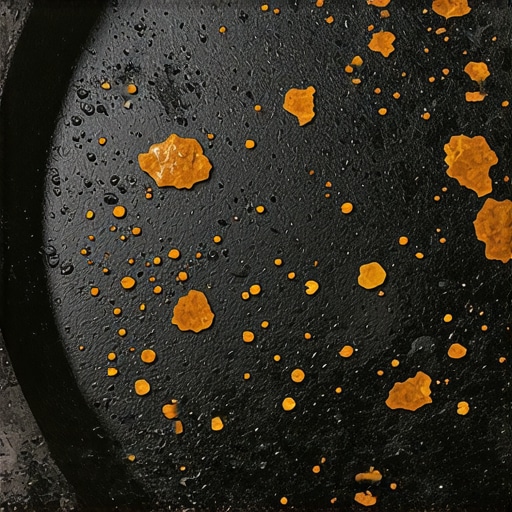
Black flakes on your expensive ribeye are not a badge of honor. They are the physical evidence of a broken chemical bond. After running this company for 15 years, I have seen thousands of pieces of premium cookware fail because owners confuse carbonized food with actual seasoning. Getting this wrong is not just an aesthetic issue; it ruins the thermal efficiency of your pan and compromises the surface of every meal you cook. If you see soot-like debris, your seasoning process is fundamentally flawed. The culprit? Brittle polymerization. Many home chefs treat their luxury kitchen tools like disposable hardware, but cast iron requires an understanding of metallurgy and fat chemistry. When fats are heated, they undergo polymerization, turning from liquid oil into a hard, plastic-like substance that bonds to the iron. If this bond is weak, it shears off. The result? Avoidable failure.
Why your cast iron pan is peeling in black flakes
The peeling you see is not the iron itself. It is a layer of seasoning that failed to anchor. This happens when the oil is applied too thick or the heat is insufficient to complete the cross-linking of the fatty acids. In the world of high-end culinary tools, precision is non-negotiable. If you have been using fats with low smoke points, you are essentially painting your pan with a layer of glass that has the structural integrity of a potato chip. You might think why you should never use olive oil to season your cast iron is just a suggestion, but it is a technical reality. Olive oil contains impurities and solids that burn before they can polymerize, leading to that flaky, black mess. True seasoning requires a high-smoke-point oil like grapeseed or a specialized flaxseed blend, though even flaxseed has been known to be too brittle for heavy daily use. The chemistry must be exact. If the oil is too thick, it creates a sticky, soft layer. When that layer eventually dries out under high heat, it loses its grip on the metal and begins to flake.
The Science of Brittle Polymerization
Think of seasoning as a structural coating. Under a microscope, cast iron is porous, resembling a jagged mountain range. The oil must fill those valleys and then harden into a monolithic sheet. If you introduce moisture or use an oil that breaks down at low temperatures, you create voids in that sheet. I often see clients who treat their cast iron like their air fryers, expecting a ‘set it and forget it’ experience. It doesn’t work that way. Thermal expansion also plays a role. Iron expands when heated. If the seasoning layer is too thick or contains trapped carbon (burnt food), it cannot expand at the same rate as the metal. The mechanical stress literally snaps the seasoning off the surface. This is why thin layers are superior. You want multiple microscopic coatings, not one thick glaze. This same principle applies when you transition to other high-performance metals; for instance, understanding the proper oil to use when seasoning a new carbon steel pan can prevent these exact issues before they start.
Thermal Shock and Chemical Erosion
Beyond the oil type, the way you clean and heat the pan dictates its lifespan. A common mistake is ‘burning off’ stuck food. While it seems efficient, hitting a seasoned pan with extreme heat without new oil leads to the oxidation of the seasoning. It turns the protective layer into dry carbon. It smells like a campfire and looks like charcoal. That charcoal has no adhesive properties. Another silent killer is acidity. If you are simmering tomato sauce for three hours in a fresh pan, the acid is eating the bond between the iron and the oil. I have watched $200 skillets stripped to grey metal because of a basic sauce error. Once that bond is compromised, the rest of the surface follows. It starts as a small pit and spreads like a windshield crack. This isn’t just about ‘flavor’—it’s about the engineering of the cooking surface. High-quality stand mixers or espresso machines have internal components to manage friction; your cast iron relies entirely on this thin, polymerized skin to prevent sticking. If you want results like the secret to perfectly seared scallops in carbon steel, the surface must be a continuous, smooth plane of hardened fat.
Industry Shift toward Raw Performance
The market is shifting. Over the next 12 to 24 months, we are seeing a massive move away from ‘pre-seasoned’ convenience toward raw, high-grit finishes that allow the user to build a custom surface. Professional chefs are abandoning the heavy, pebbled surfaces of mass-produced iron for smooth, machined finishes. This requires more skill but offers a significantly better release. We are also seeing a convergence in technology where the precision of an espresso machine’s PID controller is being mirrored in high-end induction ranges to provide the exact temperatures needed for perfect polymerization. Regulatory bodies like the ASTM are continually refining standards for metal purity in cookware to ensure that heavy metals don’t leach when seasoning fails. You must stay ahead of these changes by treating your cookware as a technical asset. Poorly maintained iron is a liability to your kitchen’s efficiency and the quality of your output. Proper storage is also a factor; I always recommend the best way to organize heavy dutch ovens in a low cabinet to avoid chipping the edges of your seasoning through physical impact.
The Executive Verdict
If your pan is peeling, stop cooking. The flakes are not toxic in small amounts, but they indicate a surface that is no longer performing. My recommendation is a full reset. Use a chainmail scrubber or high-grit sandpaper to remove the failing layers. Do not just season over the flakes; you will only trap the instability. Strip it to the base. Once you see the grey iron, start over with ultra-thin layers of grapeseed oil, heating the pan until it just begins to smoke, then buffing it dry while hot. Repeat this five times. This is the only way to ensure a bond that lasts. The ‘Buy/Sell/Hold’ on your current pan? Hold, but reinvest in the surface. Cast iron is a 100-year tool, but only if the person behind the handle understands the chemistry of the sear. Don’t let laziness dictate your culinary results. Take the time to build the bond correctly. According to reports by the NIST, material integrity is paramount in high-heat applications, and your kitchen is no different. Apply precision, or expect failure.
Frequently Asked Questions
Is the black peeling dangerous to eat?
It is mostly carbonized oil and food. While not acutely toxic, it is unappetizing and can contain trace amounts of acrylamides from burnt organic matter. It’s best to strip and re-season.
Why did my pan start peeling after I used soap?
Modern dish soap usually won’t strip seasoning, but if your seasoning was already weak or brittle (due to using the wrong oil), the surfactants can get under the flakes and accelerate the peeling process.
Can I just scrub the flakes off and keep cooking?
No. If it’s peeling in one spot, the surrounding areas are likely compromised. You’ll end up with uneven heat distribution and sticking. A full strip and re-season is the professional’s choice.
What is the best oil for a permanent bond?
Grapeseed oil offers an excellent balance of a high smoke point and a flexible polymer chain that resists flaking. Avoid flaxseed if you live in a very dry climate or use the pan for high-heat searing, as it can become too glass-like and brittle.