
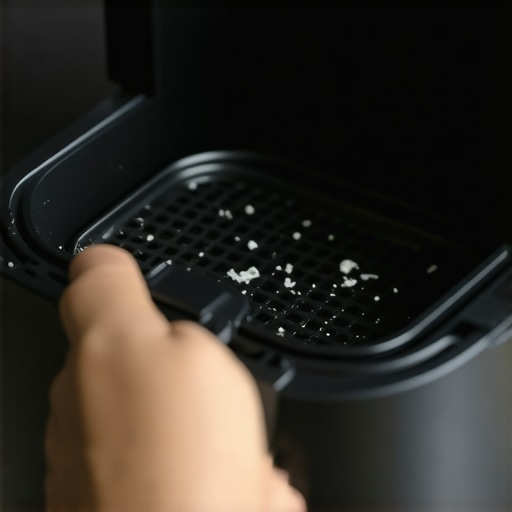
Why Your Air Fryer’s Basket Coating Is Flaking and What to Do
Peeling non-stick coatings are not a suggestion of wear; they are a definitive signal of structural failure. When those black flecks appear on your morning bacon, you are looking at the disintegration of a polymer bond that was never engineered for the thermal cycles you have put it through. After fifteen years in the high-end appliance sector, I have seen hundreds of these baskets fail, and the cause is rarely ‘accidental.’ It is a fundamental mismatch between the physics of high-velocity heat and the limitations of cheap Polytetrafluoroethylene (PTFE) or low-tier ceramic applications. If your basket is flaking, the integrity of your food is compromised. The stakes are high. Ingesting these coatings is not the goal of a luxury kitchen experience.
The Engineering Reality of Thermal Stress
The core issue lies in the coefficient of thermal expansion. Most air fryer baskets use an aluminum or thin steel substrate coated with a non-stick layer. These materials expand at different rates. When the heating element hits 400 degrees Fahrenheit, the metal expands quickly, tugging at the rigid coating. If the bond isn’t industrial-grade, the coating cracks. These microscopic fractures allow steam and fats to migrate underneath the surface. This is where why ceramic coatings fail faster than traditional non-stick becomes evident. The resulting pressure from trapped moisture turns into a localized explosion of sorts, lifting the coating away from the metal. The result? Total delamination. It is a predictable failure of cheap manufacturing masquerading as premium convenience.
The Corrosive Impact of Modern Cleaning
Chemical interference is the second culprit. People treat their air fryers like cast iron or stainless steel, but the chemistry is fragile. High-pH dishwashing detergents act as a slow-motion solvent on the adhesives used in many mid-tier air fryers. You think you are cleaning; you are actually etching. This is why many find that how to deep clean the top heating element without breaking it is just as important as the basket itself. If you use an abrasive pad—even the ‘non-scratch’ variety—you are creating micro-scores. Once the air fryer’s high-velocity fan kicks in, these scores catch the wind. The mechanical force of the air literally peels the loosened edges back like a sunburn. It is a violent environment inside that small chamber, and only the highest-spec coatings survive the friction of air-suspended grease particles.
When the Luxury Build Fails
Even in the luxury kitchen segment, I have seen $500 units fail within six months. I remember a specific client who insisted on using spray-on oils with soy lecithin. That lecithin is a gummy nightmare. Under heat, it creates a carbonized bond with the coating that is stronger than the coating’s bond to the basket. When you try to scrub the residue off, the coating comes with it. It was a mess—the acrid smell of scorched oil and the gritty texture of gray flakes on their expensive steaks. This is why the the truth about non-stick air fryer liners and airflow interference is a topic we discuss often. Protecting the surface often means compromising the very convection that makes the machine useful. You have to decide if you want a tool that lasts or a tool that is easy to hide.
Market Corrections and the Shift to Stainless
The industry is moving toward a tipping point. Within the next 18 months, I predict a massive shift toward full stainless steel or glass baskets in the high-end market. Regulatory bodies like the European Chemicals Agency (ECHA) are tightening the net on PFAS and similar compounds. We are seeing a move away from chemical non-stick toward mechanical non-stick—think laser-etched patterns and higher-density metals that require less intervention. The ‘operational risk’ of continuing to use flaking baskets is no longer just about the food; it’s about the liability of the brands. If your current model is shedding, do not wait for it to get worse. There is no ‘fix’ for a failed coating. You cannot paint it back on. You cannot ‘season’ it like a wok. Once the bond is broken, the basket is a liability.
The Executive Verdict
If your basket is flaking, stop using it immediately. My recommendation is a ‘Hard Sell’ on replacement. Do not attempt to buy ‘universal’ replacement baskets that do not seat perfectly; they disrupt the airflow and can lead to the heating element overcompensating. This is how you end up needing to know the reason your air fryer fan is rattling and how to fix it. If you are in the market for a new unit, prioritize baskets made from 304-grade stainless steel or those with heavy-duty ceramic that is fired at higher temperatures than standard consumer gear. The investment up front saves the cost of replacing the entire unit every two years.
Technical FAQ
Can I sand down the flaking part and keep using it?
Absolutely not. Sanding exposes the raw aluminum or base metal, which is not intended for direct food contact at high temperatures and will continue to oxidize and leach into your food.
Are silicone liners a safe temporary fix?
They prevent contact with the flakes, but they also kill the airflow efficiency. You’ll end up with soggy food and a stressed heating element. It’s a band-aid on a broken leg.
Does ‘PFOA-Free’ mean it won’t flake?
No. PFOA-free only refers to one specific chemical used in the manufacturing process. It has nothing to do with the physical durability or the ‘stickiness’ of the coating’s bond to the basket.
How do I know if it’s burnt grease or flaking coating?
The ‘Nail Test’ works. Burnt grease is usually raised and can be chipped off with a wooden scraper. Flaking coating is a loss of material, leaving a pit or showing the shiny metal underneath.