
Why Your Air Fryer Fan Is Making a Strange Vibrating Noise
A high-end air fryer is not merely a toaster with a fan. It is a precision convection engine designed to circulate air at velocities exceeding 2,000 RPM. When you hear a rhythmic vibration or a harsh rattle, you are listening to a mechanical failure in the making. After fifteen years of diagnosing hardware failures in the luxury kitchen space, I have found that homeowners often mistake these noises for minor quirks. They are not. A vibrating fan indicates an imbalance that puts excessive radial load on the motor bearings. If ignored, the friction generates localized heat, eventually melting the polycarbonate housing or seizing the motor entirely. The cost of a replacement unit far outweighs the effort of a diagnostic check. The stake is simple: your appliance’s lifespan and, in extreme cases, fire safety in your high-end kitchen.
The Engineering Reality of Convection Fans
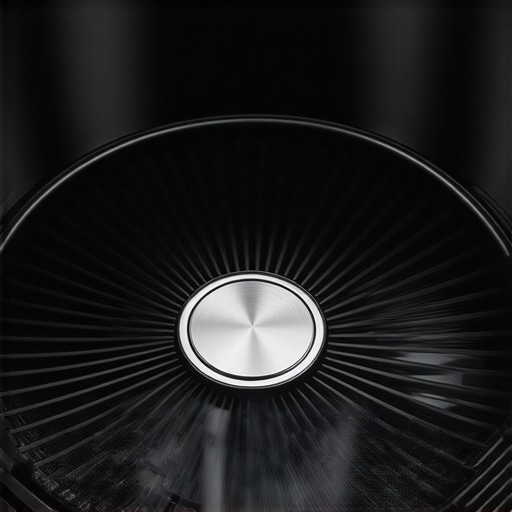
To understand the noise, you must understand the assembly. The fan in a premium air fryer consists of a high-speed motor, a drive shaft, and a multi-blade impeller. These components are balanced at the factory within a fraction of a gram. However, the environment inside an air fryer is hostile. Rapid thermal cycling—going from room temperature to 400 degrees Fahrenheit in minutes—causes materials to expand and contract at different rates. If the impeller is made of a different alloy than the shaft, the fit can loosen over time. This creates a minute gap. At high speeds, that gap allows the fan to wobble. This is the ‘Technical Truth’ that most manuals ignore: the vibration is often a result of ‘eccentricity,’ where the center of mass no longer aligns with the axis of rotation. This leads to a resonance frequency that makes the entire chassis shake. If you have been exploring healthy cooking technology, you know that performance relies on consistent air velocity. A vibrating fan cannot maintain that velocity, leading to uneven heat distribution and mediocre results.
The Imbalance of Carbonized Grease
There is a messy reality to air frying that most marketing avoids. As you cook, microscopic oil droplets are suspended in the air. These droplets eventually settle on the fan blades. Over hundreds of cycles, this grease carbonizes, turning into a hard, uneven crust. Think of it like a car tire that has lost a balancing weight. Even a half-gram of carbonized debris on one blade is enough to trigger a violent vibration at 2,000 RPM. You might notice a smell—a sharp, acrid scent of old oil being reheated. This is a sensory anchor for a failing system. Furthermore, many users unknowingly exacerbate this by using heavy liners. Understanding the airflow interference from silicone liners is critical, as restricted intake forces the fan to work harder, increasing the torque and stress on the mounting screws. When those screws back out even a millimeter, the vibration turns into a metallic clank.
The Power Draw and Motor Stress
We also have to consider the electrical load. Luxury appliances are sensitive to voltage fluctuations. Most high-capacity air fryers pull between 1,500 and 1,800 watts. If your appliance is sharing a line with other heavy hitters, the motor might experience ‘brownout’ conditions where it struggles to maintain torque. This jittery power delivery can manifest as an inconsistent fan hum that mimics a vibration. I always advise clients that a dedicated circuit requirement is not just a suggestion; it is a fundamental necessity for protecting the induction motor inside your device. Without stable current, the electromagnetic field in the motor remains uneven, causing the rotor to ‘cog’ and vibrate against the stator.
Market Corrections and the Shift to Brushless Motors
The industry is currently at a crossroads. Over the next 12 to 24 months, we expect a shift toward high-torque brushless DC (BLDC) motors in the luxury air fryer segment. These motors are significantly quieter and offer precise speed control, which reduces the harmonic vibrations that plague current AC-motor models. Regulatory changes regarding energy efficiency are also forcing manufacturers to adopt better aerodynamics. You will likely see more stainless steel impellers and fewer plastic components, as metal retains its shape better under extreme thermal stress. This second-order effect will make appliances more durable but also more difficult for the average consumer to repair without specialized tools. We are moving toward a ‘sealed unit’ philosophy where reliability is high, but the ‘right to repair’ becomes a technical challenge.
The Executive Verdict
If your air fryer is vibrating, do not wait for it to ‘settle in.’ It won’t. If the unit is under warranty, file a claim immediately citing ‘mechanical imbalance in the blower assembly.’ If it is out of warranty, your first step is a deep clean of the fan blades using a non-corrosive degreaser and a soft brush. If the noise persists after cleaning, the bearings are likely shot. My recommendation? If you own a budget model, replace it. If you own a luxury model, seek professional recalibration. Your strategy should be preventative: clean the intake vents monthly and avoid overloading the basket, which creates backpressure.
Frequently Asked Questions
Is it safe to use an air fryer that is vibrating?
No. Vibration indicates mechanical stress. It can lead to the fan shattering or the motor overheating, creating a fire risk.
Can I oil the fan motor myself?
Most modern air fryer motors use sealed bearings. Attempting to oil them often just attracts more dust and grease, worsening the problem.
Why does the noise stop after the unit warms up?
This is usually due to thermal expansion. The metal shaft expands and temporarily tightens the fit of a loose fan blade. However, the underlying wear is still occurring.
Does fan vibration affect cooking time?
Yes. An unbalanced fan moves less air. This reduces the efficiency of the convection, leading to longer cook times and soggy food.