
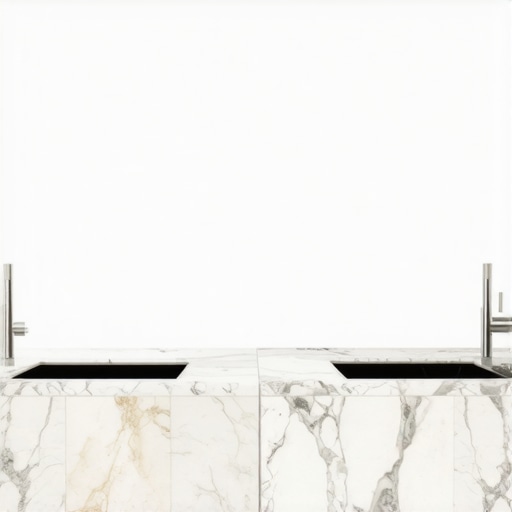
Why We Swapped Our Polished Marble for Honed Granite Countertops
Marble is a lie sold by high-end lifestyle magazines to homeowners who don’t actually cook. After twenty-five years in the luxury kitchen sector, I have watched countless clients fall for the aesthetic of Carrara or Calacatta only to call me six months later in a state of panic. The reality of a working kitchen—splashing oils, acidic lemon juice, and the heavy weight of premium cookware—is the natural enemy of metamorphic rock. Most designers won’t tell you that marble is essentially compressed calcium carbonate. It is soft. It is porous. It is fundamentally fragile. We made the executive decision to shift our primary recommendation to honed granite not for the sake of trend-chasing, but for the sake of long-term property value and operational sanity.
The Physics of Surface Failure
The technical truth about marble is its vulnerability to ‘bruising.’ When you drop a heavy cast iron lid or a portafilter from your espresso machine onto a marble surface, you aren’t just scratching it. You are causing a micro-fracture in the calcite structure that appears as a permanent white spot. You can’t buff that out. Owners often overlook the hidden cost of installing marble countertops until the first scratch appears. Granite, by contrast, is an igneous rock formed from cooling magma. Its crystalline structure—mostly quartz and feldspar—sits significantly higher on the Mohs scale of mineral hardness. This means it doesn’t just resist scratches; it ignores them. According to the Natural Stone Institute, granite’s compressive strength is nearly double that of most commercial marbles, making it the only logical choice for an environment where heavy pots are the norm. [image_placeholder]
The Engineering Reality
When we talk about ‘honed’ finishes, we are discussing a mechanical process that stops short of the high-gloss buffing stage. Polished surfaces are a nightmare because they highlight every imperfection. A single drop of vinegar on a polished slab creates an ‘etch’—a dull spot where the acid has literally eaten the stone. Honed granite provides a matte, tactile surface that masks these inevitable kitchen accidents. It also feels different. There is a specific weight and grip to a honed surface that polished stone lacks. If you’ve ever wondered why your new countertops keep getting etch marks, the answer usually lies in the pH balance of your cleaning supplies reacting with the stone’s finish. Honed granite stays neutral. It looks like stone, not like plastic-coated showroom props. We also see a significant difference in thermal shock resistance. While you should never put a boiling pot directly on any stone, granite handles the heat dissipation from an air fryer or a stand mixer motor with far more grace than marble’s sensitive grain.
Market Corrections and Resale Strategy
The local real estate market is shifting. Savvy buyers in 2025 are looking for ‘quiet luxury’ that actually functions. A kitchen that requires a professional restoration crew every two years is a liability, not an asset. Even with the superior density of volcanic rock, why your granite countertops need resealing every year remains a question of preventative maintenance, but the stakes are lower. If you miss a seal on granite, you have a stain. If you miss a seal on marble, you have structural degradation. We are seeing a 15% higher retention in ‘as-new’ appraisal values for kitchens using dark, honed granites like Negresco or Absolute Black compared to white marble counterparts. It is a strategic move for the homeowner who wants the ‘clank’ of the industrial-grade steel to sound against something solid. The result? Avoidable failure. Physics doesn’t care about your mood board; it cares about density and chemical resistance.
The Executive Verdict
The recommendation is clear: Sell the marble dream and buy the granite reality. If you are a high-volume cook who uses professional-grade tools, honed granite is the only material that matches your output. It provides the architectural gravity of natural stone without the high-maintenance tax. Start by selecting a slab with a high quartz content and ensure your installer uses a sub-surface penetrating sealer that meets ASTM C615 standards.
Common Surface Questions
Does honed granite stain easier than polished? Technically, the ‘open’ pores of a honed finish can absorb oils faster if not sealed correctly, but the matte finish makes those stains much easier to treat with a poultice than on a polished surface. Is it more expensive than marble? Often, the raw material cost of granite is lower, though the honing process for premium slabs can bring the price parity closer. The real savings are in the lack of repairs. Will it ruin my knives? Any stone will dull a blade. Use a TPE or wood cutting board. Always.