Why Every Home Cook Needs a Set of Heavy-Duty Mixing Bowls
Most home kitchens are currently outfitted with equipment that is fundamentally unfit for purpose. After twenty years in the professional culinary supply chain, I have seen thousands of ‘luxury’ kitchens equipped with thin-gauge, rattling bowls that flex under the simple pressure of a hand whisk. This is not just an aesthetic gripe. It is a mechanical failure. If your bowl moves while you are trying to emulsify a sauce, you are fighting the physics of your tools rather than focusing on the chemistry of your food. Precision requires a fixed point of reference. In a kitchen, that fixed point is your mixing bowl. Lightweight bowls are liabilities that introduce variables you cannot control.
The Engineering Reality of Centripetal Stability
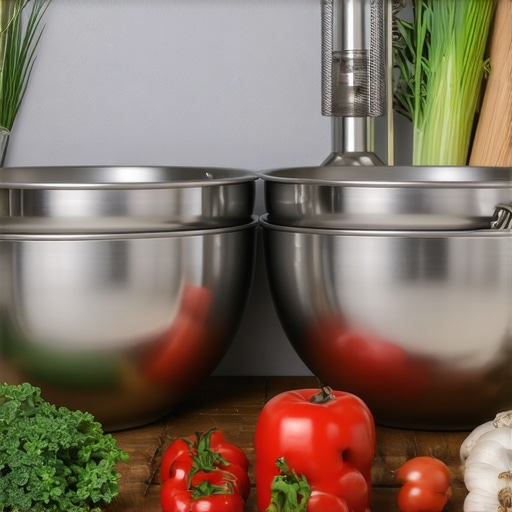
When you are whisking at high speeds, you are applying significant lateral force. A cheap, thin-walled bowl lacks the mass to dampen these vibrations. The result? Kinetic energy is wasted as the bowl skids across the countertop. Professional-grade bowls—typically those forged from 18/10 stainless steel with a minimum thickness of 0.8mm to 1.0mm—rely on their own weight to stay anchored. This is the same principle I discuss when explaining the weight test for stand mixers. Mass equates to stability. Without it, you are chasing your ingredients around the workspace. According to the American Iron and Steel Institute (AISI), the density and composition of high-grade chromium-nickel alloys provide not just corrosion resistance but the structural rigidity needed to withstand high-torque manual mixing without deformation.
Thermal Inertia and Ingredient Tempering
Temperature control is the difference between a successful meringue and a flat mess. Thin bowls are susceptible to rapid ambient temperature shifts. If you are working in a warm kitchen, a thin steel bowl will heat up almost instantly, potentially breaking your fats or over-proofing your dough. Heavy-duty bowls possess higher thermal inertia. They hold their temperature. This is why pros often chill their heavy bowls before whipping cream; the metal stays cold long enough to complete the task. This concept is vital for home bakers who often wonder why high-torque motors matter for heavy dough—it is all about maintaining a consistent environment for the ingredients under stress. A heavy bowl acts as a thermal buffer, protecting your work from the fluctuations of a home environment.
The Structural Integrity of 18/10 Stainless Steel
I have seen countless ‘discount’ sets where the bottom of the bowl is so thin it can be popped in and out like a piece of tin. This ‘oil-canning’ effect is a sign of inferior manufacturing. It ruins the surface area for whisking and makes it impossible to use an immersion blender without the risk of the blade catching the metal. High-end bowls are often manufactured to meet NSF International standards for food safety and durability, ensuring they do not pit or leach even when exposed to highly acidic marinades. When you invest in a heavy-duty set, you are buying tools that will outlast your oven. The weight of industrial-grade steel feels different in the hand. It doesn’t ping; it thuds. It doesn’t flex; it resists.
Economic Realities and Market Trajectory
The cost of raw nickel and chromium is rising. Over the next 18 months, the ‘middle market’ for cookware will likely disappear, replaced by ultra-cheap disposable sets and high-end professional gear. Buying a professional set now is a hedge against future inflation in the manufacturing sector. Many consumers think they need massive capacity, but the reality is that a balanced set of three heavy bowls is more efficient than ten cheap ones. We often see this confusion when people think 30-quart mixers are necessary for home use. They aren’t. What is necessary is the quality of the contact point. A heavy bowl allows for better leverage, faster emulsification, and less physical strain on the cook’s wrist and shoulder.
The Executive Verdict
If your mixing bowls feel like they could be crushed by a strong grip, get rid of them. They are sabotaging your technique. Look for ‘commercial-grade’ or ‘heavy-gauge’ labels. Avoid anything with a plastic rim, as these are points of failure where bacteria can hide and structural integrity is compromised. A true heavy-duty bowl should be a single, seamless piece of high-grade steel. If you are serious about your kitchen output, prioritize mass over quantity. The result? Superior texture, better temperature control, and a tool that lasts a lifetime.
Professional Kitchen Standards FAQ
Q: Why is 18/10 steel better than 18/0?
A: The ’10’ represents the nickel content, which provides the luster and, more importantly, the superior corrosion resistance. 18/0 is magnetic but will rust and pit much faster under the stress of dishwashers and acidic foods.
Q: Do silicone bottoms help or hurt?
A: They provide grip, but they can degrade over time in high-heat dishwashers. A truly heavy bowl shouldn’t need a silicone base to stay put; its own weight should provide the necessary friction.
Q: Are glass bowls a viable heavy-duty alternative?
A: Glass has mass, but it lacks the thermal conductivity and durability of steel. Drop a heavy steel bowl, and you have a dent. Drop a glass bowl, and your dinner is full of shards. For high-intensity cooking, steel is the only logical choice.