
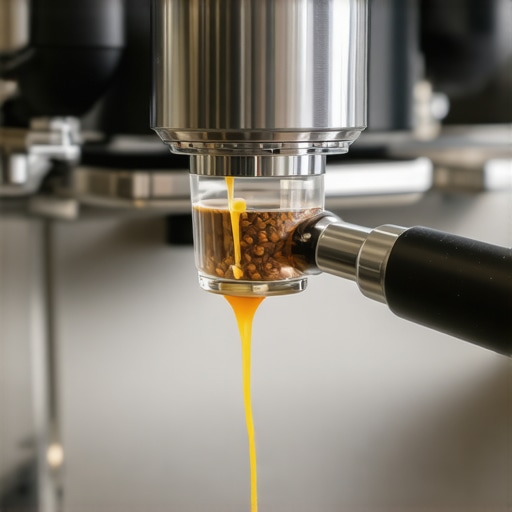
Why Bottomless Portafilters are the Best Diagnostic Tool for Your Coffee
Spouted portafilters are the equivalent of a black box for espresso. You see the liquid exit the pipes, but you have zero visibility into the thermal and physical chaos occurring inside the basket. After fifteen years of tearing down high-end espresso machines and consulting for local cafes, I can tell you this: if you are using a closed handle, you are guessing. You aren’t brewing; you’re hoping. The naked portafilter removes the safety net. It forces you to confront the reality of your puck prep. This isn’t about the aesthetics of a flowing honey-like stream for social media. It is about identifying the specific failure points in your extraction process that lead to bitter, thin, or sour shots.
The Physics of Channeling
When nine bars of pressure hit a puck of coffee, the water seeks the path of least resistance. In a standard portafilter, any ‘jetting’ or ‘channeling’ is hidden as the liquid converges into the spouts. By the time it hits your cup, the evidence is blended. A bottomless design reveals these flaws in real-time. You will see blonding spots, multiple streams that refuse to merge, or violent sprays. These are not random errors. They are direct indicators of uneven density. I often see home baristas invest in luxury kitchen setups only to ignore the best barista tools for achieving perfect espresso distribution. Without a clear view of the basket bottom, you cannot know if your tamping is level or if your grinder is producing excessive boulders that create voids.
[IMAGE_PLACEHOLDER]
Why Spouted Handles Mask Failure
The internal floor of a spouted portafilter acts as a mixing chamber. This chamber tempers the visual cues of a bad shot. For instance, if the left side of your puck is over-extracting and the right side is under-extracting, the spouts mix these two disparate fluids into a seemingly ‘decent’ crema. You taste the imbalance—that confusing mix of ash and lemon—but you can’t diagnose the source. The naked handle exposes the ‘dead zones’ where water barely penetrates the grounds. It highlights the importance of using 6-pressure-sensitive tamper sets that end 2026 channeling. The feedback is instantaneous. If the flow starts at the edges before the center, your tamping technique is flawed. The result? Avoidable failure.
The Reality of Thermal Stability
Metal has mass. A spouted portafilter requires significant time to reach thermal equilibrium with the group head. If that metal is cold, it sucks the heat right out of your extraction, leading to a sour, underextracted mess. Bottomless portafilters have less mass. They heat up faster and interfere less with the water temperature calculated by your machine’s PID. This is a technical truth: the less distance the coffee travels over external metal surfaces, the closer your cup profile stays to your intended recipe. In my experience, even high-end premium cookware users forget that espresso is a game of heat management. Eliminating the spouts is the easiest way to remove a thermal variable from your morning routine.
The Mess Factor as a Learning Tool
You will get sprayed. Your air fryers sitting nearby might get a mist of espresso. The backplate of your machine will look like a Jackson Pollock painting. This is the ‘stress test’ of the bottomless experience. When your portafilter sprays everywhere, it is telling you exactly where your puck collapsed. Most people quit here. They go back to the spouts because they want a clean counter. But the spray is the signal. It tells you that your grind is too coarse or your distribution is uneven. If you can’t handle the mess, you won’t master the craft. The sound is different too. A perfect extraction has a soft, viscous hiss. A channeled shot sounds like a tiny, aggressive faucet. Listen to the machine.
Strategic Foresight for 2026
We are seeing a shift in the local market. Customers are moving away from stand mixers and generic appliances toward professional-grade laboratory tools for their kitchens. In the next 12 to 24 months, I expect manufacturers to phase out spouted portafilters as the ‘default’ for prosumer machines. The demand for transparency in extraction is too high. We are also seeing a rise in the use of the puck screen secret for a cleaner espresso group head. This combination—a bottomless view and a puck screen—is the 2026 gold standard for home extraction. It reduces maintenance and maximizes clarity.
The Executive Verdict
My recommendation is a firm ‘Buy’ on the bottomless portafilter, but only if you are willing to fix what it reveals. If you want convenience, stick to the spouts and accept mediocre coffee. If you want to understand the fluid dynamics of your brew, the naked handle is mandatory. It is the only way to verify that your $3,000 machine is actually doing its job. Stop hiding your mistakes in a metal tube. Buy the tool, embrace the spray, and fix your puck prep. Your palate will thank you once the bitterness of channeling disappears. According to the Specialty Coffee Association (SCA) standards, extraction uniformity is the primary driver of quality; the bottomless portafilter is the only tool that makes that uniformity visible.
Frequently Asked Questions
Does a bottomless portafilter change the taste? It doesn’t change the taste directly, but it allows you to see and fix channeling, which drastically improves the flavor profile by eliminating uneven extraction.
Why is my portafilter spraying? Spraying is caused by ‘channels’ where water blasts through a weak point in the coffee puck. This usually means your grind is too coarse, your coffee is old, or your tamping is uneven.
Is it harder to clean? Actually, it is easier. There are no internal nooks or spouts for old coffee oils to build up and go rancid. A quick wipe and it is sterile.
Can I use it with any machine? You need to match the diameter (usually 58mm or 54mm) and the lug pattern of your specific group head. Not all portafilters are cross-compatible across brands.
Comments are closed.