
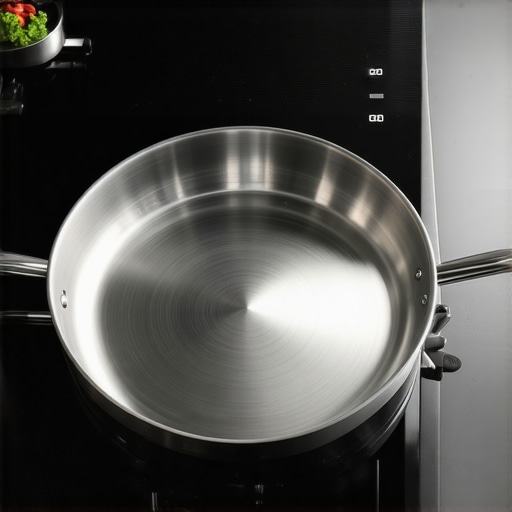
Why 5-Ply Pans Are the Best Choice for Induction Cooktops
Induction cooking is not a traditional heat transfer process. It is an electromagnetic event. After two decades of designing high-performance culinary environments, I have seen homeowners spend $5,000 on a high-end induction range only to throttle its potential with subpar metal. The standard 3-ply pan—once the gold standard—fails the stress test of modern magnetic oscillation. If you want thermal stability, you need mass. You need 5-ply construction. This is not about marketing fluff; it is about metallurgical integrity under rapid thermal cycles. The stake is simple: use thin cookware and you risk permanent warping and catastrophic hot spots. I have watched $400 sauté pans turn into spinners on a glass cooktop because the owner ignored the physics of thermal expansion.
The Physics of Energy Transfer
Induction works by creating a magnetic field that excites iron molecules in the cookware, generating heat directly within the pan. This process is instantaneous. In a 3-ply pan, the aluminum core is often too thin to distribute this sudden surge of energy before the outer steel layers begin to expand. The result? A localized heat zone that scorches your protein while the edges remain tepid. Why 3-ply construction is the minimum standard for luxury cookware is a baseline, but for induction, it represents an operational risk. 5-ply vessels utilize alternating layers of stainless steel and aluminum (or sometimes copper), creating a thermal buffer. This layering slows the initial shock, forcing the heat to move laterally across the entire cooking surface. According to research from the Association of Home Appliance Manufacturers (AHAM), consistent contact between the pan base and the induction glass is the primary driver of energy efficiency. A 5-ply base maintains that contact by resisting the ‘bowing’ effect caused by high-wattage power settings.
The Structural Resonance Problem
If you have ever heard a high-pitched whine or a rhythmic buzzing when you turn on your stove, you are hearing material failure in real-time. This resonance occurs when the layers of the pan are not bonded with enough density to withstand the magnetic pull. Cheaply made clad cookware has micro-gaps. Why your induction stove makes your pans hum and how to stop it often comes down to the mass of the vessel. 5-ply pans are inherently heavier and more ‘dead’ to these vibrations. The extra layers act as a dampening system. You can feel the difference. The weight of the industrial-grade steel feels substantial in the hand, providing a tactile assurance of quality. This mass also prevents the pan from ‘skating’ across the glass when you are whisking a delicate emulsion.
[IMAGE_PLACEHOLDER]
Thermal Momentum and Recovery
Professional chefs value 5-ply for its thermal momentum. When you drop a cold 12-ounce ribeye into a pan, the surface temperature plummets. On an induction range, which lacks the ambient heat of a gas flame, this temperature drop is even more pronounced. 5-ply pans act as a heat battery. They store more energy, allowing for the secret to getting restaurant-quality sears on induction ranges without the range constantly cycling to catch up. I remember a client in a high-rise project who insisted on thin, ‘fast-heating’ pans. She couldn’t understand why her scallops were grey instead of golden. We replaced her set with 5-ply copper-core clad steel. The problem vanished. The thicker walls held the heat, ensuring the Maillard reaction occurred immediately upon contact.
Operational Risks of the 2025 Market
As we look toward the next 12 to 24 months, we are seeing a shift in appliance manufacturing toward ‘Power Boost’ modes that exceed 3,700 watts on a single burner. This is a massive amount of energy. Traditional cookware standards from ten years ago cannot handle this. We are seeing an increase in ‘delamination’—where the layers of the pan literally pull apart due to extreme heat differentials. This is a permanent failure. Materials science reports from ASM International suggest that the shear stress between mismatched metals (like steel and aluminum) is the leading cause of cookware lifespan reduction in the induction era. Investing in 5-ply is a hedge against these higher power outputs. It is a long-term economic play. You buy the right tool once, rather than replacing warped pans every three seasons.
The Executive Verdict
For those building or upgrading to a luxury kitchen in 2025, the decision is binary. If you use induction, 5-ply is the only logical choice for high-heat searing and precision simmering. Buy a 5-ply set with a full-clad construction (extending up the sides) rather than just a disc-bottom. The disc-bottom pans are prone to catastrophic failure at the weld point under induction stress. My strategy? Start with a 12-inch 5-ply skillet and a 4-quart sauté pan. These are your workhorses. If you are currently hearing buzzing or seeing uneven browning, your cookware is the bottleneck, not your stove.
Frequently Asked Questions
Does 5-ply take longer to heat up?
Yes, by approximately 20-30 seconds compared to 3-ply. However, the heat distribution is significantly more uniform, which prevents the center-scorching common on induction surfaces.
Is 7-ply better than 5-ply for induction?
The marginal gains of 7-ply are often lost to the excessive weight. For most residential luxury ranges, 5-ply is the ‘sweet spot’ for performance versus ergonomics.
Can I use cast iron instead of 5-ply?
Cast iron works well for heat retention but lacks the responsiveness of clad steel. It is also abrasive and can scratch your glass cooktop if not handled with extreme care.
How do I identify a true 5-ply pan?
Check the rim. In high-quality clad cookware, you can often see the distinct lines of the different metal layers. If the rim is sealed, check the weight; a 5-ply pan will feel noticeably heavier than a 3-ply counterpart of the same size.