
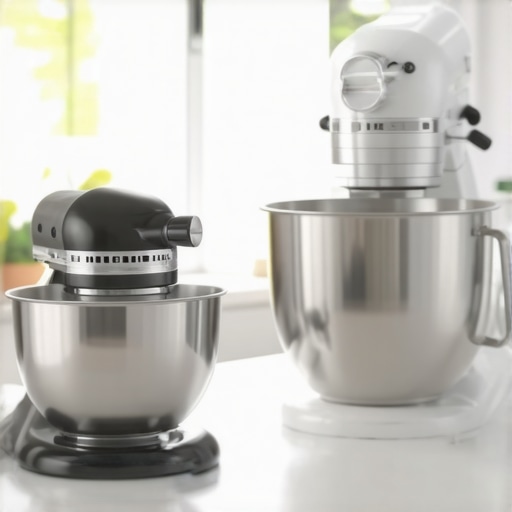
Why 30-Quart Mixers Are Overkill for Even the Most Avid Home Bakers
Buying a 30-quart floor mixer for a residential kitchen is a fundamental engineering mismatch that ignores the physics of dough hydration and gear-driven torque. After fifteen years of sourcing premium cookware and diagnosing equipment failures in high-end kitchens, I have seen too many homeowners mistake volume for capability. The stake here is not just the five-figure price tag. It is the mechanical reality that an industrial-scale machine cannot properly engage with small or medium batches. You are not buying ‘more power’; you are buying a machine designed for a different set of physical laws. The result? Poorly developed gluten and a countertop that cannot handle the lateral vibration of a heavy-duty gearbox.
The Engineering Reality of Bowl Clearance
Mechanical efficiency in a stand mixer depends entirely on the proximity of the agitator to the bowl wall. This is known as planetary action. In a 30-quart beast, the sweep of the dough hook or paddle is designed to move fifty pounds of mass. When you drop a standard home-scale batch—say, enough for three loaves of sourdough—the hook spends more time whipping air than actually kneading. The dough simply clings to the bottom, avoiding the ‘pick-up’ required for proper tensile strength. This is why the planetary action flaw that affects cheap units is ironically replicated in massive industrial units used improperly. They both fail to create a consistent shear force within the ingredients.
The Torque and DC Motor Advantage
Modern luxury kitchen standards have shifted toward precision rather than raw size. We now prioritize high-torque DC motors that maintain a constant RPM regardless of dough resistance. If you are working with stiff, low-hydration recipes, you do not need a larger bowl; you need a more resilient drive train. It is a well-documented fact that DC motors are saving heavy sourdough batches from overheating because they provide peak force at low speeds. Industrial 30-quart mixers often rely on AC motors and complex belt-driven systems that require a high minimum load to function without ‘hunting’ for a stable speed. Without that load, the machine runs inefficiently, often leading to premature gear wear.
Infrastructure and Electrical Constraints
An industrial mixer is a piece of heavy machinery, not an appliance. Most 30-quart units require a dedicated 220V circuit or, at the very least, a 20-amp NEMA 5-20R outlet. Standard 15-amp residential circuits, which handle your coffee maker or toaster, will trip the moment that induction motor hits a peak load during the second stage of kneading. Beyond the wires, consider the weight. These machines often exceed 200 pounds. Placing that on a standard quartz or granite countertop creates a concentrated load that can cause stress fractures in the stone over time, especially if the machine begins to vibrate during a heavy mix. This is a common operational risk I discuss with clients who want a ‘commercial’ look without the commercial slab-on-grade flooring. Research from organizations like the Association of Home Appliance Manufacturers (AHAM) consistently shows that residential environments are optimized for localized heat dissipation and specific vibration frequencies that commercial units simply ignore.
Technical truth: the most efficient path to professional-grade bread at home is a high-torque, 7-to-8-quart machine. These units are built to handle the same density of dough as their larger cousins but are scaled for the thermal realities of a home kitchen. If you want results, understand that high torque motors matter for heavy dough far more than the total capacity of the stainless steel basin.
Market Corrections and the Future of Kitchen Tech
The trend over the next 24 months is moving away from ‘maximalism’ and toward ‘computational baking.’ We are seeing the integration of sensors that measure the friction-induced temperature rise of the dough in real-time. Industrial mixers are too primitive for this level of data. They are brute-force tools meant for the repetitive, high-output demands of a commissary. The residential market is doubling down on specialized units that offer the same build quality as a Hobart but with the footprint of a countertop appliance. Regulatory changes regarding energy efficiency are also making large-scale AC motors less attractive for the home, as they draw significantly more power for the same amount of work compared to modern permanent-magnet motors.
The Executive Verdict
Do not buy the 30-quart floor mixer. It is a trophy, not a tool. If your goal is to produce bakery-quality results, invest in a high-wattage, DC-driven benchtop unit. These machines offer the ‘Executive Rhythm’ needed for varied batch sizes—one loaf on a Tuesday, six on a Saturday. For those in high-volume home production, a 10-quart or 20-quart commercial countertop unit might be the limit, but only if you have the dedicated electrical capacity to support it. Stick to the sweet spot of 7-8 quarts for the best balance of torque, clearance, and longevity.
Frequently Asked Questions
Why does my dough just spin on the hook in a large mixer? This happens when the batch size is too small for the bowl diameter. The hook cannot create the necessary friction against the bowl sides to stretch the gluten, leading to a ‘slug’ of dough that just rotates.
Can I use a 30-quart mixer on a standard 110V outlet? Most true 30-quart mixers are 220V. Some smaller commercial units are 110V but require a 20-amp circuit, which is not the standard 15-amp outlet found in most kitchens. Check your breaker box before purchasing.
Is an industrial mixer louder than a home mixer? Surprisingly, no. The heavy cast-iron bodies and oil-bathed gears of industrial units can be very quiet. However, the ‘clank’ of the safety cage and the weight of the components make them much more cumbersome to operate daily.
What is the main benefit of a DC motor in a stand mixer? DC motors provide high torque at low speeds and are significantly more efficient than AC motors. They also allow for a ‘soft start’ feature, preventing flour poofs and reducing stress on the internal gears.