
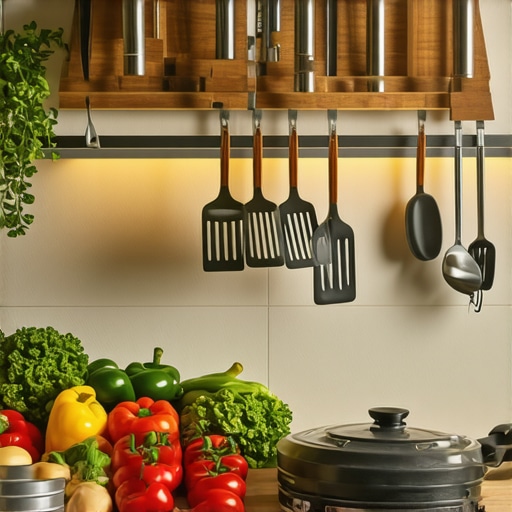
The Under-Cabinet Lighting Trick for Better Food Prep
Light is the most ignored variable in the precision kitchen. Owners spend thousands on a multi-boiler espresso machine or high-end air fryers, yet they prep food under lighting that distorts reality. After 15 years of designing high-performance kitchen environments, I have seen how poor illumination leads to botched sears and misjudged extractions. The secret is not just adding more light; it is the strategic manipulation of the Color Rendering Index (CRI) and the specific placement of the light source relative to the backsplash. Most contractors slap a generic LED strip in the center of the cabinet underside. This is a technical failure. The resulting shadows fall exactly where your knife meets the board. My trick involves forward-biased mounting using high-CRI tape lights that deliver a full spectral output, ensuring that the marbling on your ribeye looks exactly as it should before it hits the heat.
The Engineering Reality of Spectral Accuracy
Standard LED strips often suffer from a ‘green spike’ or a ‘blue haze’ that flattens the visual depth of organic materials. When you are performing the pan-searing mistake that ruins high-end ribeyes, your ability to see the Maillard reaction in real-time is hindered by low-quality light. We use the R9 value as our benchmark—this measures how well a light source renders deep red tones. Generic bulbs have an R9 near zero; professional-grade chips hit 90+. This difference is the gap between seeing a steak as gray or seeing it as the vibrant, oxygenated red of prime beef. Luminous flux, measured in lumens, is secondary to the quality of that flux. You need at least 300 to 400 lumens per linear foot at the work surface to ensure the eye doesn’t fatigue during complex prep work. The hardware must be hardwired with a driver capable of flicker-free dimming, as pulse-width modulation (PWM) at low frequencies causes subtle stroboscopic effects that interfere with hand-eye coordination.
Why Center Placement Fails Every Time
The common practice of centering the light strip under the cabinet creates a ‘scallop’ effect on the backsplash and leaves the front six inches of your countertop—your primary work zone—in a relative shadow. This is an operational risk for anyone using sharp Japanese steel or attempting a pan thickness test where subtle visual cues of oil viscosity matter. By mounting the strip immediately behind the front lip of the upper cabinet, you direct the light downward and slightly backward. This angles the illumination toward the wall, which then reflects it back onto the counter, creating a diffused, shadowless environment. This setup mimics a professional photography studio. It eliminates the ‘glare-bomb’ effect often seen on polished surfaces like those found when luxury kitchen designers favor quartzite over marble. The result? Total visual clarity from the edge of the counter to the back of the stove.
Thermal Load and Longevity Concerns
Heat is the silent killer of LED performance. High-output strips generate significant thermal energy that must be dissipated. If you stick a high-CRI strip directly to wood, the junction temperature of the LEDs will skyrocket, leading to color shift—where your warm 3000K light turns a sickly purple within six months. We utilize aluminum channels that act as heat sinks. These channels protect the chips and include an opal diffuser to eliminate ‘dotting’ on your reflective countertops. This is the same level of care required when addressing why hard water quietly destroys your multi-boiler espresso machine; ignoring the mechanical environment leads to expensive hardware failure. According to standards set by the Illuminating Engineering Society (IES), maintaining a consistent thermal environment is the only way to guarantee a L70 rating—the point where the light loses 30% of its initial brightness—at over 50,000 hours.
Macro Shifts in Circadian Design for 2026
The industry is moving toward human-centric lighting (HCL). Over the next 12 to 24 months, we expect a shift toward tunable white systems that sync with your biological clock. In the morning, your under-cabinet lights will output a crisp 5000K to stimulate alertness during breakfast prep. By dinner, they will automatically shift to a warm 2700K to encourage relaxation. This isn’t just a gimmick; it’s a second-order effect of our understanding of melanopsin-containing retinal ganglion cells. Regulatory changes in local building codes are already starting to reflect these requirements for energy efficiency and wellness. If you are renovating now, installing a single-color system is a mistake. The infrastructure should support a 5-wire system for future-proofed color tuning.
The Executive Strategy
The recommendation is simple: Buy high-CRI (95+), hardwired, forward-mounted LED systems with aluminum heat sinks. Do not settle for battery-powered pucks or cheap adhesive strips from big-box retailers. If you are an enthusiast who takes food prep seriously, your lighting must be as precise as your scale. The ROI manifests in fewer mistakes, better-looking social media content, and a kitchen that remains functional after the sun goes down. Lighting is not an accessory; it is a tool. Treat it with the same respect as a chef’s knife or a stand mixer.
Frequently Asked Questions
What is the best color temperature for food prep?
A range of 3000K to 3500K is ideal for residential kitchens. It provides a clean, white light that doesn’t feel clinical like a hospital, yet remains cool enough to show the true colors of vegetables and proteins.
Do I really need an aluminum channel?
Yes. Beyond aesthetics, the channel prevents the adhesive from failing due to heat and provides a surface for the diffuser, which removes the harsh reflections on your countertop.
Can I install these myself?
While the strips are low-voltage, the drivers require a 120V hardwired connection. For a professional result that integrates with your wall switches, a licensed electrician is recommended.
Does high CRI use more electricity?
Marginally. The efficiency (lumens per watt) might be slightly lower than a standard bulb, but for the scale of under-cabinet lighting, the impact on your utility bill is negligible compared to the visual benefits.