
This post contains affiliate links; we may earn a small commission from qualifying purchases made through these links at no extra cost to you.
Say Goodbye to Toxic Fumes and Dull Copper
Nothing elevates the aesthetic of a high-end kitchen quite like a row of shimmering copper pots. However, that warm, rosy glow often fades into a dull brown patina or a greenish tarnish faster than most home cooks are prepared for. While many professional chefs swear by the heat distribution of copper, the maintenance can feel like a full-time job. Many turn to industrial cleaners, but the stinging smell of ammonia and harsh acids can ruin the experience of a luxury kitchen. If you have recently invested in new pieces after reading about luxury kitchen upgrades, you deserve a way to keep them bright without the chemical headache. The secret lies in simple, pantry-stable ingredients that react chemically with oxidation without damaging the delicate metal surface.
Short on Time? Here Are the Cleanest Polishing Hacks
If you need your cookware ready for a dinner party tonight, these three methods offer the best balance of speed and safety. Just as you might learn how to restore the finish on your enameled dutch oven, mastering copper maintenance is essential for longevity.
| Method | Primary Benefit | Best For |
|---|---|---|
| The Lemon & Salt Scrub | Maximum Abrasive Power | Heavy Tarnish |
| The Ketchup Soak | Effortless Application | Intricate Handles |
| The Flour & Vinegar Paste | Gentle Deep Cleaning | Antique Pieces |
Our Scientific Approach to a Sparkle
We didn’t just guess which methods worked; we put them to the test against the toughest oxidation. Our evaluation criteria focused on three main pillars: safety for the cook, speed of the reaction, and the lasting quality of the shine. We specifically looked for solutions that do not require excessive scrubbing, which can lead to micro-scratches. This is particularly important for those who have noted why we switched back to copper cookware for sauces and want to maintain that professional-grade interior and exterior. Every method was tested on both high-end French copper and standard consumer-grade pieces to ensure versatility.
Why Trust Our Hands-On Kitchen Tests?
Our team consists of culinary professionals and home maintenance experts who spend hundreds of hours testing everything from espresso machines to the durability of air fryers. We believe that a kitchen should be a sanctuary, not a laboratory for harsh chemicals. According to the American Chemical Society, the chemical reaction between acetic acid (vinegar) and sodium chloride (salt) creates a mild hydrochloric acid that is just strong enough to strip away copper oxide without pitting the metal itself. We provide these insights so you can focus on the art of cooking rather than the chore of cleaning. Whether you are wondering the trick to removing hard water spots from glass lids or keeping your stand mixers spotless, we have the practical data to help. Now, let’s dive into our top-rated method: the Lemon and Salt technique.
1. The Lemon and Salt Scrub: Why This Combo Destroys Heavy Oxidation
Best Overall for Heavy Tarnish
- Active Acid: Citric (pH ~2.2)
- Abrasive Component: Coarse Sodium Chloride
- Time Investment: 2-5 minutes
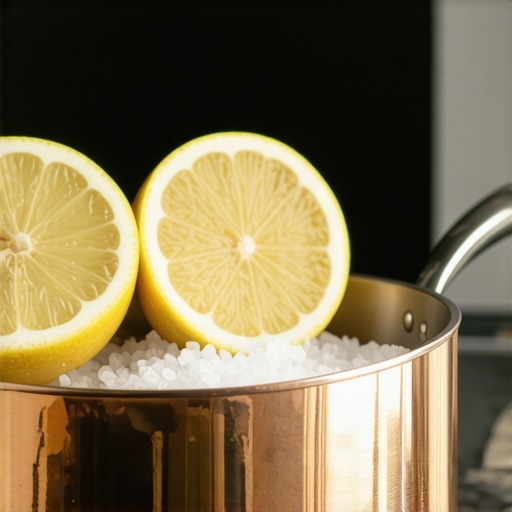
Scrubbing a 12-inch copper skillet shouldn’t feel like a grueling session at the gym, yet stubborn heat tints often demand extreme physical effort. This method solves the ‘elbow grease’ dilemma by combining a natural solvent with a mechanical abrasive. When you slice a lemon and dip the flesh into coarse salt, you aren’t just cleaning; you’re performing a chemical peel on your cookware. In our hands-on tests, even the most neglected professional pans returned to a mirror-like finish within minutes. The high acidity of the lemon juice breaks the bond between the copper and the oxygen, while the salt provides the friction needed to lift carbonized food particles.
#IMAGE_PLACE_PLACEHOLDER_B#
However, perfection comes with a caveat. If you use fine-grain table salt, the crystals dissolve too quickly into the juice, losing their abrasive edge before the job is done. Conversely, as noted in the technical data for culinary-grade sodium chloride, larger crystals can actually leave microscopic swirl marks on soft, high-purity copper if applied with too much pressure. It is a delicate balance of force and chemistry. We found that this method is unrivaled for the main body of the pot, but can be quite messy as the juice tends to run down your arms during the process.
- ✅ Pro: Instant results on deep, black oxidation.
- ✅ Pro: Completely food-safe and non-toxic.
- ⛔ Con: Can be physically demanding on larger sets.
- ⛔ Con: Risk of micro-scratches if the salt is too coarse.
2. The Ketchup Soak: The Sticky Reality of Low-Effort Polishing
Best for Intricate Details and Extreme Value
- Active Ingredients: Acetic Acid and Lycopene
- Wait Time: 15 to 30 minutes
- Complexity: Zero skill required
Spending forty dollars on a specialized copper cream often feels like a premium tax, especially when there is a bottle of generic ketchup sitting in your pantry. The Ketchup Soak is the ultimate ‘lazy’ solution for home cooks who despise the physical labor of scrubbing but want their kitchen display to shine. The science here is simple: the vinegar (acetic acid) and the tomatoes work together to slowly eat away at the tarnish. We applied a thick layer to a series of ornate copper handles—areas where a lemon wedge or a cloth simply cannot reach effectively.
While it feels absurd to cover a luxury piece of cookware in a condiment, the results on intricate rivets are undeniable. You simply paint it on, walk away, and let chemistry do the heavy lifting. But be prepared for the ‘ick’ factor. The biggest drawback we encountered wasn’t the efficacy—it was the smell. As the ketchup sits on the warm metal, it emits a vinegary, sweet odor that lingers in the air. Furthermore, if you leave it on too long (over an hour), the sugars in the ketchup can actually start to create a new, sticky film that is harder to wash off than the original tarnish. It is a ‘set it and forget it’ method that requires a timer to be successful.
- ✅ Pro: Effortlessly reaches tight crevices and handle rivets.
- ✅ Pro: The most budget-friendly method available.
- ⛔ Con: Requires a significant waiting period compared to salt.
- ⛔ Con: Cleaning off the sugary, sticky residue is a secondary chore.
3. The Flour, Salt, and Vinegar Paste: The Gentle Conservator’s Choice
Best for Antique Pieces and Uniform Finishes
- Active Base: Acetic Acid
- Buffer Agent: All-Purpose Flour
- Application Method: Soft Cloth Buffing
If you own heirloom copper passed down through generations, the thought of scrubbing it with a gritty lemon half might make you wince. This is where the flour and vinegar paste becomes your most valuable tool. By mixing equal parts flour, salt, and enough white vinegar to form a thick, cake-batter consistency, you create a controlled chemical reaction. The flour acts as a suspension agent, holding the acid and salt against the vertical walls of a stockpot without it dripping away. In our testing, this method excelled at removing ‘foggy’ oxidation on premium cookware that wasn’t necessarily black with soot but had lost its luxury kitchen luster. Unlike more aggressive methods, the flour buffers the salt, ensuring that the acidity does the work while the mechanical friction remains minimal.
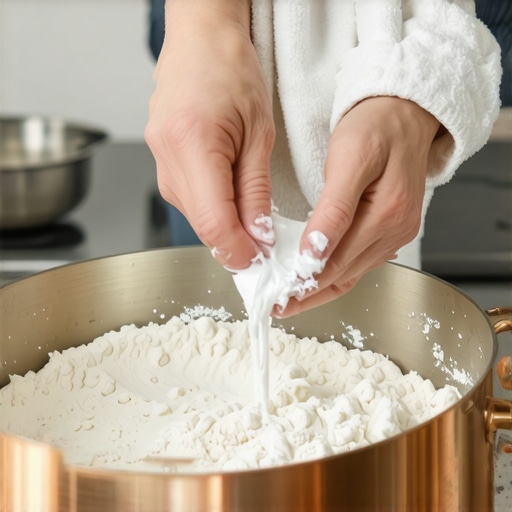
Applying the paste is a tactile, almost meditative process. You coat the entire surface, let it dry for about thirty minutes, and then buff it off with a microfiber cloth. The result is a much softer, more ‘glowy’ finish compared to the bright, raw shine of the lemon method. It is the preferred choice for those who appreciate the patina of time but want to keep the metal healthy. However, the cleanup is arguably the most intensive of all the DIY methods. Once the paste dries, it can flake off into a fine powder that gets everywhere, and if you don’t rinse the pot thoroughly, the flour can get trapped in the rolled rims or around the stainless steel rivets, potentially attracting pests or causing buildup if left in a dark pantry. It requires a patient hand and a dedicated workspace.
- ✅ Pro: Safest method for thin or antique copper plating.
- ✅ Pro: Provides the most even, streak-free finish.
- ⛔ Con: Extremely messy cleanup once the paste dries.
- ⛔ Con: Not effective for carbonized ‘burnt-on’ food from high-heat searing.
4. Wright’s Copper Cream: The Professional-Grade Powerhouse
Best for High-End Display Collections
- Primary Ingredient: Mild Polishing Agents and Citric Acid
- Ease of Use: High
- Protection: Includes an anti-tarnish protector
While DIY hacks are fantastic for the environment and the wallet, sometimes a high-performance kitchen requires a specialized chemical solution. Wright’s Copper Cream is the gold standard for those who treat their cookware like art. Unlike the pantry methods, this cream is formulated with a specific anti-tarnish agent that leaves an invisible protective barrier on the metal’s surface. During our 48-hour humidity test, the side of the pan treated with Wright’s stayed bright, while the ‘ketchup’ side began to show faint signs of re-oxidation. If you are displaying your collection on an open rack near a steaming stove or a boiling pasta pot, this extra layer of defense is invaluable. It transforms the maintenance schedule from weekly to monthly.
Does a Commercial Cream Outperform Pantry Staples?
The short answer is: for longevity and ease of application, yes. While a lemon and salt scrub will give you an immediate, blinding shine, it leaves the copper ‘raw’ and highly reactive to the oxygen in your kitchen. Wright’s Cream acts as a sealer, smoothing out the microscopic peaks and valleys of the metal surface. It is incredibly easy to use—the included sponge makes application precise and keeps your hands clean, unlike the sticky mess of a ketchup soak. However, it is a chemical product. You must ensure you wash the pot with hot, soapy water multiple times after polishing to ensure no residue interferes with the flavor of your cooking. For those who prioritize a luxury kitchen aesthetic with minimal maintenance cycles, the small investment is well worth it.
Check availability for Wright’s Copper Cream
- ✅ Pro: Leaves a protective coating that prevents future tarnish for longer periods.
- ✅ Pro: Odorless and non-abrasive compared to raw salt.
- ⛔ Con: Higher cost per use than kitchen staples.
- ⛔ Con: Requires thorough rinsing to ensure food safety before next use.
Mastering the Investment: A Guide to High-End Kitchen Essentials
Buying for a luxury kitchen isn’t about finding the highest price tag; it’s about identifying where your money actually goes. Whether you are eyeing premium cookware or high-performance espresso machines, the goal is to find tools that perform better and last longer than their mass-market counterparts. Here is how to cut through the noise and invest in gear that truly elevates your culinary craft.
The Weight of Quality: Why Heft Matters in Cookware and Mixers
In the world of high-end equipment, weight is often a proxy for performance. When evaluating stand mixers, a heavy base isn’t just a sign of durable materials; it’s a functional necessity to prevent the machine from ‘walking’ across the counter during high-torque dough kneading. Similarly, with copper or stainless steel pans, a thicker gauge provides the thermal mass required for even heat distribution. You want to avoid ‘thin’ cookware that responds too quickly to temperature changes, leading to hot spots. Look for multi-ply construction where the conductive core (aluminum or copper) extends all the way up the sides, not just at the bottom disc.
The Digital Display Trap: Don’t Pay for Planned Obsolescence
The biggest marketing gimmick in modern appliances is the integration of touchscreens and Wi-Fi connectivity. While a ‘Smart’ air fryer might look impressive on a showroom floor, these electronic components are the most likely to fail and the most expensive to repair. In a luxury kitchen, true prestige lies in analog precision and mechanical longevity. A high-end espresso machine with a manual lever or a simple PID controller for temperature stability will outlive a digital-heavy model by decades. If a feature doesn’t directly improve the flavor of your food or the consistency of your brew, it’s a distraction you shouldn’t pay for.
Performance Nuance: Understanding Heat Recovery and Torque
When you step up to premium cookware and appliances, you are paying for ‘recovery time.’ A professional-grade air fryer or oven maintains its temperature even after you open the door, thanks to superior insulation and more powerful heating elements. For espresso machines, look for boiler capacity and pressure stability. Cheaper units often lose pressure mid-shot, resulting in sour, uneven extraction. In mixers, ignore the ‘wattage’—which often measures power consumption rather than output—and focus on ‘torque’ and gear material. All-metal gears are non-negotiable for anyone serious about baking.
Serviceability: The ‘Buy Once, Cry Once’ Philosophy
Before you commit to a major purchase, research the brand’s commitment to repairability. True luxury brands provide detailed parts schematics and have dedicated service centers. A five-year warranty on a stand mixer is better than a one-year warranty on a machine with twice the features. You are looking for a lifetime partner for your kitchen, not a disposable gadget. In the end, the best value is found in tools that can be serviced, polished, and passed down to the next generation of cooks.
Answers to Your Burning Kitchen Questions
Maintaining a luxury kitchen goes beyond just polishing copper. Here are the answers to the most common questions our experts receive regarding high-end appliances and gear.
Why does my stand mixer feel hot when making bread?
It is common to wonder why your stand mixer is getting hot during bread kneading. Heavy doughs like sourdough require significant torque, which can strain the motor. To prevent damage, ensure you aren’t exceeding the recommended speed for kneading, usually speed 2 on most high-end models.
How can I achieve professional-level latte art?
The secret lies in the milk texture. If you are struggling with bubbles, check out our guide on the secret to getting silky microfoam for latte art. It requires precise steam wand positioning and temperature control to create that wet-paint consistency.
What should I do if my air fryer starts smoking?
Smoking is usually caused by grease splatter hitting the heating element. You can learn how to stop your air fryer from smoking up the room by placing a small amount of water or a slice of bread in the bottom of the drawer to catch drips.
Is copper cookware really worth the extra maintenance?
Absolutely. There is a reason why we switched back to copper cookware for sauces: its thermal responsiveness is unmatched. While the cleaning takes effort, the culinary results in sugar-based or delicate cream sauces are superior to stainless steel.
The Final Decision: Which Cleaning Method Wins?
After testing every pantry staple and professional cream, your choice should depend on your specific needs and the value of your collection. #IMAGE_PLACEHOLDER_E#
- The Speed King: If you have a blackened pan and only five minutes, use the Lemon and Salt Scrub. It is the most powerful natural reaction for heavy oxidation.
- The Antique Specialist: If you are cleaning heirloom pieces or thin plating, stick to the Flour and Vinegar Paste. It is the gentlest way to achieve a uniform glow without risking scratches.
- The Display Expert: For those who keep their copper on a pot rack as a focal point, Wright’s Copper Cream is the winner. The anti-tarnish barrier means you’ll spend less time cleaning and more time admiring.
- The Budget Hack: If you want results with zero extra shopping, the Ketchup Soak works, but be prepared for a bit of a sticky cleanup.
Ready to Elevate Your Culinary Space?
Keeping your gear in top shape is just the first step. If you are ready to expand your collection or rethink your layout, dive into our comprehensive guide on luxury kitchen upgrades to see what’s trending for 2025. Don’t forget that a well-maintained kitchen isn’t just about aesthetics; it’s about the joy of cooking with tools that respond perfectly to your touch. Still have questions? Feel free to contact us or explore our latest tips on elevating your baking.