
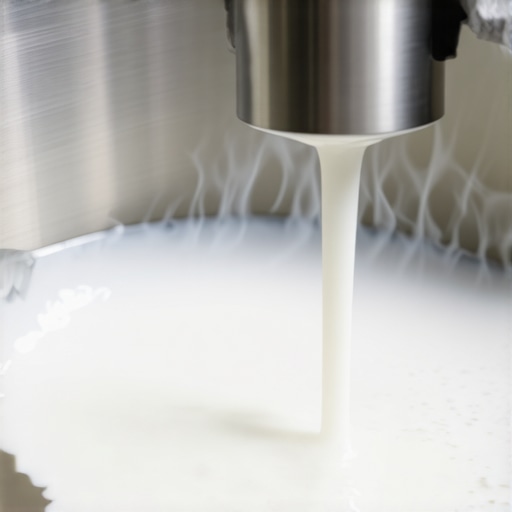
The Steam Wand Position That Guarantees Silky Latte Art
Surface tension is the primary antagonist in your quest for the perfect pour. Most home baristas fail because they treat steam like a blunt instrument rather than a scalpel. After fifteen years of calibrating high-end espresso machines and consulting for commercial roasteries, I can tell you that the secret isn’t in the machine’s price tag. It is in the geometry of the wand’s entry. If your angle is off by even five degrees, you aren’t creating microfoam. You are just making hot, soapy-looking bubbles. This technical failure ruins the structural integrity of the milk, making latte art impossible. The stakes? Wasted premium beans and the humiliation of serving a ‘latte’ that looks like dishwater.
The Physics of the Off-Center Vortex
To achieve that wet-paint texture, you must master the ‘shear force.’ Position the steam wand tip slightly off-center—about one centimeter from the wall of the pitcher. Angle the wand at approximately 30 degrees. This specific alignment creates a horizontal vortex. You aren’t just heating the liquid. You are using the kinetic energy of the steam to fold the air into the milk. This process, often called ‘stretching,’ must happen while the milk is still cold. Once the pitcher reaches 100°F (37°C), the window for air injection closes. If you keep stretching after that point, the proteins denature incorrectly. The result? A stiff, marshmallow-like cap that refuses to pour. Achieving commercial-grade microfoam at home requires this level of thermal awareness. According to standards set by the Specialty Coffee Association (SCA), the ideal final temperature for microfoam is between 140°F and 155°F. Exceeding this destroys the sweetness of the lactose.
The Reality of Thermal Stability and Pressure Drops
Theory is clean; the kitchen is messy. Even with the perfect silky microfoam technique, hardware limitations often intervene. I have seen prosumer machines lose 0.5 bar of pressure mid-stretch because the heating element couldn’t keep up with the steam demand. You feel the wand lose its ‘bite.’ The hiss turns into a low rumble. That is the sound of a failing texture. When the pressure drops, the vortex slows, and the milk begins to separate. If you notice a film forming on the wand, you have already scorched the proteins. You must always remove burnt milk immediately to prevent bacterial buildup and scale. A dirty wand disrupts the steam flow, creating erratic turbulence instead of a smooth flow. This isn’t just about aesthetics; it’s about the fluid dynamics of the steam tip’s holes. Any blockage renders your $5,000 machine useless.
Industry Shifts and the Rise of PID Control
The industry is moving toward total digital control. Within the next 24 months, expect to see more entry-level luxury kitchen appliances incorporating PID (Proportional-Integral-Derivative) controllers for steam, not just brew water. This technology, often cited in reports from IEEE (Institute of Electrical and Electronics Engineers) regarding thermal regulation, ensures that the steam pressure remains constant regardless of the boiler’s volume. For the serious enthusiast, this means the ‘operational risk’ of a ruined pitcher is significantly lower. However, even the best tech cannot compensate for a poor wand angle. The human element remains the bottleneck. We are also seeing a convergence in design, where premium cookware and coffee equipment share the same industrial-grade stainless steel finishes, necessitating better cleaning protocols to avoid pitting and corrosion.
The Technical Purist Verdict
If you are serious about latte art, stop focusing on the pour and start focusing on the whirlpool. Buy a high-quality, heavy-walled pitcher to slow down the heating process, giving you more time to stretch the milk. Hold the wand at the surface just long enough to hear the ‘paper-tearing’ sound, then bury it half an inch deep to incorporate the air. If your machine’s pressure is inconsistent, wait for the heating light to cycle off before starting your stretch. This ensures the boiler is at its maximum thermal capacity. Forget the fancy gadgets; master the 30-degree tilt. It is the only way to get the density required for high-contrast art.
Frequently Asked Questions
Why is my microfoam always too thick?
You are injecting air for too long. Stop the ‘stretching’ phase as soon as the pitcher feels like it has reached body temperature. The rest of the time should be spent ‘rolling’ the milk to break down bubbles.
Does the type of milk affect the wand position?
Yes. Oat milk and other alternatives have lower protein stability. You need a more aggressive vortex and a shallower wand tip position to keep the fats and proteins from separating under heat.
How many holes should my steam tip have?
For home baristas, a 2-hole or 4-hole tip is standard. More holes require higher boiler pressure to maintain the vortex. If your machine is underpowered, a 2-hole tip provides better control and higher velocity.
Why does my milk smell metallic?
This usually indicates scale buildup in your boiler or a dirty steam wand. Ensure you are using filtered water and purging the wand before and after every use to prevent ‘back-siphoning’ of milk into the boiler.