
The Reason Your Non-Stick Pan is Peeling After Only Six Months
The honeymoon phase of a new non-stick skillet usually ends with a flake of grey coating in your morning omelet. It’s frustrating. It’s expensive. Most importantly, it is entirely predictable. After fifteen years in the high-end cookware industry, I’ve analyzed thousands of returns, and the failure is rarely a manufacturing defect. The reality is a clash between kitchen physics and marketing promises. Your pan isn’t just worn out; it has likely suffered from a series of microscopic thermal traumas that compromised its chemical bond. Most consumers treat non-stick surfaces as indestructible shields, but in the world of premium cookware, these coatings are high-maintenance polymers that require specific thermal management.
The Engineering of Failure
The mechanical bond between a Polytetrafluoroethylene (PTFE) or ceramic layer and the metal substrate is a fragile marriage of convenience. When you place a pan on a high-output burner, the metal base expands. If the pan is thin, it expands unevenly and rapidly. This creates shear stress at the interface of the coating. Most people ignore the smoke point of their fats. Once you cross 500°F, the polymer chains begin to break down. This is the ‘Technical Truth’ most brands won’t tell you: non-stick is a consumable, not an heirloom. Even with 5-ply stainless steel construction, the surface can only handle so many expansion cycles before the lattice structure fractures. If you are using high heat for searing, you are essentially sandblasting the coating with heat. The result? Total delamination.
Thermal Shock and the Searing Mistake
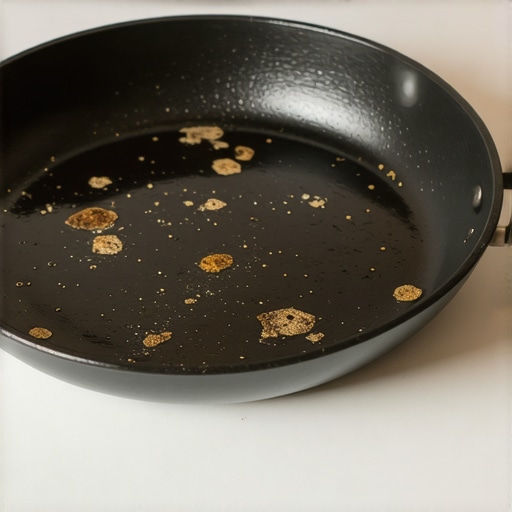
The most common killer I see in local kitchens is the ‘quench.’ You finish cooking, the pan is screaming hot, and you immediately run it under a cold tap. The ‘hiss’ you hear is the sound of the metal substrate contracting violently while the coating remains in a state of thermal expansion. This disparity causes micro-fissures. Over six months, these fissures grow into the visible peeling you see. We also need to talk about oil carbonization. When fats are heated past their smoke point, they leave behind a sticky resin. Most people try to scrub this off, further damaging the surface. This is why the non-stick coating myth persists; the slide disappears because of burnt oil, not just coating wear. According to the Cookware Manufacturers Association, proper cleaning involves avoiding abrasive pads that create the very scratches where food starts to stick.
The Induction Conflict
Induction cooktops have complicated the lifespan of non-stick pans. Because induction transfers energy directly to the iron-rich base, the heat-up time is nearly instantaneous. This ‘zero-to-sixty’ thermal ramp-up is brutal on coatings. Many owners find that their induction cooktop hates thin-bottomed pans because they warp almost immediately. A warped pan creates hot spots, and hot spots lead to localized peeling. I’ve seen $200 pans ruined in weeks because the user treated the ‘Power Boost’ setting like a standard medium heat. You can smell it—that acrid, metallic scent. It’s the smell of money evaporating. If you aren’t performing the simple magnet test to ensure a heavy, compatible base, you’re setting yourself up for failure.
Market Shifts and Regulatory Foresight
The next 18 months will see a massive shift in how non-stick is sold. Regulatory bodies are tightening the screws on PFAS and related chemicals. This means the ‘forever’ coatings are being replaced by newer, often less durable ceramic-sol-gel alternatives. While safer, these new coatings are even more prone to thermal shock. The industry is moving toward a ‘disposable luxury’ model, which I find strategically flawed for the consumer. Smart buyers are starting to realize that for high-heat tasks, they should migrate toward carbon steel or cast iron, reserving non-stick only for eggs and delicate fish. This hybrid approach saves the non-stick surface from the high-stress environments that cause peeling.
The Executive Verdict
Stop buying expensive non-stick pans expecting them to last a decade. If you want longevity, buy a heavy-gauge pan with a thick aluminum or copper core to ensure even heat distribution. Never go above medium heat. Never put it in the dishwasher, regardless of what the box says. The detergents are too alkaline and eat the bonding agents. My actionable strategy: Invest in one mid-range non-stick pan for delicate work and a high-quality stainless or carbon steel pan for everything else. This diversification extends the life of your non-stick surface by 300%.
Frequently Asked Questions
Is a peeling pan dangerous to use?
While modern PTFE is generally inert if ingested in tiny flakes, the underlying metal is now exposed, which can lead to sticking and further degradation. It’s time to replace it.
Can I repair a peeling coating?
No. Once the chemical bond to the substrate is broken, no ‘re-seasoning’ or spray can restore the factory finish safely.
Why does my pan peel even though I only use silicone spatulas?
Physical abrasion is only one cause. If you use high heat or wash it in the dishwasher, the chemical and thermal stresses will cause peeling even without metal utensils.
Does the ‘Stone’ or ‘Granite’ branding make a difference?
These are largely marketing terms for PTFE reinforced with mineral particles. They are slightly more scratch-resistant but still susceptible to the same thermal limits.