
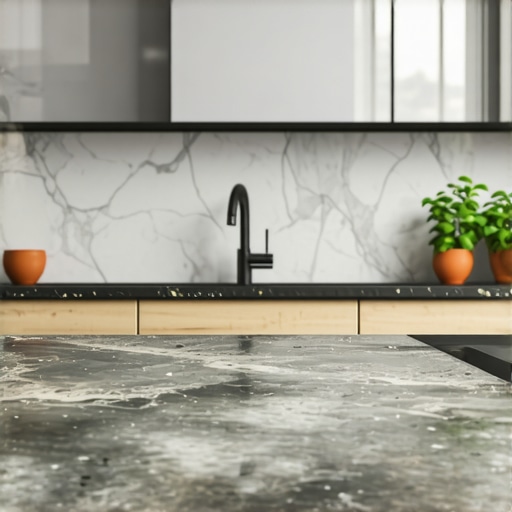
The Reason Your Granite Countertop Feels Gritty Suddenly
Granite is not a static material. It is a geological history lesson sitting in your kitchen. When a surface that was once like glass starts feeling like a 400-grit sanding block, you are witnessing the physical manifestation of chemical or structural failure. Most homeowners assume it is simply dust or uncleaned cooking residue. They scrub harder. They use more aggressive chemicals. They accelerate the destruction. After fifteen years in the high-end kitchen surfacing industry, I have seen hundreds of slabs ruined by the very people trying to save them. The grit is rarely ‘on’ the stone; it is usually ‘of’ the stone. We are talking about spalling, efflorescence, or the breakdown of factory-grade resins. The stakes are clear: ignoring this texture leads to permanent pitting that no amount of DIY buffing can fix. You are looking at a four-figure restoration bill if you misdiagnose the cause today.
The Mechanics of Surface Degeneration
The grit you feel is often a process called spalling. Granite is an igneous rock composed of quartz, feldspar, and mica. These minerals have different expansion rates and chemical sensitivities. When water—or worse, an acidic cleaner—penetrates the microscopic pores of the stone, it can weaken the bond between these mineral grains. The result? Tiny flakes of stone detach. They sit on the surface, creating that annoying, sandy texture. Another culprit is mineral salts. If your stone wasn’t sealed correctly, moisture from the sub-base or the air can pull salts through the stone. This is efflorescence. It feels like fine salt because it literally is salt. It is a sign of a deeper moisture management issue. Understanding the difference between these is the first step toward maintaining a pristine stone surface. Many modern slabs are also treated with epoxy resins at the quarry to fill natural fissures. High-heat appliances like premium espresso machines or heavy-duty air fryers can cause these resins to become brittle and flake away. This creates a localized ‘gritty’ zone right where you prep your morning coffee.
The Stress Test: When High-End Appliances Meet Natural Stone
Luxury kitchens are demanding environments. I recall a client in a high-rise who complained about a ‘persistent sand’ near her luxury range. She had spent thousands on premium cookware and professional-grade appliances, yet the stone was failing. The culprit? A high-performance air fryer. The localized thermal shock was causes the stone’s moisture content to vaporize rapidly, blowing out the mica flakes. The ‘clank’ of heavy cast iron and the heat from a 15-bar espresso machine create a micro-climate on your counter. If your granite has high iron content—common in many ‘exotic’ patterns—improper cleaning agents can actually cause the stone to rust internally. This swelling of iron oxide creates the grit. You can feel the sharp edges of the minerals protruding. It is a tactile warning. If you ignore it, the stone will eventually pit. These pits become traps for bacteria, making the surface no longer food-safe. This is why many are now considering porcelain countertop resilience as a more stable alternative for high-heat zones.
The Macro View: Shifting Standards in Stone Longevity
The industry is moving toward higher density and lower porosity. The American Society for Testing and Materials (ASTM) provides standards like ASTM C615, which classifies granite based on its physical properties. However, many slabs imported today prioritize aesthetics over structural integrity. We see stones with high mica content being sold as ‘premium’ simply because they are beautiful. In the next 12 to 24 months, expect a surge in specialized sealants utilizing nanotechnology to penetrate deeper than traditional fluorocarbon-based products. These ‘permanent’ sealers aim to solve the spalling issue by consolidating the mineral matrix from the inside out. For the owner of a modern luxury kitchen, the focus must shift from ‘cleaning’ to ‘preservation.’ This includes understanding how granite’s impact on culinary tools can also be a feedback loop; a gritty surface ruins your Japanese steel knives, and the micro-impacts of those knives can exacerbate the stone’s surface failure. Regulatory changes regarding silica dust in the stone-cutting industry are also making on-site restoration more expensive and complex. Do the work now to avoid the dust later.
The Executive Verdict
If your granite feels gritty, stop using all household cleaners immediately. Avoid vinegar, lemon juice, or anything ‘green’ that contains citric acid. Buy a neutral pH stone soap. Check your sealer by performing the ‘water drop test’—if water doesn’t bead up within 30 seconds, your stone is unprotected. My recommendation: if the grit is localized near heat-producing appliances, move them. If it is across the whole slab, you need a professional deep-clean and a high-solids solvent sealer. If you are planning a renovation, ensure your stone is graded for high-traffic use and not just ‘decorative’ use. Knowledge is the difference between a lifetime surface and a temporary one.
Frequently Asked Questions
Can I use a razor blade to scrape the grit off?
Only if the grit is topical residue like dried grease. If the grit is the stone itself flaking, a razor will only pull more minerals out and deepen the pits.
Why does the grit come back even after I wipe it?
This confirms the problem is structural (spalling) or chemical (efflorescence). You are feeling the stone breaking down, not external dirt landing on it.
Will a ‘permanent’ sealer fix the current grittiness?
No. A sealer is a preventative, not a restorative. You must have the surface professionally honed or polished to remove the damaged layer before applying a high-grade sealer.
Is it possible my water is causing the grit?
Yes. Hard water deposits (calcium and magnesium) can build up on the surface, especially near sinks. This is ‘topical’ grit and can be removed with specialized stone-safe descalers.