
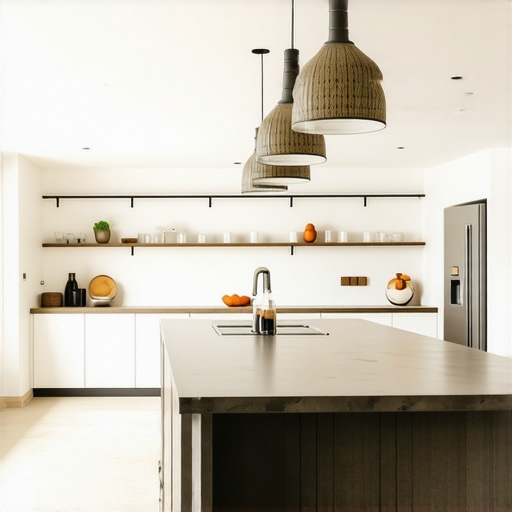
A massive kitchen island is the most common design regret I see after fifteen years in the high-end remodeling sector. Homeowners equate square footage with status. The result? A choked floor plan that punishes the cook. Every day, I walk into homes where a multi-ton slab of granite has been shoehorned into a space that cannot breathe. You lose the ability to move. You lose the efficiency of your premium cookware. This is the ‘Island Bloom’ error, and it is an expensive one to fix once the plumbing and electrical are trenched into your subfloor. [image placeholder]
The Physics of Clearance Zones
For a luxury kitchen to function, the negative space is just as vital as the cabinetry itself. Most builders stick to a 36-inch clearance. That is a mistake born of greed and laziness. In a high-traffic environment where you have multiple people working, 42 inches is the absolute basement. If you are operating pro-sumer espresso machines or large stand mixers on your island, you need space to step back and evaluate your work. When clearances drop below the 36-inch threshold, the kitchen ceases to be a workspace and becomes an obstacle course. I have seen clients bruise their hips for years because they wanted an extra twelve inches of stone they did not actually need. You must account for the swing of the dishwasher door and the depth of your range handles. A layout that ignores these kinetic realities is a layout destined for a sledgehammer. You can see how kitchen islands are actually too big for workflow in many modern builds. The result? Avoidable failure.
The Appliance Footprint Trap
We see it constantly with the rise of bulky air fryers and heavy-duty mixers. These tools require specific landing zones. If your island is too wide, the center of the stone becomes a dead zone—a literal no-man’s-land that you cannot reach to clean without a step stool. This is why your new kitchen feels cluttered even with plenty of drawers. You end up crowding the perimeter because the island center is inaccessible. If you are planning a renovation, the island should facilitate the movement of heat and ingredients, not block them. Think about the path from the fridge to the prep sink. If that path requires a detour around a ten-foot monolith, your design has failed. This violates the core principles of why most kitchen renovations fail the triangle rule.
The Operational Reality of Stone Mass
There is a structural reality many skip. A ten-foot island with a 3cm mitered edge quartz top weighs as much as a small car. If your subfloor was not engineered for that point load, you will see floor tile grout cracking within twenty-four months. I have stood in kitchens where the island was so large the installers had to cut the slab in three places, ruining the vein match. The visual impact is destroyed by the very size that was meant to impress. Beyond the weight, there is the ventilation issue. A massive island often houses a cooktop. If that island is too deep, your overhead hood—unless it is a custom oversized unit—will not capture the grease and steam from the front burners. Your expensive cabinets end up coated in a film of atomized oil. This is a technical truth most sales reps ignore to close a larger slab sale.
Strategic Foresight for the Local Market
The market is shifting away from the ‘Airfield’ island. We are seeing a return to ‘Galley-Plus’ configurations. This involves longer, narrower islands that prioritize a clear path of travel. In the next 18 months, expect a surge in ‘Table-Style’ islands with open legs. This allows for visual transparency and makes a small footprint feel expansive. For the serious home chef using a pot filler or high-BTU ranges, the focus is on speed and reach. You want to be able to pivot, not hike. According to the National Kitchen & Bath Association (NKBA) standards, proper traffic flow is the number one predictor of long-term homeowner satisfaction. Ignoring these standards for the sake of a larger countertop is a vanity play that kills ROI.
The Executive Verdict
If you are planning a renovation today, measure your clearance twice. Then add four inches. If your island width exceeds 48 inches, ensure you have a specific, reachable purpose for that center space. Otherwise, you are just paying for stone you will never use. Sell the oversized dream; buy the functional reality.
Frequently Asked Questions
What is the ideal distance between an island and a counter? For a single cook, 42 inches is the minimum. For a family kitchen, 48 inches is the gold standard. Anything over 60 inches starts to feel disconnected and inefficient. Can I put a sink and a cooktop on the same island? Only if the island is at least 9 feet long. Otherwise, you lose all your prep space and create a safety hazard with water splashing near high-heat burners. Why does my island feel like a barrier? It likely blocks the natural path between your sink, fridge, and stove. If you have to walk around the island to get a simple glass of water, the geometry is fundamentally flawed. Does a larger island add more value to my home? Only to a point. If the island makes the kitchen feel cramped or prevents the dishwasher from opening fully, it actually decreases the home’s value during professional inspections.